Compounded Semaglutide: What the Term Means in Research Supply Contexts
Reading Time: 10 mins
Compounded Semaglutide: What the Term Means in Research Supply Contexts
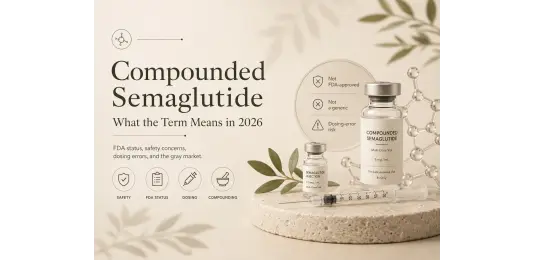
You're searching for compounded semaglutide, probably because a telehealth ad or clinic promised a cheaper Ozempic or Wegovy. What those ads rarely mention: the legal basis for these products evaporated in early 2025. What's sold today occupies a gray zone between a one-off pharmacy custom and an unvetted chemical. This article explains what that means — plainly, with nothing to sell. This article is for general education only and does not replace medical advice from a licensed healthcare professional. Quick Answer: What Compounded Semaglutide Actually Is Compounded semaglutide is not FDA-approved and not a generic. It's a pharmacy-mixed preparation, usually made from bulk ingredients the FDA has never reviewed for safety, effectiveness, or manufacturing quality. The window that let compounders produce "essentially a copy" of the brand-name drugs closed on February 21, 2025, when the FDA declared the shortage resolved. As of August 2026, large-scale sales operate outside that framework, and the agency has already proposed a permanent ban. The product's documented risks include severe dosing errors — the very thing the pre-filled pens were designed to prevent. How Semaglutide Works — The Same Molecule, Different Packaging Semaglutide is a GLP-1 receptor agonist, a synthetic version of a hormone that triggers insulin release, slows stomach emptying, and sends fullness signals to the brain. It shares 94% of its structure with the body's own GLP-1 and resists rapid breakdown — half the drug clears in about a week, so a single injection stays active all week. All FDA-approved semaglutide products come from Novo Nordisk. They contain the same molecule, but each is approved for a distinct use and comes in a different form:
- Ozempic injection (type 2 diabetes)
- Wegovy injection (chronic weight management)
- Ozempic tablets (formerly Rybelsus; oral, for type 2 diabetes, rebranded January 2026)
- Wegovy tablets (oral, approved December 2025 for weight management)
- "Compounded semaglutide is just a generic Ozempic." False. The FDA has approved no generic semaglutide. Generics require proof of bioequivalence; compounded drugs skip that entire review.
- "Microdosing is evidence-based and safer." No clinical study supports microdosing for effectiveness. The standard starter dose is part of a medically supervised ramp-up, not microdosing, and staying below therapeutic levels hasn't been shown to produce weight loss.
- "If it comes from a state-licensed pharmacy, it's as safe as the pens." State licensure doesn't mean the FDA has reviewed the product. The 520 adverse-event reports — including hospitalizations — are specific to compounded semaglutide, not the approved brands.
- "Ozempic face" is a medical condition. That phrase is a media nickname for facial fat loss during rapid weight reduction, not a diagnosis. Any significant weight loss can produce the same appearance.
- "Tirzepatide is basically a stronger semaglutide." They belong to different drug classes. Conflating them misleads people trying to understand their options.