Exploiting Cancer Biology, Not Broad Cytotoxicity
Oncology research peptides exploit aberrancies of cancer biology rather than broad cytotoxicity. The catalog's defining compound, PNC-27, is a 32-residue chimera of p53 residues 12-26 fused to an antennapedia-derived cell-penetrating leader. It binds membrane-associated HDM-2, which is normally intracellular but appears on the plasma membrane of multiple cancer cell types, and the resulting complexes form transmembrane pores in preclinical models. A June 2025 Oncology Research review (Rehman et al.) surveyed the broader tumor-targeting peptide field. Thymosin α-1 and LL-37 sit alongside it as context-dependent immunomodulators studied in checkpoint-inhibitor combination work.
Oncology Research
Showing 1–11 of 11 results
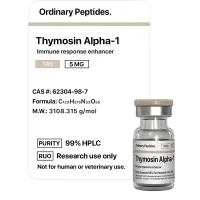
The "exploit aberrancies" framing that opens this page maps onto a real shift in cancer biology thinking. Conventional chemotherapy targets rapid cell division — a feature shared by cancer cells and many normal proliferating tissues (bone marrow, gut epithelium, hair follicles), which is why broad cytotoxicity has predictable side effects. The 2025 Rehman et al. review in Oncology Research (33(7):1547-1570) synthesizes the alternative approach: tumor-targeting peptides that exploit specific molecular differences between cancer and normal cells — overexpressed surface receptors, atypical protein localization, altered metabolic dependencies. The catalog below sits in this targeted-peptide framework rather than the broad-cytotoxicity framework. The evidence base remains substantially preclinical — most compounds discussed in the Rehman review have not progressed beyond Phase 1/2 trials — but the mechanistic logic is more refined than first-generation cytotoxic chemistry.
PNC-27: The Membrane HDM-2 Vulnerability
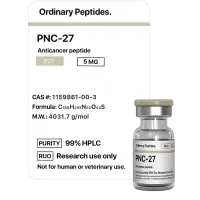
PNC-27 is a 32-residue chimeric peptide combining two functional regions: residues 12-26 of the p53 tumor suppressor (the HDM-2-binding domain) fused to a 16-residue penetratin sequence from the Drosophila antennapedia homeodomain (acting as a cell-penetrating peptide leader). Molecular weight approximately 4031 Da. The mechanism centers on an unusual cancer-specific vulnerability — many cancer cell types express HDM-2 on the plasma membrane surface, whereas in normal cells HDM-2 is intracellular only. PNC-27 binds membrane-associated HDM-2 and forms transmembrane pores in 1:1 ring-shaped structures characterized by immuno-electron microscopy. The pores produce cancer cell necrosis rapidly. Untransformed fibroblasts — which lack membrane HDM-2 expression — remain unaffected in the same experimental conditions. The Pincus and Michl groups at Mount Sinai and SUNY Downstate have characterized this mechanism across multiple cancer cell lines including pancreatic, breast, and cervical cancer. The compound remains in preclinical investigation; clinical translation has been slower than the in vitro selectivity suggested.
The Membrane HDM-2 Question
Why HDM-2 appears on cancer cell plasma membranes is still being characterized. HDM-2 (MDM2 in mice) is a nuclear E3 ubiquitin ligase whose primary function is regulating p53 degradation. The membrane localization observed in cancer cells appears unrelated to this nuclear function and may involve association with lipid rafts, interaction with other membrane proteins, or aberrant trafficking specific to transformed cell states. The phenomenon was first characterized by the Pincus group in pancreatic cancer lines and subsequently confirmed across multiple tumor types. The mechanistic question — what drives membrane HDM-2 in cancer cells — remains under active investigation. The therapeutic implication is straightforward: a molecule that binds membrane HDM-2 and disrupts membrane integrity should produce cancer-selective effects with minimal off-target damage to normal tissues.
Other Tumor-Targeting Approaches in the Catalog
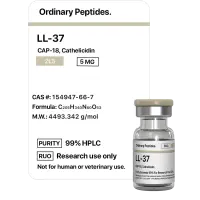
Beyond PNC-27, the catalog includes peptides that target different cancer-specific vulnerabilities. Thymosin α-1 is studied in oncology contexts primarily as an immune-priming agent — its mechanism through dendritic cell maturation and T-cell function is examined as a potential adjunct to checkpoint inhibitor immunotherapy in "cold" tumors. Multiple recent retrospective and prospective studies (covering ovarian, hepatocellular, and lung cancers) examine these combinations, with results varying by tumor type and patient selection. LL-37 has a more ambiguous oncology profile — it shows context-dependent effects in different cancer types, sometimes pro-tumorigenic (skin cancers, ovarian) and sometimes anti-tumorigenic (colon, gastric). This dual behavior reflects the broader theme in immunology research that immunomodulators don't act uniformly across tissue contexts. The Rehman 2025 review also covers other classes — anti-angiogenic peptides (anti-VEGF mimics), apoptosis-inducing peptides (Smac/DIABLO mimetics), and peptide-drug conjugates — though most of these remain outside the typical research peptide catalog.
Research Models Commonly Used
Standard in vitro oncology peptide work uses established human cancer cell lines covering major tumor types: MCF-7 and MDA-MB-231 for breast cancer, PANC-1 and MIA PaCa-2 for pancreatic, A549 for lung, HeLa for cervical, HepG2 for hepatocellular. Selectivity testing compares effects on transformed cells versus matched normal counterparts (NIH-3T3 fibroblasts, HEK293 epithelial cells, primary human dermal fibroblasts). In vivo work uses xenograft models — immunodeficient mice (nude, SCID, NSG) implanted with human cancer cell lines, with tumor growth measured by caliper or bioluminescent imaging. Syngeneic models in immunocompetent mice (B16 melanoma, MC38 colorectal, 4T1 breast) are essential for immunology peptide work because they preserve intact immune function. Mechanism characterization in oncology peptide research increasingly relies on single-cell transcriptomics, spatial proteomics, and high-resolution imaging — methods that have substantially refined what "tumor selectivity" can be characterized as.
Frequently Asked Questions
How does PNC-27 selectively target cancer cells?
PNC-27 binds HDM-2 (also called MDM2) protein expressed on the plasma membrane of many cancer cell types. In normal cells, HDM-2 is intracellular and not exposed on the membrane surface. The selective binding leads to formation of transmembrane pores composed of PNC-27/HDM-2 complexes in ring-shaped structures, producing rapid cancer cell necrosis. Untransformed cells lacking membrane HDM-2 expression are not affected. This selectivity mechanism is unusual among peptide anticancer agents — most depend on overexpressed surface receptors rather than aberrant protein localization.
What is the antennapedia sequence in PNC-27?
The antennapedia sequence is a 16-amino acid peptide derived from the Drosophila antennapedia homeodomain, commonly called penetratin. It functions as a cell-penetrating peptide (CPP) — it can cross plasma membranes and deliver attached cargo into cells. In PNC-27, penetratin is fused to the p53(12-26) binding domain at the C-terminus, providing the cellular delivery function for the active HDM-2-binding region. Antennapedia/penetratin is one of the original characterized CPPs and remains a standard tool in peptide research for intracellular delivery applications.
Why do cancer cells express HDM-2 on the plasma membrane?
The mechanism is still being characterized. HDM-2 is normally a nuclear protein involved in p53 degradation. Its membrane localization in cancer cells appears to involve association with lipid rafts, abnormal trafficking, or interaction with other plasma membrane proteins specific to transformed cells. The phenomenon has been observed across multiple cancer types (pancreatic, breast, cervical, hepatocellular) but not in untransformed cells. The mechanistic basis for membrane HDM-2 expression in cancer is an active area of investigation and represents one example of the kind of "cancer aberrancy" that targeted peptide approaches are designed to exploit.
How does thymosin alpha-1 fit into cancer research?
Thymosin α-1 is studied in cancer research primarily as an immune-priming agent rather than a direct anticancer compound. Its mechanism through TLR-9/TLR-2 signaling on dendritic cells supports antigen presentation and T-cell priming, which may enhance the efficacy of checkpoint inhibitor immunotherapy (anti-PD-1, anti-PD-L1) in tumors with limited baseline immune infiltration. Recent retrospective studies and one active Phase 2 trial (NCT06607926, neoadjuvant in NSCLC) examine these combinations. The mechanistic rationale is well-established; the clinical efficacy data is still developing and varies by tumor type and patient selection.
Why does LL-37 have opposing effects in different cancer types?
LL-37 shows context-dependent effects across cancer types — it appears pro-tumorigenic in some contexts (ovarian cancer, certain skin cancers, where it promotes cell migration and survival) and anti-tumorigenic in others (colon and gastric cancer, where it may trigger apoptosis or immune activation). The directionality depends on receptor expression patterns (FPR2, P2X7), tumor microenvironment factors, and whether the peptide acts on tumor cells directly or on surrounding immune and stromal cells. This dual behavior makes LL-37 a complex research compound rather than a uniform agent — its effects must be characterized in specific cancer contexts rather than generalized.
What is a cell-penetrating peptide?
Cell-penetrating peptides (CPPs) are short peptides (typically 5-30 amino acids) that can cross cellular membranes and deliver attached molecular cargo into cells. The first characterized CPP was the HIV-1 TAT peptide (1988); penetratin (from Drosophila antennapedia) followed in 1994. CPPs are commonly used in research as delivery vehicles for peptides, oligonucleotides, proteins, and even nanoparticles that would not otherwise cross plasma membranes. The mechanism of CPP entry varies — some involve direct translocation, others involve endocytic pathways. PNC-27 uses penetratin as its CPP leader, attached to the active p53-derived binding domain.
Reference Points for Further Reading
The 2025 Rehman et al. review in Oncology Research (DOI: 10.32604/or.2025.062197, PMID 40612874) provides the current consolidated overview of tumor-targeting peptides in precision oncology. For PNC-27 specifically, the 2022 Sarafraz-Yazdi et al. paper in Biomedicines (DOI: 10.3390/biomedicines10050945) covers the membrane HDM-2 pore-formation mechanism with electron microscopy characterization. The Pincus and Michl group publications across two decades cover the broader p53-derived peptide research lineage. For cell-penetrating peptides generally, the Langel reviews remain standard references. For tumor immunology and checkpoint inhibitor combination strategies, the Topalian and Drake reviews in Cancer Cell and Annual Review of Medicine provide standard frameworks. For LL-37 in cancer contexts, the Hilchie and Hoskin reviews cover the context-dependent dual behavior across tumor types.
All compounds in this catalog are intended for in vitro and preclinical research use only. None are approved by the FDA or any other regulatory authority for therapeutic use in humans or for the treatment, prevention, or diagnosis of any cancer or disease. The mechanistic research described on this page represents investigational science conducted in laboratory and animal models, not clinical practice. Compounds affecting cancer cell biology require careful research protocols given the potential for off-target effects in long-term studies. Clinical trial information referenced on this page describes research conducted with investigational or approved pharmaceutical products and is provided as scientific context, not as claims for the research compounds offered here.