Reagents for Peptide Reconstitution
Peptide reconstitution materials cover two distinct chemical needs. Bacteriostatic water is USP sterile water for injection containing 0.9% benzyl alcohol, a preservative that suppresses microbial growth and supports multi-dose use of a reconstituted vial for roughly 28 days. Acetic acid solution differs: 0.6% in water sits at about pH 3.0, low enough to drop below the isoelectric point of peptides that aggregate at neutral pH. The net positive charge generated breaks the hydrophobic clusters. Standard order is acid first in 100–200 µL, then dilute with BAC water to working concentration.
Preparation Materials
Showing 1–2 of 2 results
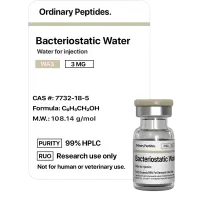
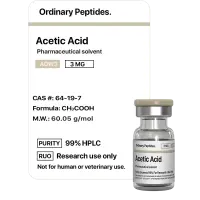
Reconstitution is where peptide research most often fails before it begins. A vial that arrives at 99% purity by HPLC can lose effective activity within days through incorrect solvent selection, freeze-thaw cycling, or pH-driven aggregation. The chemistry is well-understood — peptide stability follows predictable physical principles — but the practical execution requires matching solvent to peptide sequence rather than using a default protocol for every compound. The two solvents covered on this page (bacteriostatic water and acetic acid solution) address most cases. Compounds with cysteine residues, hydrophobic clusters, or net-neutral charge at physiological pH may require additional considerations covered toward the end of this page.
Bacteriostatic Water: The Standard Choice
Bacteriostatic water for injection (BAC water) is USP-grade sterile water containing 0.9% benzyl alcohol as a preservative. The benzyl alcohol concentration is specifically calibrated — high enough to suppress microbial growth across the typical use window (28 days post-reconstitution), low enough to remain non-cytotoxic at the dilutions used in research applications. The 28-day window assumes proper storage (2–8°C refrigeration) and aseptic technique with each withdrawal. After 28 days, even with preservative, the vial should be discarded — preservative efficacy declines and contamination risk increases with each septum penetration. BAC water is the appropriate solvent for the majority of peptides in standard research catalogs, including most growth hormone secretagogues, GHRH analogs, and stable short peptides. It is not appropriate for compounds known to aggregate at neutral pH or for peptides containing free cysteines prone to oxidation.
Acetic Acid Solution: For Aggregation-Prone Peptides
Certain peptides aggregate at neutral pH through hydrophobic interactions or β-sheet formation. The molecules cluster together, falling out of solution as visible particulates or remaining as soluble oligomers that lose receptor binding activity. The standard solution is to use a low-pH solvent that drops below the peptide's isoelectric point (pI). At 0.6% acetic acid in water, pH sits at approximately 3.0. Peptides with pI values above 3.0 — which includes most short cationic and amphipathic sequences — carry a net positive charge in this solvent. The electrostatic repulsion between positively charged peptide molecules breaks hydrophobic clustering, allowing dissolution.
The practical protocol: add acetic acid solution first in a small volume (typically 100–200 µL per milligram of peptide), gently agitate to dissolve, then dilute with bacteriostatic water to the working concentration. The order matters — adding BAC water first to a aggregation-prone peptide often produces visible cloudiness that doesn't fully clear even with subsequent acid addition. Compounds commonly requiring acetic acid include hydrophobic peptides like Melanotan II, certain fragment peptides, and several growth hormone secretagogues at higher concentrations.
Sodium Chloride and Sterile Water Alternatives
Two adjacent options occasionally appear in research protocols. 0.9% sodium chloride for injection (saline) is isotonic and matches physiological osmolarity, suitable for compounds that show osmotic sensitivity. The lack of preservative limits multi-dose use — saline-reconstituted vials should be used immediately or stored frozen as single-use aliquots. Sterile water for injection without preservative behaves similarly. Both alternatives are appropriate for short-duration experiments where benzyl alcohol could interfere with downstream assays (some receptor binding studies, certain cell viability measurements). For most research peptide applications, BAC water is the safer default unless a specific reason requires preservative-free conditions.
Storage and Handling
Lyophilized (freeze-dried) peptides have a longer shelf life than reconstituted solutions. Unopened vials of most research peptides remain stable at 2–8°C for 18–24 months, or longer at –20°C. Once reconstituted, the stability window depends on the solvent and peptide chemistry — BAC water-reconstituted peptides typically remain stable for 28 days refrigerated; acetic acid-reconstituted peptides may have shorter or different windows depending on the compound. Avoid repeated freeze-thaw cycles of reconstituted solutions — each cycle damages a subset of molecules through ice crystal formation and concentration of solutes at the freezing front. For long-term storage of reconstituted material, prepare single-use aliquots in sterile vials, freeze at –80°C if available, and thaw each aliquot only once.
Frequently Asked Questions
What is bacteriostatic water and how does it differ from sterile water?
Bacteriostatic water is USP-grade sterile water for injection containing 0.9% benzyl alcohol as a preservative. The benzyl alcohol suppresses bacterial growth, extending the usable window of a reconstituted multi-dose vial to approximately 28 days under refrigerated storage. Sterile water for injection contains no preservative and is intended for single-dose use — once a vial is opened, it should be used immediately or discarded. The choice between the two depends on whether multi-dose reconstitution is needed and whether benzyl alcohol could interfere with the intended research application.
Why do some peptides need acetic acid rather than water?
Certain peptides aggregate at neutral pH through hydrophobic interactions, forming insoluble particulates or inactive oligomers. Acetic acid solution lowers the pH below the peptide's isoelectric point (typically pH ~3.0 for 0.6% acetic acid), giving the peptide a net positive charge. The electrostatic repulsion between like-charged molecules breaks the hydrophobic clustering and allows the peptide to dissolve. Hydrophobic peptides, peptides with significant β-sheet potential, and certain fragment peptides typically benefit from this approach.
What is the correct order for adding solvents during reconstitution?
For most peptides reconstituted in bacteriostatic water alone, simply add the BAC water slowly down the side of the vial and gently swirl — avoid vigorous shaking, which can damage peptide bonds. For peptides requiring acid pre-dissolution, add the acetic acid solution first (typically 100–200 µL per milligram), gently agitate until dissolved, then dilute with BAC water to working concentration. Adding water first to an aggregation-prone peptide often produces persistent cloudiness that doesn't fully clear with subsequent acid addition.
How should reconstituted peptides be stored?
Reconstituted peptide solutions are generally stored at 2–8°C (standard refrigeration) for short-term use. For longer storage, prepare single-use aliquots in sterile vials and freeze at –20°C or preferably –80°C. Avoid repeated freeze-thaw cycles — each cycle damages a fraction of the peptide through ice crystal formation. Bacteriostatic water-reconstituted peptides typically maintain stability for about 28 days refrigerated; preservative-free solutions should be used or aliquoted immediately. Specific stability windows vary by compound and should follow individual product documentation.
What is the shelf life of lyophilized peptides?
Lyophilized (freeze-dried) peptides have substantially longer shelf life than reconstituted solutions. Unopened vials of most research peptides remain stable at 2–8°C for 18–24 months when kept dry and protected from light. At –20°C, the shelf life extends to 36 months or longer for most sequences. The lyophilized state lacks the water needed for hydrolysis reactions that degrade dissolved peptides, which is why dry storage is substantially more stable than reconstituted solutions. Specific shelf life information should follow individual product Certificate of Analysis documentation.
Why should freeze-thaw cycles be avoided?
During freezing, ice crystals form within the solution and concentrate the peptide and other solutes at the freezing front. The high local concentration and mechanical stress from crystal formation damage a fraction of peptide molecules with each cycle — through bond cleavage, aggregation, or oxidation. After multiple cycles, the cumulative damage can substantially reduce active peptide concentration and introduce degradation products that may behave differently in research assays. The standard solution is to prepare single-use aliquots that are thawed only once, used, and discarded.
How is the working concentration calculated for a reconstituted peptide?
Working concentration depends on the total mass of peptide in the vial and the total volume of solvent added. For example, a vial containing 5 mg of peptide reconstituted in 2 mL of bacteriostatic water yields a concentration of 2.5 mg/mL (2500 µg/mL). For research applications, the volume of solvent is selected to produce a convenient working concentration for the planned experimental dose. Online peptide calculators are available that compute exact concentrations and dose volumes based on vial size and solvent volume — these are standard tools in research laboratory work.
Reference Points for Further Reading
The USP-NF monograph on Bacteriostatic Water for Injection (USP <1231>) provides the formal pharmacopoeial specification including benzyl alcohol concentration and quality requirements. For peptide stability and storage chemistry, the Manning et al. review "Stability of Protein Pharmaceuticals: An Update" (Pharmaceutical Research, 2010) covers the underlying degradation pathways. For reconstitution protocols specific to peptide chemistry, the Bachem and GenScript handbook documentation provide practical references frequently cited in laboratory practice. The Joint Commission and ISMP guidance on multi-dose vial use covers aseptic technique and the 28-day window standard. For isoelectric point calculations and predicted solubility behavior, ExPASy ProtParam (web.expasy.org/protparam) is a standard tool used in laboratory practice to predict which peptides require acidic solvents.
All reconstitution materials in this catalog are intended for laboratory and research use only. They are not for human or veterinary therapeutic use, regardless of any USP grading or sterility designation. The procedures described on this page are general practices for laboratory peptide preparation and do not constitute medical or clinical advice. Stability windows, storage requirements, and reconstitution protocols vary by specific peptide compound — individual product Certificate of Analysis and product documentation should be consulted for compound-specific guidance.