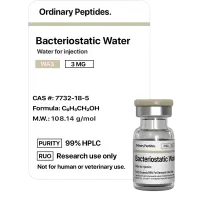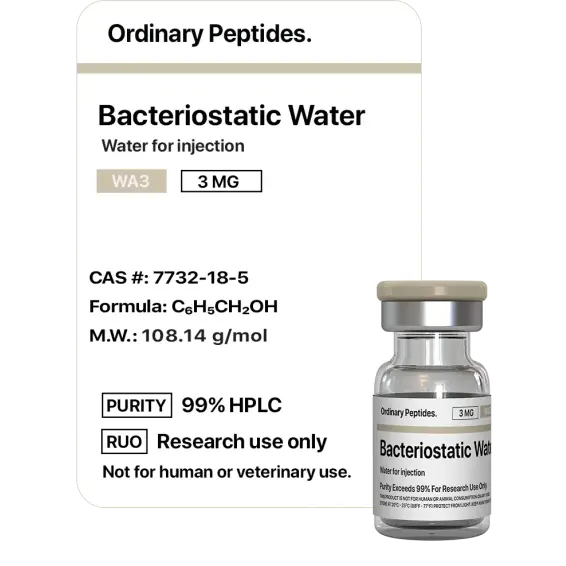
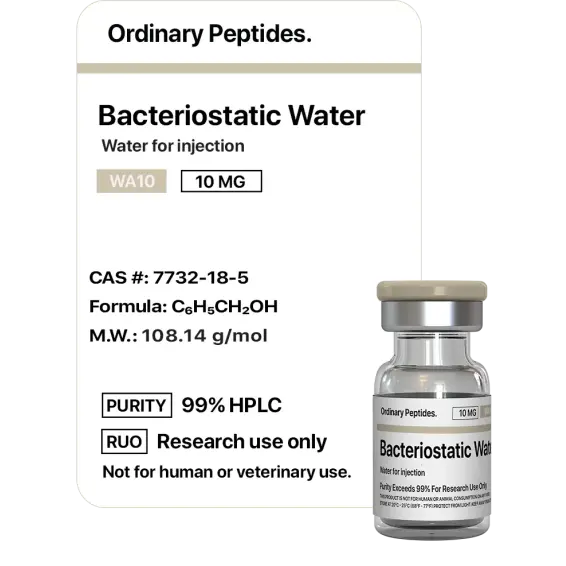
Bacteriostatic water
For in vitro testing and laboratory use only. Not for human or animal consumption. Bodily introduction is illegal. Handle only by licensed professionals. Not a drug, food, or cosmetic. Educational use only.
BWI (Bacteriostatic Water for Injection): The Standard Solvent for Peptide Reconstitution
BWI is sterile water with 0.9% benzyl alcohol — a preservative that inhibits bacterial growth and makes it the standard solvent for reconstituting freeze-dried peptides in multi-dose vials. Once opened, it must be refrigerated and discarded after 28 days.
Most peptides — including BPC-157, TB-500, and CJC-1295 — reconstitute directly in BWI. The exception is IGF-1 LR3, which first requires dissolution in 0.1% acetic acid before BWI is added.
Critical Reconstitution Technique
Always run BWI down the vial wall — never directly onto the powder — and swirl gently, never shake, to prevent peptide aggregation. Never freeze reconstituted peptide solutions, as this damages the peptide structure.
Quality and Safety
Always use pharmaceutical-grade BWI from trusted manufacturers such as ICU Medical, Pfizer, or Fresenius Kabi. Non-pharmaceutical sources carry invisible endotoxin risks that cannot be detected without laboratory testing.
Bacteriostatic Water (BWI): A Technical Guide for Peptide Research Applications
Based on pharmacopoeial documentation, pharmaceutical sciences literature, and established research practice — see References. Last updated: April 2026.
The Short Version
Bacteriostatic Water for Injection (BWI) is sterile water containing 0.9% benzyl alcohol as a preservative. It is the standard reconstitution solvent for lyophilised (freeze-dried) peptides in laboratory and clinical research settings. Understanding the difference between BWI and its alternatives — sterile water, saline, acetic acid — is fundamental to anyone working with the peptides covered in this series.
The right solvent choice directly affects peptide stability, degradation rate, solubility, pH environment, and — when injection is involved — safety. The wrong solvent can inactivate a peptide before it is ever used, cause precipitation, or introduce contamination risks. BWI solves the most practical problem in working with multi-dose peptide vials: how to maintain microbiological safety across repeated needle penetrations over several weeks.
| At a glance | |
|---|---|
| Full pharmaceutical name | Bacteriostatic Water for Injection, USP |
| Composition | Sterile water for injection + 0.9% benzyl alcohol (9 mg/mL) |
| Preservative | Benzyl alcohol 0.9% w/v |
| Approximate pH | 5.7 (slightly acidic) |
| Post-opening shelf life | 28 days at 2–8°C |
| Regulatory status (US) | Prescription product (FDA); OTC in many other countries |
| Typical vial sizes | 30 mL (multi-dose vials most common) |
| Primary manufacturers | Pfizer, ICU Medical/Hospira, Fresenius Kabi, APP Pharmaceuticals |
| Absolute contraindication | ⚠️ Neonates and infants under 28 days (benzyl alcohol toxicity) |
What Bacteriostatic Water Is — and What It Is Not
The USP defines Bacteriostatic Water for Injection as sterile water containing one or more suitable antimicrobial agents. In virtually all commercial US preparations, the single preservative is benzyl alcohol at 0.9% concentration. The key word is bacteriostatic — not bactericidal. Benzyl alcohol at 0.9% inhibits the growth and multiplication of bacteria; it does not rapidly kill all microorganisms on contact. BWI does not sanitise a contaminated solution — it prevents an already sterile solution from becoming bacterially contaminated during repeated vial use.
When you reconstitute a lyophilised peptide, you penetrate the vial’s rubber septum with a needle. Every needle insertion introduces a theoretical contamination risk, even with careful aseptic technique. Without a preservative, Sterile Water for Injection (SWI, no preservative) is technically single-use only: once entered, the solution can no longer be presumed sterile on subsequent access. Benzyl alcohol solves this by maintaining microbiological integrity across the multiple vial entries characteristic of research protocols.[1]
Composition: What Is Actually in the Vial
Water for Injection (WFI) — the base
Water for Injection (USP) must meet stringent specifications: conductivity ≤1.3 μS/cm; endotoxin content ≤0.25 EU/mL (by LAL test); sterility per USP <71>; absence of pyrogens; total organic carbon <500 ppb. This is fundamentally different from HPLC-grade or laboratory-distilled water, which are not manufactured for parenteral use and are not subject to endotoxin or pyrogen testing. Using non-pharmaceutical water as a reconstitution solvent carries endotoxin risks that are invisible on visual inspection but can cause serious inflammatory responses upon injection.[2]
Benzyl alcohol 0.9%
Benzyl alcohol (C&sub6;H&sub5;CH&sub2;OH; MW 108.14) is an aromatic alcohol that occurs naturally in many plant essential oils. At 0.9% (9 mg/mL) it inhibits bacterial growth by disrupting bacterial cell membrane integrity and inhibiting enzyme systems, achieving its minimum inhibitory concentration against most clinically relevant organisms. At this concentration, benzyl alcohol also provides mild local anaesthesia — one practical reason for preferring BWI over sterile water where both are pharmacologically acceptable.[3]
The Neonatal Contraindication: An Absolute Safety Warning
In the early 1980s, a cluster of infant deaths was traced to toxic benzyl alcohol exposure from BWI used to flush umbilical catheters in neonatal intensive care units. The condition — “gasping syndrome” — involved metabolic acidosis, progressive neurological deterioration, respiratory failure, and death. The mechanism: neonates lack the hepatic enzyme systems (primarily alcohol dehydrogenase and aldehyde dehydrogenase) that metabolise benzyl alcohol to hippuric acid for renal excretion. Benzyl alcohol accumulates as benzaldehyde and benzoic acid, causing direct toxic effects. The threshold cumulative daily dose associated with toxicity in premature infants is approximately 99 mg/kg/day — a level easily reached through multiple BWI-based exposures in intensive care. This contraindication appears in all BWI prescribing information and represents an absolute restriction. No research justification overrides it.[5]
BWI vs. Alternative Reconstitution Solvents
| Solvent | Preservative | Post-opening stability | Primary use | Key limitations |
|---|---|---|---|---|
| BWI (0.9% benzyl alcohol) | Yes | 28 days at 2–8°C | Most peptides; multi-dose protocols | Contraindicated in neonates; slightly acidic pH 5.7; incompatible with select peptides |
| Sterile Water for Injection (SWI) | None | Single use only | Peptides incompatible with benzyl alcohol; single-dose preparations | No bacterial protection after first entry |
| Normal Saline (0.9% NaCl) | None / variable | Single use / variable | Final dilution before IV injection | Ionic environment may affect solubility; single use without preservative |
| 0.1–1% Acetic Acid (AcOH) | None | Research use, not for injection | IGF-1 LR3 and other poorly water-soluble peptides; initial dissolution | Acidic pH 3–4; never inject directly — requires further dilution |
When to use 0.1% acetic acid
A small but important subset of peptides — particularly IGF-1 LR3 — dissolve poorly in neutral or slightly acidic water. The standard protocol: add 10–50 μL of 0.1% acetic acid directly to the lyophilised peptide; gently swirl until dissolved (primary dissolution step); then dilute to final working concentration with BWI or sterile saline. The final solution reaches near physiological pH after dilution. For GHK-Cu, BPC-157, TB-500, and most other peptides in this series, BWI alone is sufficient and no acetic acid step is needed.
Peptide-Solvent Compatibility Reference
| Peptide | Recommended primary solvent | Notes |
|---|---|---|
| BPC-157 | BWI | Standard reconstitution; dissolves readily |
| TB-500 (Ac-LKKTETQ) | BWI | Dissolves readily |
| GHK-Cu | BWI | Copper complex stable in BWI; slight blue-green tint normal |
| CJC-1295, Ipamorelin, Sermorelin | BWI | Standard reconstitution |
| Tesamorelin (Egrifta) | Sterile water (per prescribing info) | Pharmaceutical product with specific instructions |
| Epithalon, DSIP, PT-141, Melanotan II | BWI | Standard reconstitution; dissolves readily |
| IGF-1 LR3 / Des(1-3) IGF-1 | 0.1% acetic acid → dilute with BWI | Requires acid dissolution step first |
| KPV, Selank, Semax | BWI | Standard reconstitution; dissolves readily |
| Thymosin Alpha-1 (Zadaxin) | BWI or sterile water | Pharmaceutical grade uses provided sterile water diluent |
| Thymulin | BWI | Standard reconstitution; ensure zinc cofactor availability if required |
| VIP | BWI | Standard reconstitution; very short half-life regardless of solvent |
| GDF-8 propeptide / Follistatin-344 | BWI | Large protein; extremely gentle reconstitution essential |
Step-by-Step Reconstitution Protocol
What you need
Lyophilised peptide vial; pharmaceutical-grade BWI vial (30 mL); insulin syringe U-100 (1 mL, with 0.01 mL graduations); alcohol wipes (70% isopropyl alcohol); clean work surface; sterile gloves if available.
Protocol
Step 1 — Preparation: Wash hands thoroughly. Allow both vials to reach room temperature if refrigerated. Inspect both vials visually: BWI should be clear and colourless with no particles; lyophilised peptide should be a white or off-white powder or cake, intact, with no discolouration.
Step 2 — Wipe rubber stoppers: Wipe the rubber septum of both vials with a fresh alcohol wipe. Allow to dry for 30 seconds before needle insertion — injecting through wet alcohol is a common error that introduces small alcohol volumes into the solution.
Step 3 — Draw BWI: Insert the needle into the BWI vial and withdraw the desired volume (see concentration calculation table below).
Step 4 — Introduce BWI into peptide vial — wall technique: This is the most consequential technical step. Do not inject BWI directly onto the lyophilised powder — the jet creates localised hydrodynamic shear that can cause denaturation or aggregation of sensitive peptides. Instead: position the needle tip so it touches the glass wall of the vial, above the powder level. Depress the plunger slowly and let the water run down the glass wall and pool gently at the bottom.
Step 5 — Dissolve: Do not shake the vial. Shaking introduces air-water interfaces that cause protein aggregation — the resulting solution may appear clear but contain inactive oligomers. Gently swirl the vial between your palms in a rolling motion, or slowly invert and return 5–10 times. Most lyophilised peptides dissolve in 30–120 seconds.
Step 6 — Inspect: The solution should be clear or very slightly yellow (from benzyl alcohol), free from particles, with no cloudiness or precipitate. A cloudy solution indicates incomplete dissolution or aggregation — do not use until fully resolved.
Step 7 — Store immediately: Label the vial with the reconstitution date, peptide name, concentration, and 28-day expiry. Refrigerate at 2–8°C.
Concentration Calculations
| Peptide amount | BWI volume | Resulting concentration |
|---|---|---|
| 2 mg | 1 mL | 2 mg/mL (2,000 μg/mL) |
| 2 mg | 2 mL | 1 mg/mL (1,000 μg/mL) |
| 5 mg | 2.5 mL | 2 mg/mL |
| 5 mg | 5 mL | 1 mg/mL |
| 10 mg | 5 mL | 2 mg/mL |
| 10 mg | 10 mL | 1 mg/mL |
Dose conversion on a U-100 insulin syringe (1 mg/mL)
| Dose (μg) | Volume (mL) | U-100 syringe units |
|---|---|---|
| 50 μg | 0.05 mL | 5 units |
| 100 μg | 0.10 mL | 10 units |
| 200 μg | 0.20 mL | 20 units |
| 300 μg | 0.30 mL | 30 units |
| 500 μg | 0.50 mL | 50 units |
At 2 mg/mL, halve the syringe units for the same dose (e.g., 200 μg = 10 units). Higher concentrations reduce injection volume — a practical advantage for subcutaneous administration.
Storage Requirements
Unopened BWI vial: 15–30°C; protect from light and excessive heat; do not freeze; use within manufacturer’s expiry date. Opened/punctured BWI vial: Store at 2–8°C; use within 28 days of first puncture — this is the USP standard, not informal guidance; mark the opening date on the vial and discard at 28 days regardless of remaining volume.[1]
Reconstituted peptide solution: Store at 2–8°C immediately after reconstitution; typical stability in BWI is 2–4 weeks (varies significantly by compound). Do not freeze reconstituted peptide solutions in BWI. Freeze-thaw cycles damage peptide structure through ice crystal formation, localised concentration effects, pH shifts during freezing, and aggregation promotion — producing a solution that may appear clear but contains inactive oligomers. Lyophilised (undissolved) peptide in the original sealed vial can be frozen; once dissolved, the rules change. If long-term storage beyond 4 weeks is needed, prepare single-use aliquots in sterile water (without preservative) and freeze those aliquots at −20°C or −80°C; only thaw what will be used immediately.[8]
Visual Inspection Protocol
Before each use of BWI and each injection of a reconstituted peptide, perform a systematic visual inspection. Hold the vial up to a light source against a dark background.
Accept if: clear, colourless liquid (BWI) or clear solution (peptide — GHK-Cu may have a slight blue-green tint; some peptides produce very slightly yellow solutions; both are normal); no visible particles; no cloudiness or turbidity; vial integrity intact; within 28 days of opening and within expiry date.
⚠️ Discard if: any cloudiness, turbidity, or milky appearance; visible particles (floaters, flakes, crystals); unexpected discolouration (deep yellow, brown, pink); compromised vial integrity; beyond 28-day use period or manufacturer expiry. Cloudiness typically indicates incomplete dissolution, aggregation, or bacterial growth. When in doubt, discard.
Common Errors in BWI and Peptide Reconstitution
1. Confusing BWI with SWI: Both are clear colourless liquids in similar vials. Always read the label explicitly — “Bacteriostatic” should be visible. Using SWI for a multi-dose vial dramatically increases contamination risk with each entry. 2. Injecting directly onto the powder: Creates hydrodynamic forces that can cause irreversible aggregation, particularly for larger peptides and proteins. Always direct the flow down the glass wall. 3. Shaking the vial: Vigorous shaking introduces air-water interface — a potent driver of protein aggregation. Rolling motion only. 4. Using non-pharmaceutical water: Laboratory-grade distilled water and HPLC-grade water have not been tested for endotoxins or pyrogens. Endotoxin contamination at very low concentrations (below the threshold visible on inspection) can cause fever and severe inflammatory responses. 5. Storing reconstituted peptides at room temperature: The degradation rate difference between 4°C and 22°C is substantial for most peptides. Refrigerate immediately and consistently. 6. Ignoring the 28-day BWI limit: Benzyl alcohol’s bacteriostatic capacity is not indefinite, and cumulative contamination risk increases across many needle entries. 7. Freeze-thaw cycling reconstituted peptides: Reliably reduces biological activity. If long-term storage is needed, freeze only lyophilised peptide or prepare SWI aliquots specifically for freezing.
Quality and Sourcing Considerations
A significant fraction of BWI sold online for the research peptide market comes from sources with no pharmaceutical quality certification. The invisible risk is endotoxin contamination: lipopolysaccharides from gram-negative bacterial cell walls are potent pyrogens causing systemic inflammatory responses at doses of nanograms per kilogram. They pass through most filtration, are colourless, and cannot be detected by visual inspection. Pharmaceutical WFI is tested to endotoxin levels below 0.25 EU/mL; non-pharmaceutical water has no such guarantee.[2]
Frequently Asked Questions
Can I use normal saline instead of BWI?
For some peptides and applications, yes — particularly as the final diluent before IV administration. However, standard saline vials are not bacteriostatic (single use only unless specifically formulated with preservative), and the ionic environment of saline affects solubility differently than BWI. For most subcutaneous research peptide protocols, BWI remains the standard.
Can I make my own bacteriostatic water?
Not in any pharmacologically reliable way. Pharmaceutical BWI requires GMP manufacturing, validated sterilisation, endotoxin testing, and benzyl alcohol concentration verification. Mixing benzyl alcohol into distilled water does not produce a pharmaceutical equivalent — water quality, sterility, and endotoxin status are not controllable in a non-GMP environment.
How do I know if my peptide has degraded in BWI?
Visual changes (cloudiness, precipitate) can indicate aggregation. However, peptide degradation often produces no visible change — the solution looks identical but contains fragments with reduced or absent biological activity. Respecting storage temperature and time limits is the practical protection against degradation.
Key Takeaways
- BWI is the standard reconstitution solvent for most lyophilised research peptides. The 0.9% benzyl alcohol preservative maintains microbiological safety across multiple vial entries, enabling 28 days of refrigerated use.[1]
- ⚠️ 28 days after first puncture — non-negotiable. Mark the opening date on every vial and discard at 28 days regardless of remaining volume.
- Reconstitution technique matters. Direct BWI down the glass wall, never onto the powder. Never shake — roll or invert gently. These steps protect peptide integrity in ways that are invisible but pharmacologically significant.[9]
- Not all peptides use BWI. IGF-1 LR3 and Des(1-3) IGF-1 require acetic acid for primary dissolution. Verify solvent compatibility for each specific peptide before reconstituting.
- ⚠️ Pharmaceutical-grade BWI only. Endotoxin contamination in non-pharmaceutical water is the invisible risk that visual inspection cannot detect. The cost difference is trivial relative to the safety risk.
- ⚠️ Do not freeze reconstituted peptide solutions. Freeze-thaw cycling degrades peptide structure and reduces biological activity. Store at 2–8°C and use within the compound-specific stability window.[8]
- ⚠️ The neonatal contraindication is absolute. Benzyl alcohol at any dose in neonates under 28 days of age is life-threatening.[5]
References
Pharmacopoeial Standards
- United States Pharmacopeia and National Formulary (USP-NF). Bacteriostatic Water for Injection (monograph). Water for Injection (monograph). USP 47–NF 42.
- United States Pharmacopeia. General chapter <71> Sterility Tests. General chapter <85> Bacterial Endotoxins Test.
- ICU Medical (Hospira). Bacteriostatic Water for Injection USP. Prescribing Information. Revised 2023.
- Pfizer. Bacteriostatic Water for Injection, USP. Package Insert. 2022.
Benzyl Alcohol Safety
- FDA Drug Safety Communication. Benzyl alcohol may be toxic to newborns. FDA. 1982.
- Golightly LK, Smolinske SS, Bennett ML, et al. Pharmaceutical excipients — adverse effects associated with inactive ingredients in drug products. Medical Toxicology and Adverse Drug Experience. 1988;3(2):128–165.
Peptide Stability and Reconstitution
- Cleland JL, Powell MF, Shire SJ. The development of stable protein formulations: a close look at protein aggregation, deamidation, and oxidation. Critical Reviews in Therapeutic Drug Carrier Systems. 1993;10(4):307–377.
- Wang W. Lyophilization and development of solid protein pharmaceuticals. International Journal of Pharmaceutics. 2000;203(1–2):1–60.
- Chi EY, Krishnan S, Randolph TW, Carpenter JF. Physical stability of proteins in aqueous solution: mechanism and driving forces in nonclinical protein aggregation. Pharmaceutical Research. 2003;20(9):1325–1336.
ICH Quality Guidelines
- ICH Q1A(R2). Stability Testing of New Drug Substances and Products. International Council for Harmonisation. 2003.
Bacteriostatic water (BW) is sterile water for injection that contains 0.9% benzyl alcohol as a preservative. The benzyl alcohol inhibits the growth of most bacteria, which is what gives it the "bacteriostatic" name. It is one of the most commonly used diluents for reconstituting lyophilized (freeze-dried) peptides, hormones, and other injectable compounds.
Regular sterile water for injection contains no preservative and is intended for single use only — once opened, any unused portion must be discarded immediately to prevent contamination. Bacteriostatic water, thanks to the benzyl alcohol preservative, can be used multiple times from the same vial over a period of up to 28 days after opening when stored correctly in the refrigerator.
Most injectable peptides come as a lyophilized powder that must be dissolved in a liquid before injection. Bacteriostatic water is the preferred diluent because it is sterile, compatible with the vast majority of peptides, allows multiple draws from the same vial without contamination risk, and does not degrade peptide stability the way some other solutions might. It is the standard choice for peptides like BPC-157, CJC-1295, TB-500, IGF-1, and many others.
The bacteriostatic water should be drawn into a syringe and injected slowly down the side of the vial containing the peptide powder — never directly onto the powder, as this can degrade the peptide. The vial should then be gently swirled, never shaken, until the powder is fully dissolved. The solution should appear clear before use.
Unopened vials should be stored at room temperature away from light. Once opened and used for reconstitution, both the bacteriostatic water vial and the reconstituted peptide solution should be stored in the refrigerator at 2 to 8°C and used within 28 days. Freezing a reconstituted peptide solution is generally not recommended as it can degrade the peptide.
The benzyl alcohol preservative is the main safety consideration. It is toxic to newborns and should never be used to reconstitute medications intended for neonates or premature infants. People with a known allergy or sensitivity to benzyl alcohol should also avoid it. For these cases, plain sterile water for injection is the safer alternative, used as a single-use solution only.
Anyone self-administering injectable peptides should only do so under the guidance of a qualified healthcare provider. Improper reconstitution, contaminated technique, incorrect storage, or use of poor-quality bacteriostatic water can all lead to injection site infections or systemic complications. Always source bacteriostatic water from a licensed pharmacy.