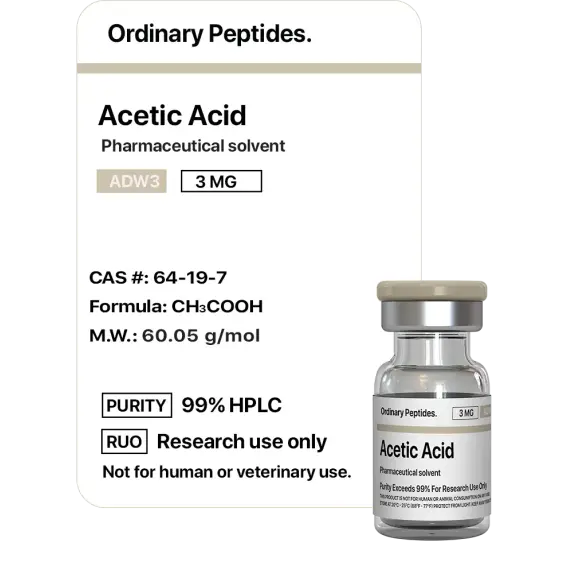
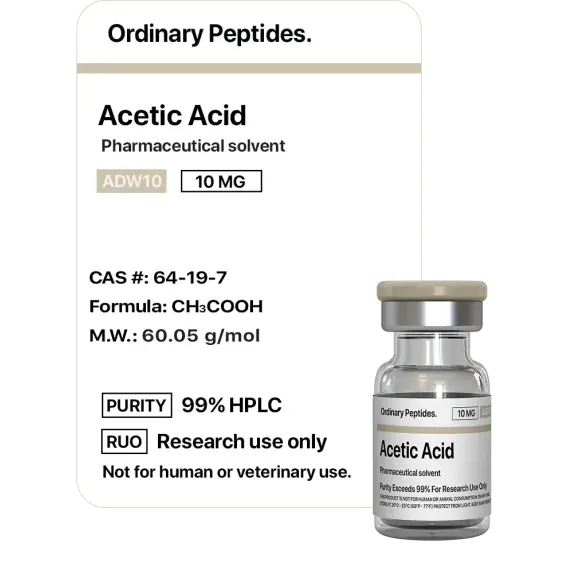
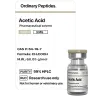
Acetic Acid
For in vitro testing and laboratory use only. Not for human or animal consumption. Bodily introduction is illegal. Handle only by licensed professionals. Not a drug, food, or cosmetic. Educational use only.
Acetic Acid (0.1%) for Peptide Reconstitution: Key Facts
Dilute acetic acid at 0.1% (pH ~3.4) is a niche but essential intermediate dissolution solvent for cationic peptides like IGF-1 LR3 and Des(1-3) IGF-1, which aggregate in neutral water. The low pH creates electrostatic repulsion between molecules, allowing full dissolution where plain water fails.
The Two-Step Protocol
The protocol is always two steps: first dissolve with 50–100 µL of 0.1% acetic acid, then dilute to ≥1 mL total with BWI, bringing the final pH to a safe ~5.5–6.5 for injection. This sequence is not optional — it is the correct order of operations.
Critical Safety Point
When Not to Use Acetic Acid
For the vast majority of peptides — including BPC-157, TB-500, CJC-1295, and ipamorelin — BWI alone is correct. Acetic acid adds unnecessary complexity and should only be used where dissolution in neutral water is not achievable.
Acetic Acid (Reconstitution-Grade / 0.1% Solution): A Technical Guide for Peptide Research Applications
Based on pharmaceutical chemistry literature, peptide formulation science, and established research practice — see References. Last updated: April 2026.
The Short Version
Dilute acetic acid (typically 0.1% v/v, occasionally 0.5–1%) is the standard initial reconstitution solvent for a specific subset of peptides and growth factors that dissolve poorly or incompletely in neutral or slightly acidic water. The most important examples from this series are IGF-1 LR3, Des(1-3) IGF-1, and — in some protocols — GHK-Cu and a handful of other compounds.
Two common errors in peptide work stem from misunderstanding acetic acid’s role: using the wrong solvent entirely (producing an undissolved or aggregated peptide), and injecting an undiluted acidic solution (which causes tissue damage at the injection site). This article covers why acetic acid is used, when it is necessary versus optional, how to prepare it correctly, and critically — the subsequent dilution step that brings the final solution to a safe pH for use.
| At a glance | |
|---|---|
| Chemical name | Acetic acid (ethanoic acid) |
| Formula | CH&sub3;COOH; MW 60.05 Da; CAS 64-19-7 |
| Form used in peptide work | Dilute aqueous solution: typically 0.1% v/v (approximately pH 3.4) |
| Primary purpose | Initial dissolution of poorly water-soluble peptides |
| Final pH before use | ⚠️ Must be diluted to pH ≥5.5–7.0 before administration |
| Is acetic acid the final solvent? | No — it is an intermediate. Always dilute further with BWI or saline |
| Key peptides requiring it | IGF-1 LR3; Des(1-3) IGF-1; some cationic peptides |
Why Some Peptides Need Acetic Acid
Most small peptides covered in this series (BPC-157, TB-500, CJC-1295, ipamorelin, GHK-Cu) dissolve readily in bacteriostatic water at its natural pH of approximately 5.7. Certain larger or more strongly positively charged peptides do not behave this way. At physiological or near-physiological pH, these peptides tend to self-associate (molecules with similar charge distributions cluster through hydrophobic and electrostatic interactions), form visible aggregates or invisible oligomeric clusters, and adsorb to the negatively charged inner surface of glass vials — reducing the effective dissolved concentration.
The solution is to shift the pH to a more acidic environment before dissolution. At lower pH values (typically pH 3–4), positively charged amino acid residues (Lys, Arg, His) carry even stronger positive charges, increasing electrostatic repulsion between peptide molecules and preventing the self-association that drives aggregation. The peptide dissolves because molecules are repelling each other rather than clustering.[1]
The structural chemistry of IGF-1 LR3
IGF-1 LR3 is the prototypical example. With 83 amino acids, multiple Lys and Arg residues, and its IGFBP-blocking N-terminal extension (MFPAMPLLSLFVN — notably hydrophobic leucine, phenylalanine, and valine residues), IGF-1 LR3 has both a net positive charge and a significant hydrophobic component. In neutral water, hydrophobic regions drive intermolecular association while positive charges are insufficiently repulsive to prevent clustering. At pH 3–4: histidine residues become fully protonated (pKa ~6.0), adding positive charge; the increased net positive charge enhances electrostatic repulsion; hydrophobic clustering is suppressed because repulsion forces dominate. The result: complete and reproducible dissolution in 10–30 seconds rather than the incomplete, aggregated result produced by adding neutral BWI directly to IGF-1 LR3 powder.[2]
Acetic Acid Chemistry: What You Are Working With
Glacial acetic acid is essentially pure acetic acid (≥99.5% pure, density ~1.05 g/mL, solidifies just below 16.6°C). It is a corrosive liquid that causes serious chemical burns to skin, eyes, and mucous membranes at full concentration. Handle with gloves and eye protection in a ventilated area. 0.1% acetic acid is a dilute solution containing 1 mL of glacial acetic acid per 1,000 mL of water. At this concentration it is mildly acidic (pH approximately 3.4), non-corrosive, and safe to handle. It is this dilute form that is used in peptide reconstitution.
| Concentration | pH (approx.) | Common use |
|---|---|---|
| 1.0% | ~2.9 | Research applications; some peptide work |
| 0.5% | ~3.1 | Some protocols; intermediate concentration |
| 0.1% | ~3.4 | Standard for IGF-1 LR3 and most growth factor peptides |
| 0.01% | ~3.9 | Some published formulation protocols |
The 0.1% concentration is standard because it provides sufficient acidity for dissolution while requiring the least subsequent dilution to return to an acceptable pH. Acetic acid is the terminal product of ethanol metabolism and a normal intermediary metabolite — it circulates in blood as acetate at physiological concentrations around 0.1 mM. At the small quantities introduced by a properly diluted peptide injection (micrograms of acetic acid in a 0.1–0.5 mL injection), the body metabolises acetic acid via the TCA cycle essentially immediately. What does cause problems is undiluted or insufficiently diluted acetic acid injected directly — at pH 3.4, a subcutaneous injection causes local tissue acidosis, pain, and potentially sterile inflammation. This is why the dilution step is mandatory.
Preparing 0.1% Acetic Acid
Route 1: Purchase pre-made 0.1% acetic acid solution
Several laboratory chemical suppliers and specialised peptide vendors sell pre-prepared 0.1% acetic acid in sterile water specifically for IGF-1 and growth factor reconstitution. These are the most convenient option from reputable suppliers. Look for: prepared in Water for Injection (WFI) or equivalent; sterile-filtered (0.22 μm); free from endotoxins (the key requirement).
Route 2: Prepare from glacial acetic acid + Water for Injection
This is the method used in research laboratories. Requires: glacial acetic acid (reagent grade ≥99.5%; ACS or HPLC grade preferred); Water for Injection, USP (from a sealed pharmaceutical vial); a 0.22 μm sterile syringe filter; a sterile container; gloves and eye protection.
Preparation (example: 10 mL of 0.1%): Combine 0.01 mL (10 μL) of glacial acetic acid with 9.99 mL of WFI. Mix thoroughly. Filter through a 0.22 μm sterile syringe filter into a sterile container. Use immediately or store at 2–8°C. A microsyringe or calibrated micropipette is needed for this small volume — do not attempt to measure 10 μL with a standard disposable syringe; the error margin is too large.
Route 3: Food-grade sources — not recommended
White vinegar (5% acetic acid) can theoretically be diluted 50-fold to yield 0.1%. This is not recommended for injectable peptide work: vinegar contains other organic acids, sugars, and fermentation byproducts; it is not sterile; and it cannot be assumed endotoxin-free. For research use, only pharmaceutical-grade or laboratory reagent-grade acetic acid in WFI should be used.[7]
The Reconstitution Protocol for Acetic Acid–Requiring Peptides
The key difference from BWI-only reconstitution is a two-step process: acetic acid first for dissolution, then BWI or saline for pH adjustment and volume completion.
Two-step protocol (IGF-1 LR3 example)
What you need: Lyophilised IGF-1 LR3 vial; 0.1% acetic acid in WFI (sterile); Bacteriostatic Water for Injection (BWI) or sterile normal saline; U-100 insulin syringe(s); alcohol wipes; gloves.
Step 1 — Primary dissolution with acetic acid: Wipe the rubber stopper of the IGF-1 LR3 vial with an alcohol wipe; allow to dry. Draw 50–100 μL (0.05–0.10 mL; 5–10 units on a U-100 syringe) of 0.1% acetic acid. Direct the needle to the inner glass wall of the peptide vial and slowly introduce the acetic acid down the wall — not onto the powder directly (same wall technique as with BWI). Swirl gently — within 30–60 seconds the solution should be completely clear. Do not proceed with a cloudy solution.
Step 2 — Dilution with BWI: Add the remaining volume of BWI to reach your target concentration. The small acetic acid volume (50–100 μL) diluted to a total volume of 1–2 mL raises the pH from ~3.4 to approximately 5.5–6.5 — within a range that is much more tissue-compatible and close to subcutaneous tissue pH (~7.4) after injection.
Example concentration calculation (1 mg IGF-1 LR3)
Add 50 μL of 0.1% acetic acid → peptide dissolves. Add 950 μL BWI to reach total volume 1,000 μL (1 mL). Final concentration: 1 mg/mL (1,000 μg/mL). Final acetic acid concentration in the vial: ~0.005% — well below tissue irritation threshold when injected in small volumes.
The pH-Volume Relationship for Dilution Safety
| Acetic acid volume | BWI volume | Total volume | Final AcOH % | Approx. final pH |
|---|---|---|---|---|
| 50 μL (0.1%) | 950 μL | 1,000 μL (1 mL) | ~0.005% | ~5.8–6.2 ✅ |
| 100 μL (0.1%) | 900 μL | 1,000 μL (1 mL) | ~0.01% | ~5.5–5.9 ✅ |
| 50 μL (0.1%) | 1,950 μL | 2,000 μL (2 mL) | ~0.0025% | ~6.0–6.5 ✅ |
| 100 μL (0.5%) | 900 μL | 1,000 μL (1 mL) | ~0.05% | ~4.8–5.2 ⚠️ |
The final pH values are estimates — actual pH depends on the peptide’s buffering capacity and exact BWI pH. When using higher acetic acid concentrations or lower total volumes, pH verification with strips is worthwhile. When in doubt, use a smaller initial acetic acid volume and a larger total volume.
Peptide-Specific Guidance for Acetic Acid Use
IGF-1 LR3 and Des(1-3) IGF-1 — require acetic acid: The archetypal acetic acid peptides. Standard two-step protocol as described above. Most published research and community protocols use 10–100 μL of 0.1% acetic acid as the primary dissolution solvent, followed by dilution with BWI or sterile saline. Des(1-3) IGF-1 has even higher IGF-1R affinity than LR3 and identical solubility characteristics — same protocol applies.
Native IGF-1 (mecasermin/Increlex): The FDA-approved pharmaceutical comes as a ready-to-inject solution in sodium acetate buffer, pH 5.4 — the clinical implementation of the same chemistry at industrial scale. No user reconstitution required.
GHK-Cu — generally dissolves in BWI; acetic acid usually unnecessary: GHK-Cu is a small charged tripeptide with a chelated copper ion. It typically dissolves readily in BWI without acetic acid. If the peptide dissolves completely in BWI within 60 seconds of gentle swirling, acetic acid is not needed.
BPC-157 — BWI only: BPC-157 dissolves readily in BWI. Some community protocols have circulated recommending acetic acid for BPC-157 — this is not necessary and may complicate pH management. BWI is correct.
Growth hormone secretagogues (GHRP-2, GHRP-6, ipamorelin, sermorelin, CJC-1295) — BWI only: These peptides dissolve readily in BWI at pH 5.7. Acetic acid is not indicated.
Larger protein-based compounds (follistatin, GDF-8 propeptide) — case-by-case: These are large proteins, not small peptides. General-purpose acetic acid protocols are not appropriate without specific guidance from the compound’s manufacturer or characterised research protocols.
Safety: What Happens If the pH Is Too Low
Subcutaneous tissue has a normal pH of approximately 7.4. Injecting an acidic solution creates a local pH gradient that activates acid-sensing ion channels (ASICs) in nearby sensory neurons — the direct cause of the burning pain associated with acidic injections. At pH values below approximately 5.5, subcutaneous injection can cause: immediate burning pain; local inflammatory response with erythema and induration; in cases of significant volume and low pH, sterile abscess formation; and with repeated acidic injections at the same site, local tissue damage and scarring. This is entirely preventable with proper dilution. The issue arises when the undiluted acetic acid solution (containing the dissolved peptide but before BWI dilution) is accidentally injected — a serious and avoidable error.
The two-vial approach
One practical technique to prevent accidental injection of undiluted acetic acid solution: reconstitute with acetic acid in the original peptide vial (Vial A); after dissolution, transfer the complete contents to a fresh clean BWI vial (Vial B) containing the appropriate BWI volume; mix gently in Vial B. This separates the dissolution step (Vial A, acidic) from the final working solution (Vial B, near-neutral), reducing the risk of accidentally drawing from the wrong vial.
Storage of 0.1% Acetic Acid Solutions
Pre-made 0.1% acetic acid (no preservative): Store at 2–8°C; use within 1–2 weeks if in an opened container; prepare fresh for each reconstitution session if possible; discard if any cloudiness, discolouration, or particles develop. Acetic acid solutions have no preservative — use single-use technique or strict aseptic handling when accessing the solution.
Reconstituted peptides (after acetic acid + BWI dilution): Store at 2–8°C immediately after reconstitution; typical stability for IGF-1 LR3 after reconstitution is 2–4 weeks. Do not freeze the reconstituted solution — freeze-thaw cycles degrade reconstituted peptides (see BWI article).[5]
Reconstitution Solvent Extended Reference
| Solvent | pH | Preservative | Multi-dose | Primary use | Not suitable for |
|---|---|---|---|---|---|
| BWI (0.9% benzyl alcohol) | ~5.7 | Yes (28 days) | Yes | Most small peptides | Neonates; acetic acid–requiring peptides (alone) |
| Sterile Water for Injection | ~5.5–7.0 | No | Single use only | BWI-incompatible peptides; single doses | Multi-dose vials |
| 0.1% Acetic acid in WFI | ~3.4 | No | Single use / short-term | IGF-1 LR3; Des(1-3) IGF-1; cationic proteins | Direct injection without dilution |
| Normal saline (0.9% NaCl) | ~5.5 | No | Single use | IV dilutions; final diluent | Primary dissolution of acetic acid-requiring peptides |
| Bacteriostatic saline | ~5.5 | Yes (benzyl alcohol) | Yes (28 days) | Multi-dose IV/IM preparations | Same neonatal contraindication as BWI |
Common Errors Specific to Acetic Acid Protocols
⚠️ Error 1 — Injecting the acetic acid solution before BWI dilution: The most dangerous error. The undiluted dissolved peptide in 50–100 μL of 0.1% acetic acid is at pH ~3.4 — caustic enough to cause significant injection site pain and tissue damage. Always complete the BWI dilution step before drawing up for use.
Error 2 — Using food-grade acetic acid (vinegar): White vinegar is not sterile, not endotoxin-tested, and contains multiple organic impurities. Not a suitable substitute for laboratory or pharmaceutical-grade acetic acid in WFI.
Error 3 — Assuming all peptides need acetic acid: Acetic acid is necessary for a specific subset of cationic or hydrophobic peptides. For BPC-157, TB-500, GHK-Cu, and most other small peptides, BWI alone is correct. Using acetic acid unnecessarily adds complexity and pH management burden without benefit.
⚠️ Error 4 — Using glacial acetic acid directly: If concentrated (glacial) acetic acid accidentally enters the peptide vial without prior dilution, discard the peptide. The extremely low pH will cause immediate acid hydrolysis of peptide bonds, denaturing the peptide irreversibly. Always prepare the 0.1% working solution before use; never add glacial acetic acid directly to a peptide vial.
Error 5 — Insufficient dilution with BWI: Using 200 μL acetic acid and diluting to only 500 μL total produces a final solution of ~0.04% acetic acid at pH ~4.5 — uncomfortably acidic for injection. Use the minimum volume of acetic acid needed for dissolution (typically 50 μL) and dilute to at least 1 mL total volume.
Quick Reference: Acetic Acid vs. BWI Decision Guide
Use acetic acid protocol (0.1% AcOH, then dilute with BWI) if:
• Your peptide is IGF-1 LR3 or Des(1-3) IGF-1
• The manufacturer’s protocol specifically recommends acetic acid
• Your peptide does not dissolve completely in BWI within 2 minutes
Use BWI only if:
• Your peptide dissolves completely in BWI within 2 minutes
• Your peptide is BPC-157, TB-500, ipamorelin, sermorelin, CJC-1295, or most other small peptides
When in doubt for a novel peptide: try BWI first; if incomplete dissolution persists after 2–3 minutes, try 0.1% acetic acid protocol; consult specific literature for the compound.
Key Takeaways
- ⚠️ 0.1% acetic acid is an intermediate dissolution solvent — never the final product. The dissolved peptide must always be diluted with BWI to bring the pH to safe levels before use.
- The key peptides requiring acetic acid are IGF-1 LR3 and Des(1-3) IGF-1. Most other peptides covered in this series dissolve readily in BWI without an acetic acid step.
- Use 50–100 μL of 0.1% acetic acid for primary dissolution, then dilute to ≥1 mL total with BWI. This keeps the final acetic acid concentration below 0.01% and the final pH above ~5.5 — within an acceptable range for subcutaneous injection.[5]
- ⚠️ Never inject the undiluted acetic acid solution. At pH 3.4, it causes tissue damage and pain. The BWI dilution step is mandatory, not optional.
- Pharmaceutical-grade or laboratory-grade acetic acid in WFI only. Vinegar, food-grade acetic acid, or non-pharmaceutical preparations are not appropriate for research injectable applications.
- Acetic acid solutions have no preservative. Prepare fresh or store at 2–8°C for a maximum of 1–2 weeks in a sterile container; use single-use technique when accessing the solution.
References
Peptide Chemistry and Solubility
- Manning MC, Chou DK, Murphy BM, Payne RW, Katayama DS. Stability of protein pharmaceuticals: an update. Pharmaceutical Research. 2010;27(4):544–575.
- Chi EY, Krishnan S, Randolph TW, Carpenter JF. Physical stability of proteins in aqueous solution: mechanism and driving forces in nonclinical protein aggregation. Pharmaceutical Research. 2003;20(9):1325–1336.
IGF-1 Formulation
- Baxter RC. Insulin-like growth factor binding proteins in the human circulation: a review. Hormone Research. 1994;42(4–5):140–144.
- Increlex (mecasermin) prescribing information. Ipsen Biopharmaceuticals. 2022. (Pharmaceutical formulation in sodium acetate buffer pH 5.4 — the clinical implementation of the same chemistry)
Reconstitution Chemistry
- Wang W. Lyophilization and development of solid protein pharmaceuticals. International Journal of Pharmaceutics. 2000;203(1–2):1–60.
- Cleland JL, Powell MF, Shire SJ. The development of stable protein formulations: a close look at protein aggregation, deamidation, and oxidation. Critical Reviews in Therapeutic Drug Carrier Systems. 1993;10(4):307–377.
Acetic Acid Properties
- CRC Handbook of Chemistry and Physics. Dissociation constants of organic acids: acetic acid, pKa 4.76. CRC Press.
- NIST WebBook. Acetic acid (CAS 64-19-7). Physical and chemical properties.
In peptide therapy, acetic acid refers to dilute sterile acetic acid solution — typically 0.1% to 1% concentration — used as a diluent to dissolve certain lyophilized peptides that do not reconstitute well in bacteriostatic water or sterile water. It is the same compound found in vinegar but prepared to pharmaceutical-grade sterility and precision for injectable use.
Some peptides are chemically basic and require a mildly acidic environment to dissolve properly and remain stable in solution. The most well-known example is IGF-1 and its analogs, which dissolve poorly in neutral water but dissolve readily in dilute acetic acid. Using the wrong diluent can result in incomplete dissolution, peptide aggregation, or accelerated degradation — all of which reduce effectiveness and potentially increase injection risk.
The most notable peptides reconstituted with acetic acid include IGF-1, IGF-1 LR3, IGF-1 DES, and Growth Hormone Releasing Hormones such as CJC-1295 without DAC. Some other growth-factor peptides with basic isoelectric points also benefit from acetic acid as a diluent. The manufacturer or supplier documentation should always specify the recommended diluent for each specific peptide.
A small volume of dilute acetic acid — typically 0.1% concentration — is drawn into a syringe and injected slowly down the side of the peptide vial, never directly onto the powder. The vial is then gently swirled until fully dissolved. Once reconstituted in acetic acid, the solution is often then diluted further with bacteriostatic water or saline before injection to bring the pH closer to physiological levels and reduce injection site irritation.
The standard concentration used for peptide reconstitution is 0.1% acetic acid in sterile water. Higher concentrations such as 1% are sometimes used but carry a greater risk of tissue irritation at the injection site. Anything approaching vinegar strength — typically around 5% — is completely inappropriate for injection and can cause serious tissue damage.
The primary risk of acetic acid reconstitution is injection site irritation, stinging, or discomfort if the solution is too acidic or not sufficiently diluted before injection. Repeated injection of acidic solutions into the same site can cause local tissue inflammation. Microbial contamination is also a concern if the acetic acid solution is not prepared to sterile pharmaceutical standards — homemade dilutions from household vinegar are never appropriate and are dangerous.
Pharmaceutical-grade sterile acetic acid for injection should only be sourced from a licensed compounding pharmacy. It should never be prepared at home from food-grade vinegar or laboratory reagents. As with all injectable diluents and peptides, reconstitution and administration should only be carried out under the guidance of a qualified healthcare professional.