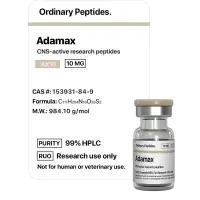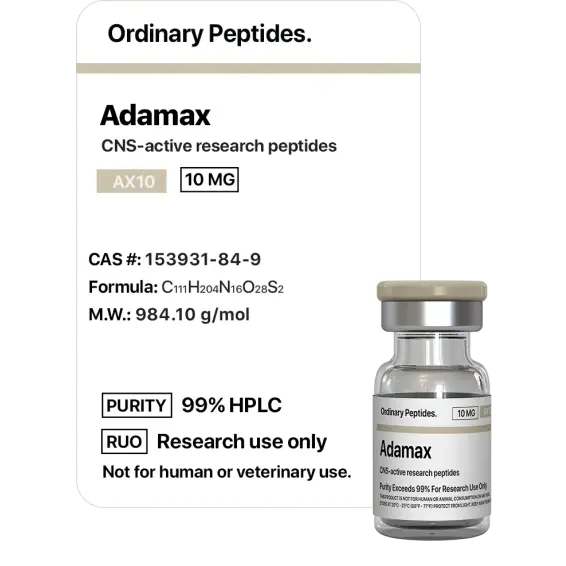
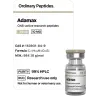

Adamax
For in vitro testing and laboratory use only. Not for human or animal consumption. Bodily introduction is illegal. Handle only by licensed professionals. Not a drug, food, or cosmetic. Educational use only.
Adamax: An ACTH-Like Neuropeptide Candidate With a Meaningful Research Background and an Honest Story
Adamax is not just another loud "internet nootropic," but an ACTH-like peptide candidate that is usually discussed in a research context alongside Semax — and that is precisely what makes it interesting for people who value the origin of an idea more than hype. In the available descriptions, it appears to be a Semax-like molecule with a cognitive positioning, but without the same transparent and independent evidence base, which is already an important signal for anyone trying to make a careful judgment.
Its strength as a topic lies in the concept itself: this is not a generic "peptide for everything," but a product emerging from the ACTH-analogue line, an area that has attracted scientific interest for quite some time. At the same time, Adamax is compelling precisely because it is a rare and poorly documented candidate, where the research intrigue still runs noticeably ahead of any confident conclusions.
For a client who values precision, context, and an honest presentation without fairy tales, this is exactly the kind of case where the interest comes not from a promise of miracles, but from the unusual nature of the molecule itself and its place within the neuropeptide niche. Looked at soberly, Adamax is an option for those who care less about a polished legend and more about a meaningful research background — while understanding that this is not a mass-market product, but a controversial yet noteworthy peptide candidate.
Adamax: What It Is, What It Isn’t, and What the Science Actually Shows
Based on peer-reviewed literature — see References section. Last updated: April 2026.
The Short Version
Adamax is a synthetic heptapeptide — a modified, more pharmacokinetically stable version of Semax, which is itself a fragment of the adrenocorticotropic hormone (ACTH). The key modification: an adamantane group attached to the C-terminus, which makes the molecule harder for enzymes to break down and theoretically better at crossing the blood-brain barrier.
The research story here is layered and requires careful reading. Semax has genuine published human data — decades of Russian clinical research, including approved use in Russia for stroke recovery. Adamax has essentially none of its own. It is a newer, modified derivative that exists almost entirely in the research chemical market, with its proposed effects extrapolated from Semax data and theoretical pharmacokinetic reasoning. That distinction matters throughout this article — and we’ll return to it repeatedly.
| At a glance | |
|---|---|
| Full name | Adamax (N-acetyl Semax amidate with adamantane modification) |
| Sequence | Ac-Met-Glu-His-Phe-Pro-Gly-Pro-AG-NH₂ |
| Parent compound | Semax (ACTH fragment 4–10 analog) |
| Key modification | C-terminal adamantane group + N-terminal acetylation |
| Molecular class | Synthetic neuropeptide |
| Research status | Research chemical only; no approved use anywhere |
| Own clinical trials | None published |
| Regulatory status | Not approved by FDA, EMA, or equivalent authorities |
Where It Came From: The Semax Story First
To understand Adamax, you genuinely need to understand Semax — because Adamax is essentially Semax with engineering improvements bolted on. Semax was developed at the Institute of Molecular Genetics of the Russian Academy of Sciences, starting in the 1980s. The original inspiration came from a much older observation: researchers had noticed in the 1950s that ACTH — the pituitary hormone that regulates cortisol — seemed to have cognitive effects that had nothing to do with its hormonal function. Scientists began isolating the fragments responsible. Eventually they narrowed it down to the ACTH(4–10) sequence and refined it into the heptapeptide now called Semax: Met-Glu-His-Phe-Pro-Gly-Pro.
Semax is a registered prescription medication in Russia, where it has been used for stroke recovery, brain hypoxia, cognitive disorders, and optic nerve damage since the 1990s. It appears on Russia’s List of Vital and Essential Drugs. This gives Semax something relatively rare in the world of nootropic peptides: actual human clinical data, even if much of it was published in Russian-language journals and has not been thoroughly replicated in Western research settings.[2][5]
The practical problem with Semax is stability: it degrades quickly in the body, its half-life in circulation is short, and frequent dosing is needed to maintain effects. Researchers looked for ways to make it more durable. That search led to the adamantane modification.
What Makes Adamax Different: The Adamantane Modification
Adamax is a synthetic heptapeptide derived from Semax, with the specific amino acid sequence Ac-MEHFPG-AG-NH₂. Structural limitations within Semax lead to significant constraints on its half-life and efficiency of crossing the blood-brain barrier. To address these limitations, the adamantylacetate group was introduced at the C-terminus — a modification developed in the context of research chemistry, not through a regulated clinical drug development process.
What is adamantane? It’s a rigid, cage-like carbon structure — sometimes described as diamond-shaped — that is highly lipophilic (fat-loving). This property matters enormously for brain access: the blood-brain barrier is largely a lipid membrane, and molecules that dissolve more readily in fats cross it more easily than those that don’t.[9]
| Modification | Intended effect |
|---|---|
| N-terminal acetylation | Protects against exopeptidase degradation; may increase plasma half-life |
| C-terminal adamantane group | Increases lipophilicity; intended to enhance BBB penetration; resists enzymatic breakdown |
| C-terminal amidation | Additional stability against carboxypeptidases |
Adamantane addition consistently increases lipophilicity — typically by +2 to 3 log units in logP — and improves BBB penetration across diverse drug classes in general pharmacology research,[8] though this specific magnitude has not been measured for Adamax in human pharmacokinetic studies.
How It’s Supposed to Work: Proposed Mechanisms
Adamax is thought to act through several overlapping pathways, most of which are inherited from its parent compound Semax. Here’s what the research on Semax actually shows — and where Adamax extrapolates from that foundation.
BDNF and TrkB Signalling
This is the best-documented mechanism in the Semax literature. The heptapeptide Semax is an analog of the adrenocorticotropin fragment (4–10) which after intranasal application has profound effects on learning and exerts marked neuroprotective activities. A single application of Semax results in a maximal 1.4-fold increase of BDNF protein levels alongside a 1.6-fold increase of TrkB tyrosine phosphorylation levels, and a 3-fold and a 2-fold increase of BDNF and TrkB mRNA levels, respectively, in the rat hippocampus.[1]
BDNF — brain-derived neurotrophic factor — is the brain’s own maintenance and growth signal. It supports neuron survival, promotes synaptic connections, and plays a central role in learning and memory. TrkB is the receptor through which BDNF acts. Activating this system is one of the most studied mechanisms for supporting cognitive function and neuroplasticity.
Monoamine Neurotransmitter Modulation
Semax and its analogs appear to influence dopamine, serotonin, and norepinephrine systems — the neurotransmitters associated with focus, mood, and motivation. This may partly explain the attentional and cognitive effects reported by Semax users.
Melanocortin Receptor Interaction
There is a report of Semax competitively antagonising the action of α-melanocyte-stimulating hormone (α-MSH) at the MC4 and MC5 receptors in both in vitro and in vivo experimental conditions, indicating that it may act as an antagonist or partial agonist of these receptors. The exact clinical significance of this interaction remains unclear.[7]
Enkephalinase Inhibition
Semax, as well as the related peptide Selank, have been found to inhibit enzymes involved in the degradation of enkephalins and other endogenous regulatory peptides, though the clinical significance of this property is uncertain.[6]
Neuroprotective and Neuroinflammatory Effects
Semax predominantly enhanced the expression of genes related to the immune system — affecting the activity of immune cells and enhancing the expression of chemokine and immunoglobulin genes. The immunomodulating effect and its impact on the vascular system during ischemia are likely to be key mechanisms underlying the neuroprotective effects of the peptide.[3] These findings are from Semax research in animal ischemia models and have not been directly tested for Adamax.
| Proposed mechanism | Evidence source | Quality of evidence |
|---|---|---|
| BDNF/TrkB upregulation | Semax rat studies; human BDNF plasma data [1] | Moderate for Semax; extrapolated for Adamax |
| Monoamine modulation | Semax animal studies | Preclinical only |
| Melanocortin receptor interaction | In vitro and animal models [7] | Preliminary |
| Enkephalinase inhibition | In vitro [6] | Preliminary; clinical relevance unclear |
| Neuroinflammation modulation | Semax animal ischemia models [3] | Preclinical; not tested for Adamax |
|
Enhanced BBB penetration vs. |
General adamantane pharmacology [8][9] | Theoretically supported; not human-verified for Adamax |
What the Research on Semax Actually Shows
Since all published human data belongs to Semax, it’s important to be clear about what that data actually demonstrates — and where its limitations lie.
Stroke recovery
In a study of 110 patients after ischemic stroke, Semax administration increased BDNF plasma levels that remained elevated throughout the study period. Semax use and high BDNF levels accelerated improvement and improved final outcomes on the Barthel index score.[2]
Semax was studied in 30 patients in the acute period of hemispheric ischemic stroke. Including Semax in combined intensive therapy had measurable influence on the rate of restoration of damaged neurological functions, particularly in the regression of motor disorders.[5]
Neuroprotection in animal models
Both Semax and PGP activate the transcription of neurotrophins and their receptors in the cortex of rats subjected to permanent middle cerebral artery occlusion. This activating influence was mostly observed 3 and 24 hours after the ischemic attack — a window when cells in the penumbra still retained functional activity and could potentially survive.[4]
Honest limitations of this evidence base
The Semax clinical evidence has real gaps. Much comes from Russian-language publications with relatively small sample sizes and methodological limitations by modern standards.[10] Little human evidence exists for potential side effects. There is not a strong rationale — and little evidence — that intranasal Semax is useful for age-related indications. These limitations apply even more strongly to Adamax, for which no dedicated clinical trials exist at all.
The Evidence Gap: Semax vs. Adamax
| What we know | Source | Applies to Adamax? |
|---|---|---|
| BDNF upregulation in rat hippocampus | Semax animal studies [1] | Extrapolated — not directly tested |
| Improved stroke outcomes in humans | Semax clinical studies [2][5] | Extrapolated — not directly tested |
| Neuroprotection in ischemia models | Semax animal models [3][4] | Extrapolated |
| Adamantane increases lipophilicity and BBB penetration | General pharmacology literature [8][9] | Yes — magnitude in humans not measured |
| Enhanced enzymatic stability vs. Semax | Chemical reasoning + general data | Plausible; not human-verified |
| Cognitive enhancement in healthy humans | No rigorous data for either compound | No |
| Long-term safety in humans | Unknown for Adamax; minimal data for Semax | Unknown |
Reported Adverse Effects and Safety Considerations
Adamax has no dedicated safety studies. Available information comes from Semax data and anecdotal reports.
| Adverse effect | Source | Notes |
|---|---|---|
| Nasal irritation | Semax intranasal use | Common with intranasal route |
| Headache | User reports | Anecdotal |
| Restlessness / overstimulation | User reports | Particularly at higher doses |
| Sleep disruption | User reports | Dose and timing dependent |
| Mild nausea | Occasional reports | Uncommon |
| Increased blood glucose | Semax data (~7.4% of diabetic patients in one review) | Monitor in diabetics |
| Anxiety (paradoxical) | Semax animal model data; some user reports | Possible at higher doses |
| Allergic reactions | Possible with any peptide | Seek immediate medical attention if suspected |
Regulatory Status
| Jurisdiction | Status |
|---|---|
| USA (FDA) | Not approved; not a licensed drug; sold as research chemical only |
| EU (EMA) | Not approved |
| Russia | Semax is approved; Adamax specifically is not a registered medication |
| WADA | Not currently on the prohibited list (2024–2025) |
| General legal status | Legal grey area in most jurisdictions |
Comparison with Related Compounds
| Compound | Modification vs. Semax | Evidence level | Notable difference |
|---|---|---|---|
| Semax | Baseline | Moderate (Russian clinical data) | Most human evidence available |
| N-acetyl Semax amidate | N-terminal acetylation + C-terminal amidation | Preclinical + anecdotal | More stable than base Semax |
| Adamax | All of above + adamantane | Essentially anecdotal | Theoretically enhanced BBB penetration and stability; no human trials |
| Selank | Different ACTH-derived sequence | Some Russian clinical data | Anxiolytic focus; different target profile |
| P21 | Adamantane-modified CNTF fragment | Preclinical only | Different parent compound; similar modification strategy |
Common Misconceptions
“Adamax has been clinically tested.”
No. The human clinical data cited in most Adamax-related content belongs to Semax. Adamax itself has not been the subject of published peer-reviewed clinical trials.
“Adamax is 2–3x more effective than Semax.”
This is a vendor claim, not a finding from peer-reviewed research. The theoretical basis for improved pharmacokinetics is reasonable; specific “X times more potent” figures are not scientifically established for Adamax and should be treated as marketing language.
“It’s safe because it’s derived from a natural hormone.”
ACTH fragments have been significantly modified from their natural source. “Naturally derived” does not guarantee safety, and the adamantane modification specifically has not been assessed for long-term effects in human trials.
“The Russian clinical data proves Adamax works.”
Russian clinical data supports
Semax — a related but chemically distinct compound.[2][5] Extrapolation to Adamax assumes the modifications improve, rather than alter, the pharmacological profile. That assumption is plausible but unverified.
“Claims about Adamax online reflect published science.”
Much of the online content about Adamax draws heavily on Semax research without clearly distinguishing between the two compounds, or cites general adamantane pharmacology as if it were Adamax-specific data. The gap between what is claimed and what is actually published is significant.
FAQ
Is Adamax legal?
In most countries, including the US, it occupies a legal grey area — not a scheduled substance, but also not an approved drug. Sold as a research chemical marked “not for human consumption.”
Is it the same as Semax?
No. It shares the same core peptide sequence but has additional chemical modifications — most notably the adamantane group — that change its pharmacokinetic profile. Think of it as Semax with a different chassis, not a different engine.
Why is there so little research on Adamax specifically?
Because it is a relatively new research chemical that has not entered formal clinical development. Interest has been driven primarily by the nootropics and biohacking communities rather than academic or pharmaceutical research programmes.
What would it take to actually know if Adamax works?
At minimum: published, peer-reviewed pharmacokinetic studies confirming BBB penetration and half-life in humans, followed by randomised controlled trials comparing Adamax to both placebo and Semax on clearly defined cognitive or clinical endpoints.
Is the adamantane modification a proven improvement?
The pharmacokinetic rationale is scientifically sound — adamantane is widely used in pharmaceutical design to improve CNS penetration and metabolic stability.[8] Whether this translates to better real-world outcomes for this specific peptide in humans has not been tested or published.
Key Takeaways
- Adamax is a modified derivative of Semax, with structural changes designed to improve stability and brain penetration. The chemical rationale is legitimate and grounded in established pharmacology.
- All published human clinical data belongs to Semax, not Adamax. Extrapolation is reasonable in principle but unverified in practice for this specific molecule.
- The evidence base for cognitive enhancement in healthy people is thin even for Semax — and essentially nonexistent for Adamax specifically.
- The neuroprotective data for Semax in stroke contexts is the most credible available,[2][5] but it comes primarily from Russian clinical research with methodological limitations, and it does not directly speak to Adamax.
- Adamax has no safety data of its own. Long-term effects in humans are genuinely unknown.
- Vendor claims about Adamax substantially outpace the published science. Specific performance figures — “2–3x more effective,” precise potency comparisons, confirmed neuroprotective outcomes — are marketing language unsupported by peer-reviewed Adamax-specific research.
References
Scientific Articles (Semax — Parent Compound)
- Dolotov OV, Karpenko EA, Inozemtseva LS, et al. Semax, an analog of ACTH(4-10) with cognitive effects, regulates BDNF and trkB expression in the rat hippocampus. Brain Research. 2006;1117(1):54–60. PMID: 16996037
- Gusev EI, Barskov IV, et al. The efficacy of Semax in the treatment of patients at different stages of ischemic stroke. Zhurnal Nevrologii i Psikhiatrii imeni S.S. Korsakova. 2018. PMID: 29798983
- Medvedeva EV, et al. Semax, an analog of ACTH(4-7), regulates expression of immune response genes during ischemic brain injury in rats. PMC. 2017. PMID: 28255762 / PMC3987924
- Shadrina MI, et al. Semax and Pro-Gly-Pro activate the transcription of neurotrophins and their receptor genes after cerebral ischemia. PMC. 2024. PMC11498467
- Gusev EI, Skvortsova VI, et al. Effectiveness of Semax in acute period of hemispheric ischemic stroke. PMID: 11517472
- Kost NV, Sokolov OY, et al. Semax and Selank inhibit the enkephalin-degrading enzymes of human serum. Russian Journal of Bioorganic Chemistry. 2001;27(3):156–159.
Reviews and Background
- Kolomin T, et al. A new generation of drugs: synthetic peptides based on natural regulatory peptides. Neuroscience and Medicine. 2013.
- Abraham MH, Acree WE, Liu X. Descriptors for adamantane and some of its derivatives. Journal of Molecular Liquids. 2021;325. doi: 10.1016/j.molliq.2020.114894
- Zhou Y, et al. Brain penetrating peptides and peptide-drug conjugates to overcome the blood-brain barrier and target CNS diseases. WIREs Nanomedicine and Nanobiotechnology. 2021. doi: 10.1002/wnan.1695
Institutional Sources
- Alzheimer’s Drug Discovery Foundation. Semax — Cognitive Vitality For Researchers. alzdiscovery.org
- Wikipedia. Semax. en.wikipedia.org/wiki/Semax
- Institute of Molecular Genetics, Russian Academy of Sciences — original developer of Semax; institutional context for the compound family.
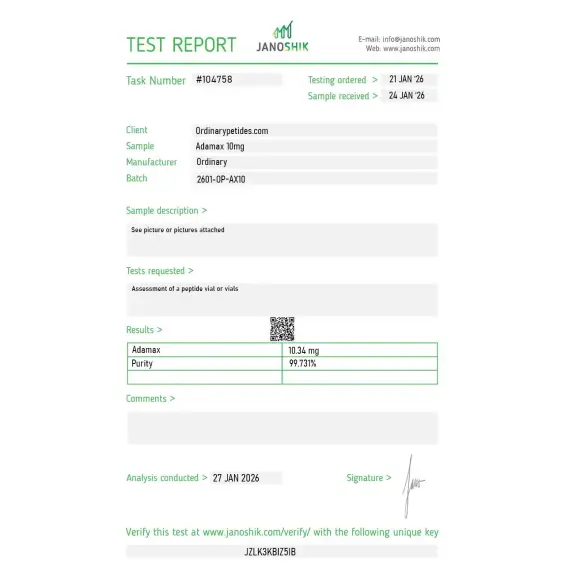
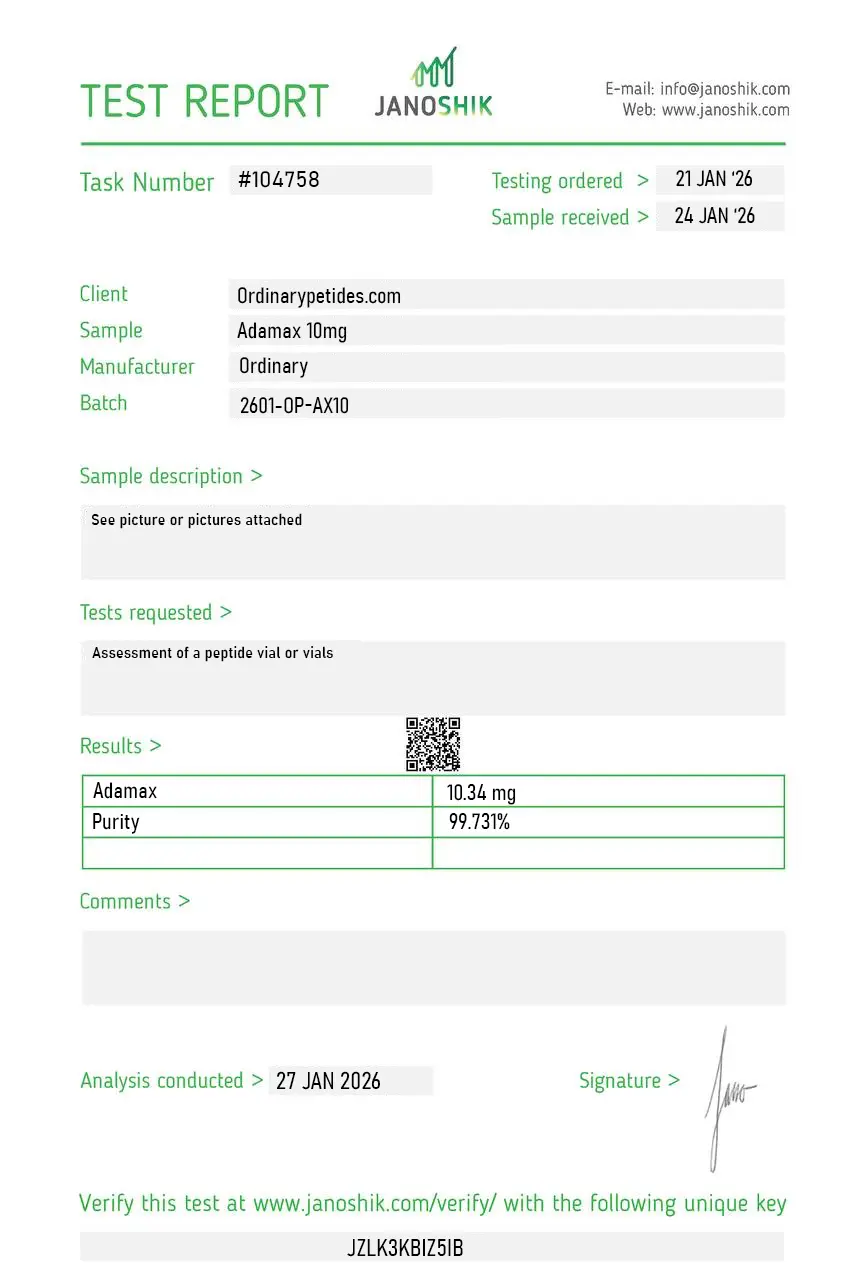
Certificate of Analysis
An independent test report is available for Adamax. This report provides batch-level documentation and analytical verification information for research reference.
Based on 3 reviews
4.7
-
2
-
1
Useful that the listing treats it as a distinct stabilized analog rather than just relabeling Semax, but it could be clearer that the underlying pharmacology evidence is still inherited from the base-Semax literature — there isn't a separate body of work on the acetylated-amidated form specifically. A buyer should know they're extrapolating the parent compound's (already largely single-tradition, Russian-language) evidence onto a modified version. Material itself was reliable for our pathway assays.
We run it head-to-head against unmodified Semax specifically to isolate what the terminal protection buys you — same MEHFPGP core, same proposed BDNF-pathway activity, but different degradation kinetics. That modified-versus-parent comparison is the actual experiment, and sourcing both from one catalog keeps the only variable the modifications themselves rather than vendor chemistry. Both held their profiles across the conditions we tested.
The whole reason to reach for this over base Semax is the double terminal protection — N-acetylation blocks the aminopeptidases, C-amidation blocks the carboxypeptidases, so the molecule survives meaningfully longer in serum-containing media than the unmodified heptapeptide. For our extended-incubation work that stability margin is the entire point; base Semax degrades before our timepoints. The material behaved consistently with that expected resistance.
Adamax is primarily used in laboratory research focused on cognitive enhancement, memory consolidation, neuroplasticity, and BDNF pathway modulation studies.
Adamax is studied for its potential influence on neurotrophic signaling pathways, particularly those associated with BDNF expression and synaptic plasticity. These mechanisms are central to learning, memory, and neuronal adaptation research.
At the molecular level, it is a synthetic peptide ACTH analogue, but in terms of evidence quality it is much closer to poorly verified research-use compounds than to a well-studied medicine.
No. They can be used only as indirect scientific context, not as direct evidence of Adamax efficacy or safety.
Not reliably. Only a hypothetical Semax-like mechanism can be discussed, nothing more.
No reliable comparative data are visible in verifiable literature.
Three structural modifications distinguish Adamax from regular Semax. First, an acetyl group on the N-terminus creates a more stable intermediate form — this is N-Acetyl Semax, which already crosses the blood-brain barrier more readily than plain Semax and resists premature degradation. Second and most critically, an adamantane group is added to the C-terminus — the same modification used in P21. Adamantane is a tricyclic, highly lipophilic diamondoid structure that dramatically increases membrane permeability, extends half-life by protecting against enzymatic breakdown, and enhances CNS penetration. The result is a compound with the cognitive-activating properties of Semax but significantly greater bioavailability, stability, and duration of action.
The proposed mechanism centers on BDNF upregulation — Adamax is understood to increase Brain-Derived Neurotrophic Factor levels and enhance TrkB receptor sensitivity in the hippocampus, the brain's primary learning and memory center. BDNF is essential for synaptic plasticity, neuronal survival, and the formation of new neural connections. Additionally it modulates dopamine, norepinephrine, and serotonin signaling — which supports mood, motivation, and focus. It also interacts with HPA axis pathways, potentially reducing inflammation-associated neurological stress, and shows antioxidant and anti-inflammatory neuroprotective properties in cellular models.
Because Adamax has no published formal research of its own, all reported benefits derive from anecdotal biohacker reports and extrapolation from Semax and P21 data. Users report significant improvements in focus, motivation, and cognitive performance under demanding tasks, describing it as providing mental clarity and drive comparable to prescription stimulants but without the same edge or crash. Preliminary clinical observations referenced by some sources suggest better neurological outcomes post-stroke when administered early, potentially through reduction of oxidative stress and neuronal repair — though this data appears to be extrapolated from Semax research rather than Adamax-specific trials. Athletic endurance improvements are also reported, described as 2 to 3 times greater than other Semax analogs.
Adamax is available as both a nasal spray and a subcutaneous injectable solution. The nasal spray route is reported to produce faster onset due to direct olfactory-to-CNS delivery. Typical doses in biohacker protocols range from 100 to 200 mcg per administration. It is reconstituted from lyophilized powder using bacteriostatic water and stored refrigerated after reconstitution. Morning administration is generally recommended to align with circadian rhythms and avoid stimulatory interference with sleep.
No dedicated safety studies exist for Adamax specifically. Safety extrapolation from Semax — its parent compound — shows a generally favorable profile with no significant metabolic disruption, IGF-1 elevation, or major adverse events in clinical use. However Adamax is structurally novel and its adamantane modification has not been independently studied in humans in this context. Possible side effects inferred from the Semax family include mild irritability, headache, overstimulation at higher doses, and nasal irritation with the spray form. The complete unknown risk profile of a brand-new compound is itself the most significant concern.
Given the complete absence of formal safety data, this is one of the highest-caution compounds in this entire FAQ series. Anyone with psychiatric conditions — particularly anxiety disorders, bipolar disorder, or psychosis risk — should avoid it entirely given its dopaminergic and noradrenergic stimulatory effects. People with cardiovascular conditions, pregnant or breastfeeding women, and anyone under 18 should not use it. The compound's creator explicitly stated it should be treated as a research compound only and that purchases should not be based on anecdotal claims. Any use outside of a formal research setting is genuinely inadvisable.