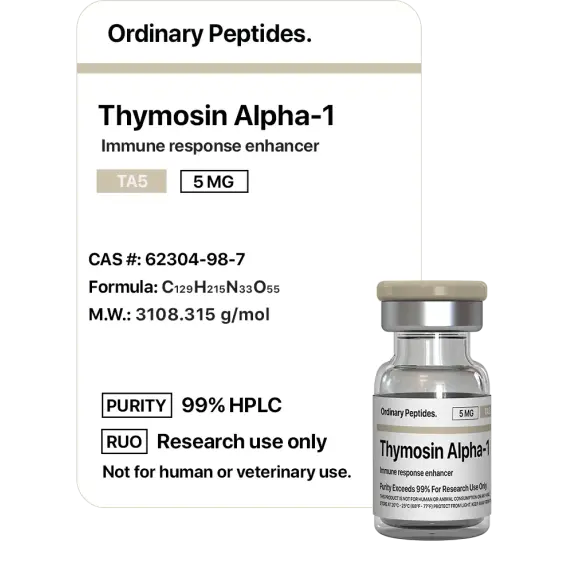
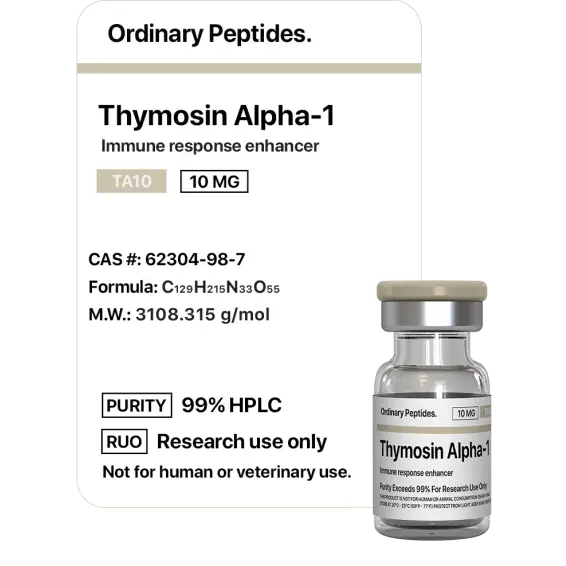
Thymosin Alpha-1
For in vitro testing and laboratory use only. Not for human or animal consumption. Bodily introduction is illegal. Handle only by licensed professionals. Not a drug, food, or cosmetic. Educational use only.
Thymosin Alpha-1 (Tα1): The Thymic Peptide With a Real Research Track Record
Thymosin alpha-1 is a natural 28-amino acid thymic peptide, and its synthetic version, thymalfasin, was created as an identical copy of the human molecule — which already makes it more than just another "immune support" buzzword.
In the research context, Tα1 has been studied as a bidirectional immune modulator: published data describe activation of TLR2/TLR9 pathways, dendritic cell maturation, and support of a Th1-type response rather than a simple "on switch" for immunity.
In clinical practice outside the US, it built its strongest track record in hepatitis B during the interferon era and as a vaccine adjuvant in selected immunocompromised groups. At the same time, the science stays refreshingly honest: the FDA has not approved it for any indication, and the largest sepsis trial in 2025 did not show a reduction in 28-day mortality.
That tension is exactly what makes Tα1 interesting — not as a miracle claim, but as a peptide with a serious scientific biography, a broad research footprint, and plenty left to explore.
Thymosin Alpha-1 (Thymalfasin / Zadaxin): A Scientific Review
Based on peer-reviewed literature — see References. Last updated: April 2026.
The Short Version
Thymosin alpha-1 occupies a position that few compounds in this series can match: simultaneously a legitimately approved pharmaceutical in over 35 countries and a research chemical in the world’s largest pharmaceutical market. It has been in clinical use since the late 1990s, studied in over 70 clinical trials involving 11,000+ subjects, and its core mechanism — immunomodulation through toll-like receptor signalling — is among the most clearly characterised of any peptide in this series.
The story begins in the 1960s–70s, when Allan Goldstein and colleagues at George Washington University discovered that thymosin fraction 5 (TF5), a crude thymic extract, could restore immune competence in thymectomised animals. Systematic fractionation revealed the most immunologically active component: a 28-amino acid peptide named thymosin alpha-1 (Tα1). Goldstein purified, sequenced, and synthesised it in 1977, demonstrating that synthetic and natural Tα1 were equivalent, and championed its clinical development over the subsequent five decades.[1]
The most important recent development is the TESTS trial (BMJ, January 2025) — N=1,106 sepsis patients, double-blind, placebo-controlled — which found no reduction in 28-day all-cause mortality (HR 0.99; P=0.93). This negative result is a sobering corrective to prior smaller positive trials, though subgroup analyses suggest potential benefit in elderly and diabetic patients.[5]
| At a glance | |
|---|---|
| Full name | Thymosin alpha-1; thymalfasin (INN); Zadaxin (brand) |
| Type | Synthetic 28-amino acid endogenous peptide |
| Molecular weight | ~3,108 Da |
| N-terminal modification | N-terminal acetylation (Ac-Ser-) |
| Discovery | Allan Goldstein et al., George Washington University; isolated 1972, sequenced 1977 |
| Approved countries | ✅ 35+ (China, Italy, India, South Korea, Philippines, Singapore, Latin America, Middle East, SE Asia) |
| Primary approved indication | Chronic hepatitis B; also hepatitis C adjunct, vaccine adjuvant in immunocompromised |
| FDA status | Not approved; orphan drug designation (4 indications); compounding restricted December 2024 |
| WADA status | ✅ Not prohibited |
| Standard dosing | 1.6 mg SC injection twice weekly × 6 months (hepatitis B) |
Discovery: Allan Goldstein and the Thymosin Programme
The scientific context begins with Jacques Miller’s 1961 demonstration that neonatal thymectomy in mice produced profound immunodeficiency, establishing the thymus as the master organ of cellular immunity. Allan Goldstein, working with Abraham White at the Albert Einstein College of Medicine, began systematically fractionating thymic extracts. By the late 1960s their work had produced thymosin fraction 5 (TF5) — a crude mixture of thymic peptides with measurable immune-restoring activity in thymectomised animals. It was not until 1977 that Tα1 was purified and separated from TF5 and found to possess 10–1000 times higher activity than TF5 itself.
The 1977 paper by Goldstein, Low, McAdoo et al. in PNAS reported the isolation, sequence determination, and synthetic equivalence of thymosin alpha-1 — one of the most important papers in the history of thymic biology, opening the path to pharmaceutical production without animal-derived extraction.[1]
Structure
Full sequence: Ac-Ser¹-Asp²-Ala³-Ala&sup4;-Val&sup5;-Asp&sup6;-Thr&sup7;-Ser&sup8;-Ser&sup9;-Glu¹⁰-Ile¹¹-Thr¹²-Thr¹³-Lys¹⁴-Asp¹⁵-Leu¹⁶-Lys¹⁷-Glu¹⁸-Lys¹⁹-Lys²⁰-Glu²¹-Val²²-Val²³-Glu²⁴-Glu²⁵-Ala²⁶-Glu²⁷-Asn²⁸-OH
Key structural features: N-terminal acetylation (Ac-Ser-) is a naturally occurring post-translational modification required for full biological activity and protection against aminopeptidase degradation. The abundance of Glu and Asp residues gives the peptide a net negative charge important for TLR signalling interactions. The Tα1 sequence is >95% identical across human, mouse, rat, and bovine — suggesting fundamental evolutionary conservation. Tα1 is derived in vivo by proteolytic processing of prothymosin alpha (ProTα), a nuclear protein of 109 amino acids, with Tα1 representing its N-terminal 28 residues after cleavage and acetylation.
After subcutaneous injection, Tα1 is well-absorbed with peak blood drug concentration at 1–2 hours and a plasma half-life of less than 3 hours. The short half-life is pharmacologically reconcilable with twice-weekly clinical dosing because TLR receptor activation and downstream gene expression changes persist substantially longer than the circulating peptide itself.
Mechanism of Action
1. Toll-like receptor activation (primary mechanism)
Tα1 can bind to TLR3/4/9 and activate downstream IRF3 and NF-κB signal pathways, promoting the proliferation and activation of target immune cells. TLR2 and TLR7 are also associated with Tα1. TLR2/NF-κB, TLR2/p38MAPK, or TLR7/MyD88 signalling pathways are activated by Tα1 to promote the production of various cytokines, thereby enhancing innate and adaptive immune responses.[3] Specifically: TLR9/IRF3 produces type I interferons (IFN-α, IFN-β) critical for antiviral defence; TLR4/NF-κB promotes pro-inflammatory cytokines and dendritic cell maturation; TLR2/p38-MAPK activates macrophage effector functions.
2. Dendritic cell maturation and IDO pathway
Tα1 activates dendritic cell tryptophan catabolism and establishes a regulatory environment for balance of inflammation and tolerance.[2] It promotes DC maturation (upregulation of MHC class II, CD80, CD86, CD40), DC migration to lymph nodes, and the IDO (indoleamine 2,3-dioxygenase) pathway that balances Th1 immune activation against immune tolerance. This DC-centred mechanism is why Tα1 can both enhance immune responses to pathogens and cancer while preventing immune overactivation.
3. T-cell maturation and exhaustion reversal
Tα1 directly promotes thymocyte maturation from CD4–/CD8– double-negative toward CD4+ and CD8+ single-positive T cells; enhances thymic export of functional naïve T cells; reverses T-cell exhaustion in chronic viral infection and cancer by reducing PD-1, Tim-3, and LAG-3 expression; and promotes IFN-γ-producing Th1 responses protective in viral infection and cancer.
4. NK cell, macrophage activation, and MHC-I upregulation
Tα1 enhances NK cell cytotoxic activity and macrophage phagocytic and antigen-presenting functions. Critically, it upregulates MHC class I expression on tumour cells — increasing their visibility to cytotoxic CD8+ T cells. Tumours frequently downregulate MHC class I as an immune evasion strategy; restoring MHC I expression re-exposes them to immune attack, underpinning interest in Tα1 as a cancer immunotherapy adjuvant.
Regulatory Status
International approvals (35+ countries)
Zadaxin (thymalfasin) is approved in China (major market; hepatitis B and immune adjuvant in oncology and critical care), Italy (adjuvant to influenza vaccine in immunocompromised subjects), India (chronic hepatitis B), South Korea, the Philippines, Singapore, multiple Latin American, Middle Eastern, and Southeast Asian markets. Approvals followed a development programme primarily led by SciClone Pharmaceuticals, which licensed the compound from Goldstein and pursued regulatory approval in Asian markets where hepatitis B prevalence was highest.
United States: orphan designations, not approval
The FDA granted orphan drug designations for thymalfasin for chronic active hepatitis B, malignant melanoma, DiGeorge anomaly with immune defects, and hepatocellular carcinoma. Orphan drug designation is not approval — it provides research incentives but does not constitute a finding of safety and effectiveness. Clinical development in the US for hepatitis C and melanoma proceeded to Phase 2/3 trials but was not completed to full FDA approval standard. The arrival of direct-acting antivirals for hepatitis C and checkpoint inhibitors for melanoma reduced the commercial urgency of the FDA approval pathway.
FDA compounding restriction (December 2024)
⚠️ At its December 4, 2024 PCAC meeting, the FDA reviewed thymosin alpha-1 for the 503A bulk substances list and raised concerns about immunogenicity risk from compounded preparations, peptide impurity profiles, and the absence of FDA-standard clinical data. The practical consequence: compounding pharmacies in the US face significant restrictions on preparing thymosin alpha-1, limiting access for patients who had previously used it through compounding pathways.[8]
Clinical Evidence Programme
Hepatitis B (primary approved indication)
Chronic HBV infection causes immune dysfunction — HBV-specific T cells become exhausted, the cytokine environment skews away from Th1 (antiviral) responses. Tα1’s mechanism directly addresses this by restoring Th1 cytokine production, reversing T-cell exhaustion, and enhancing antigen presentation. Multiple Phase 2/3 trials and meta-analyses support reduction in HBV DNA levels, normalisation of serum ALT, HBeAg seroconversion, and improvement in liver histology, with best results in combination with interferon-alpha. In the era of direct-acting antivirals, Tα1’s role has shifted toward supporting immune-mediated viral clearance (functional cure, defined as HBsAg loss) in difficult-to-treat populations rather than viral suppression alone.
Sepsis: the TESTS trial and its implications
Prior evidence: A meta-analysis of 19 small RCTs (N=1,354) found Tα1 significantly reduced sepsis mortality (RR 0.59; P=0.0001). The biological mechanism was compelling — sepsis causes immune paralysis (T-cell exhaustion, monocyte deactivation, lymphopenia) that Tα1 should theoretically reverse.
⚠️ The TESTS trial failed to demonstrate mortality benefit in unselected sepsis. This is methodologically solid and appropriately supersedes prior smaller trials susceptible to small-study bias. The subgroup signals (elderly, diabetic) are hypothesis-generating, not confirmatory. The trial was conducted entirely in Chinese centres, which may differ in standard of care from other contexts.
Cancer immunotherapy adjuvant
The strongest cancer evidence is in hepatocellular carcinoma (HCC): several RCTs and meta-analyses show improved recurrence-free survival after curative resection in HBV-related HCC, consistent with the HBV immune control mechanism. The GASTO-1043 trial (N=138, NSCLC) found Tα1 reduced grade 3–4 lymphopenia from chemotherapy (19.1% vs. standard care) and improved overall response rate — suggesting immune-protective effects during chemotherapy. A melanoma Phase 3 trial (N=488) found no additional toxicity at high doses but no statistically significant efficacy signal.
COVID-19
Multiple retrospective analyses and smaller prospective studies during 2020–2021 showed Tα1 associated with reversal of COVID-19-associated lymphopenia, reduction in T-cell exhaustion markers, and reduced severity/mortality in selected populations. These are observational and small RCT data; no large definitive COVID-19 trial has been published. The biological rationale — restoring lymphocyte function depleted by SARS-CoV-2 — is coherent and consistent with Tα1’s mechanism.
Vaccine enhancement
Tα1 as a vaccine adjuvant in immunocompromised and elderly populations with poor vaccine responses has been studied in hepatitis B vaccination non-responders and influenza vaccination. Italy’s approval specifically covers use as an influenza vaccine adjuvant in immunocompromised subjects. The mechanism is clear: Tα1 enhances antigen presentation by DCs and promotes T-cell-dependent specific antibody production, addressing the blunted vaccine responses characteristic of immunosenescence.
Evidence Summary
| Application | Evidence quality | Status |
|---|---|---|
| Chronic hepatitis B | Moderate (multiple RCTs + meta-analysis) | ✅ Approved 35+ countries |
| Sepsis — unselected [5] | High negative evidence (TESTS N=1,106; HR 0.99) | ❌ Negative Phase 3 |
| Sepsis — elderly/diabetic | Low positive signal (subgroup; not confirmatory) | Hypothesis-generating |
| HCC (post-resection adjuvant) | Moderate (RCTs for HBV-related HCC) | Supportive use in Asia |
| NSCLC immunoprotection | Moderate (GASTO-1043, N=138) | Promising; limited scale |
| COVID-19 | Low-moderate (retrospective + small prospective) | No definitive trial |
| Vaccine enhancement | Moderate (mechanistically supported) | ✅ Adjuvant indication approved in Italy |
Safety Profile
Thymosin alpha-1 has one of the most consistently favourable safety profiles of any immunomodulatory agent across this breadth of indications. The most common adverse effect is mild injection site reactions (redness, transient discomfort) in a minority of patients. The TESTS trial (1,106 patients) found no secondary or safety outcome differed statistically significantly between groups. The ETASS sepsis trial found “no serious drug-related adverse event.” A melanoma 5-arm trial (488 patients) found “no additional toxicity even at 6.4 mg.”[5]
Across over 11,000 clinical trial subjects and decades of post-marketing experience in Asia and Europe, no pattern of serious delayed toxicity has emerged — a genuinely exceptional safety profile for an immunomodulatory agent. Contraindications: deliberate immunosuppression (organ transplant recipients; Tα1’s immunostimulatory effects could promote graft rejection); active autoimmune disease (theoretical exacerbation risk); pregnancy (insufficient safety data); paediatric safety not formally established below certain ages. The FDA’s December 2024 compounding review noted concerns about immunogenicity risk specifically with compounded preparations of uncertain purity; with pharmaceutical-grade Zadaxin, immunogenicity has not been a clinical problem.
Common Misconceptions
“Thymosin alpha-1 is a thyroid hormone.”
No connection to the thyroid. Tα1 is a thymic hormone — produced by the thymus gland, not the thyroid. Thymus and thyroid are anatomically proximate structures but entirely different organs. The confusion is purely nomenclatural.
“The TESTS trial proved that Tα1 doesn’t work.”
TESTS demonstrated that Tα1 does not reduce 28-day all-cause mortality in unselected sepsis patients. It did not test hepatitis B, cancer adjuvant use, vaccine enhancement, or COVID-19. A potential beneficial signal was found in elderly and diabetic subgroups. The result is important for the sepsis application but should not be used to dismiss Tα1’s evidence base in its primary approved indications.[5]
“Thymosin alpha-1 and thymosin beta-4 are the same compound.”
They share only the name “thymosin” (both were historically isolated from thymosin fraction 5). They are completely different molecules with different sequences, molecular weights, mechanisms, and clinical applications. Tα1 is an immunomodulatory hormone; Tβ4 is an actin-sequestering peptide for wound healing and tissue repair. Confusion between them is widespread and pharmacologically incorrect.
Frequently Asked Questions
Why hasn’t thymosin alpha-1 received FDA approval despite approval in 35+ countries?
Three converging factors: the clinical programme prioritised Asian markets where hepatitis B prevalence and opportunity were highest; FDA approval requires US-conducted trials meeting FDA-specific protocols that were not prioritised; the arrival of direct-acting antivirals made the hepatitis applications less commercially urgent; and the sepsis application, which attracted recent clinical investment, failed in the TESTS trial. Pursuing FDA approval requires sustained commercial investment in US trials that was not made.
Is Tα1 useful for healthy people wanting to “boost” immune function?
The evidence is specifically in immunocompromised or immune-deficient states — chronic viral infection, cancer, sepsis, aging-associated immunosenescence, post-transplant immune reconstitution. There is no clinical trial evidence supporting enhanced immune function in healthy, immunologically replete adults. Immunomodulation is most meaningful when there is something specific to modulate.
How does Tα1 compare to other thymic peptides?
Among thymic peptides, Tα1 has by far the most rigorous and extensive clinical evidence. Thymulin has mechanistic clarity but very limited clinical development. Thymalin has Russian clinical experience but methodologically weak evidence. TB-500/thymosin beta-4 has been studied for wound healing but no large clinical trials. Tα1 is the gold standard for clinical evidence in this compound class.
Key Takeaways
- ✅ Thymosin alpha-1 has the largest and most rigorous clinical evidence base of any thymic peptide — over 70 trials, 11,000+ subjects, multiple approved indications in 35+ countries, a 50-year development history beginning with Goldstein’s landmark 1977 purification.[1]
- ✅ The mechanism is well-characterised at the molecular level. TLR2/3/4/7/9 activation → IRF3 and NF-κB signalling → DC maturation, T-cell activation, NK cell enhancement, MHC-I upregulation. This is mechanistic clarity comparable to the best-understood peptides in modern pharmacology.[2][3]
- ⚠️ The TESTS trial (BMJ, January 2025) is a major and honest corrective. The largest RCT in the field, 1,106 patients, found no mortality benefit in unselected sepsis. Prior meta-analyses of smaller trials are now appropriately understood as susceptible to small-study bias. The sepsis application is uncertain; the approved hepatitis and adjuvant indications are not affected.[5]
- The FDA/Western regulatory gap is not evidence suppression — it reflects real evidence standards differences. The approval in 35+ countries is meaningful evidence of clinical utility. The FDA’s non-approval reflects the absence of FDA-standard trials, not evidence that the compound is ineffective.
- ✅ Safety is the strongest aspect of the evidence profile. Across 11,000+ trial subjects, no serious drug-related adverse events have been documented — a genuinely exceptional profile for an immunomodulatory agent.
References
Discovery and Structure
- Goldstein AL, Low TL, McAdoo M, et al. Thymosin alpha-1: isolation and sequence analysis of an immunologically active thymic polypeptide. PNAS. 1977;74(2):725–729.
Mechanism
- Romani L, Bistoni F, Perruccio K, et al. Thymosin alpha-1 activates dendritic cell tryptophan catabolism and establishes a regulatory environment for balance of inflammation and tolerance. Blood. 2006;108(7):2265–2274.
- Thymosin α1 and its role in viral infectious diseases: the mechanism and clinical application. Molecules. 2023;28(8):3539.
Clinical Evidence — Sepsis (Critical)
- Gu B, Zhou Y, Nie Y, et al. Efficacy of thymosin α1 for sepsis: a systematic review and meta-analysis of randomised controlled trials. Frontiers in Cellular and Infection Microbiology. 2025;15:1673959.
- Wu J, Pei F, Zhou L, et al. The efficacy and safety of thymosin α1 for sepsis (TESTS): multicentre, double blinded, randomised, placebo controlled, Phase 3 trial. BMJ. 2025 Jan 15:388:e082583. PMID 39814420
Comprehensive Review
- Thymosin alpha-1: a comprehensive review of the literature. PMC7747025. World Journal of Gastroenterology. 2020.
Cancer
- Costantini C, Bellet MM, Pariano M, et al. A reappraisal of thymosin alpha-1 in cancer therapy. Frontiers in Oncology. 2019;9:483843.
FDA Regulatory Documents
- Hankla E, Li J. Pharmacy Compounding Advisory Committee meeting: Thymosin alpha-1 (Tα1) related bulk drug substances. CDER, FDA. December 4, 2024.
Key Investigators
- Allan L. Goldstein, PhD — George Washington University; discoverer and primary champion of thymosin alpha-1 from its 1966 discovery through 50+ years of clinical development; arguably the single most important figure in thymic peptide pharmacology.
- Enrico Garaci, MD — University of Rome Tor Vergata; led the European scientific development programme for Tα1 and the mechanistic understanding of its TLR signalling.
- Luigina Romani, PhD — University of Perugia; characterised the DC tryptophan catabolism mechanism and IDO pathway — the key paper linking Tα1 to adaptive immune balance.[2]
Certificate of Analysis
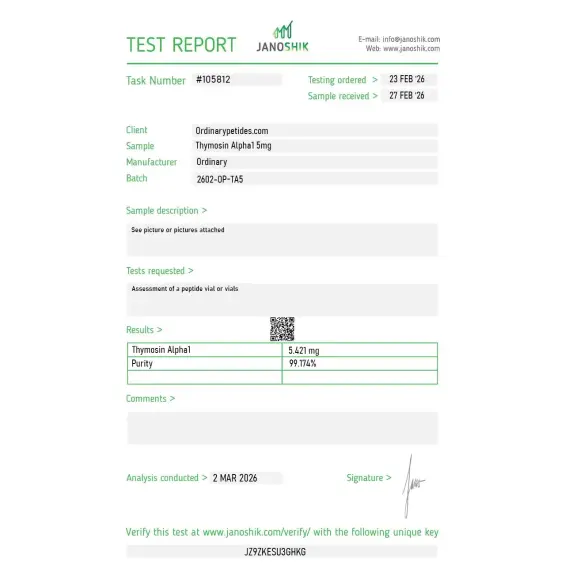
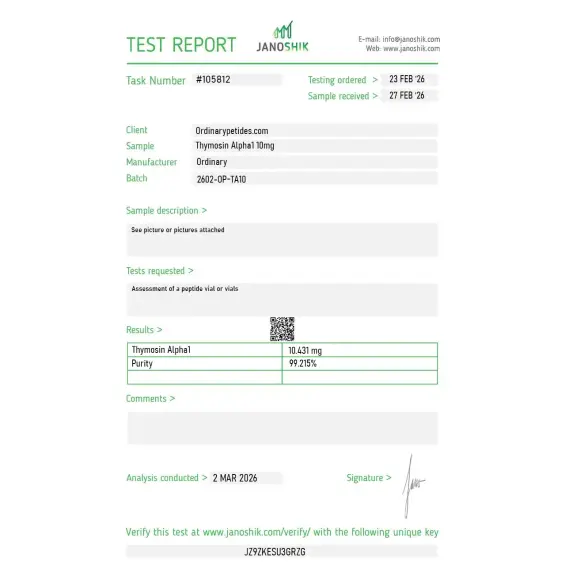
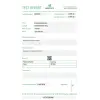
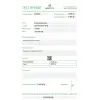
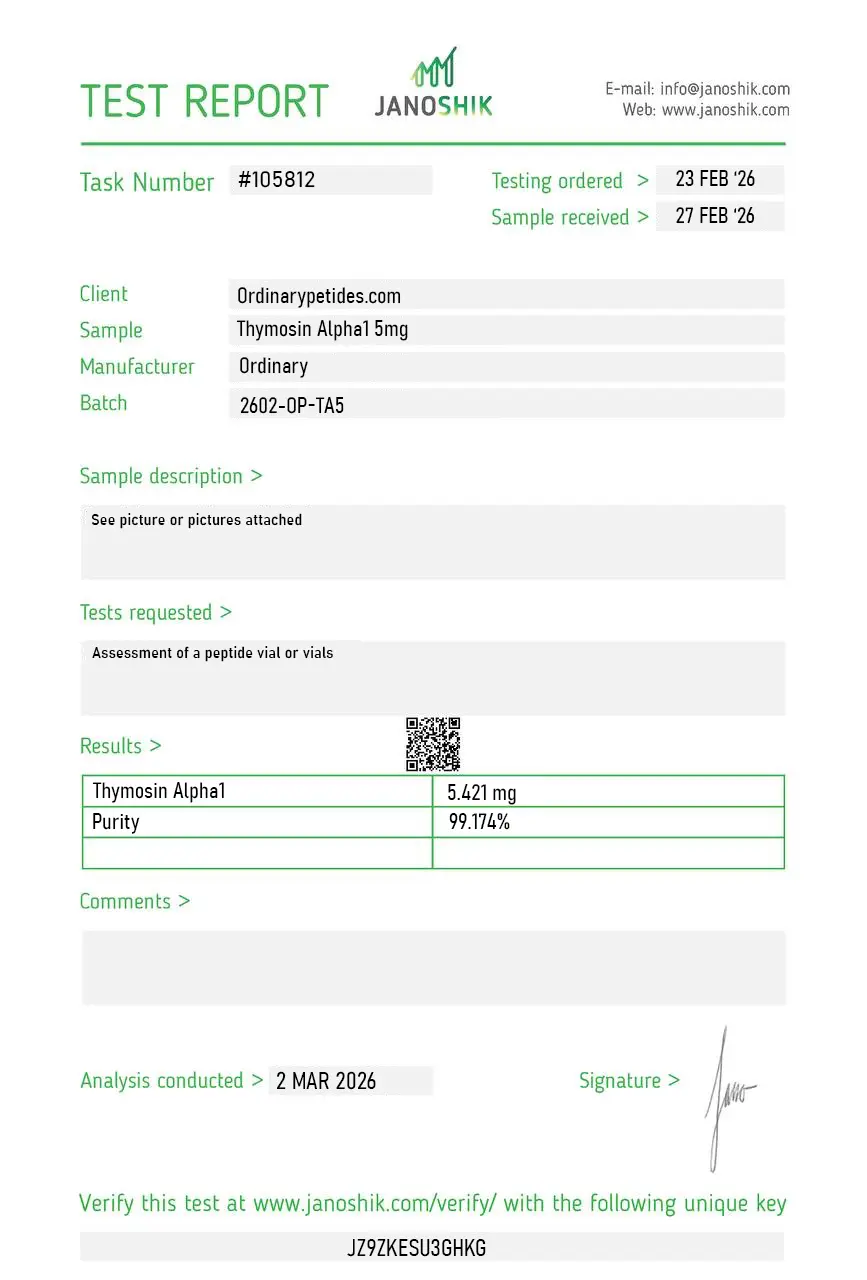
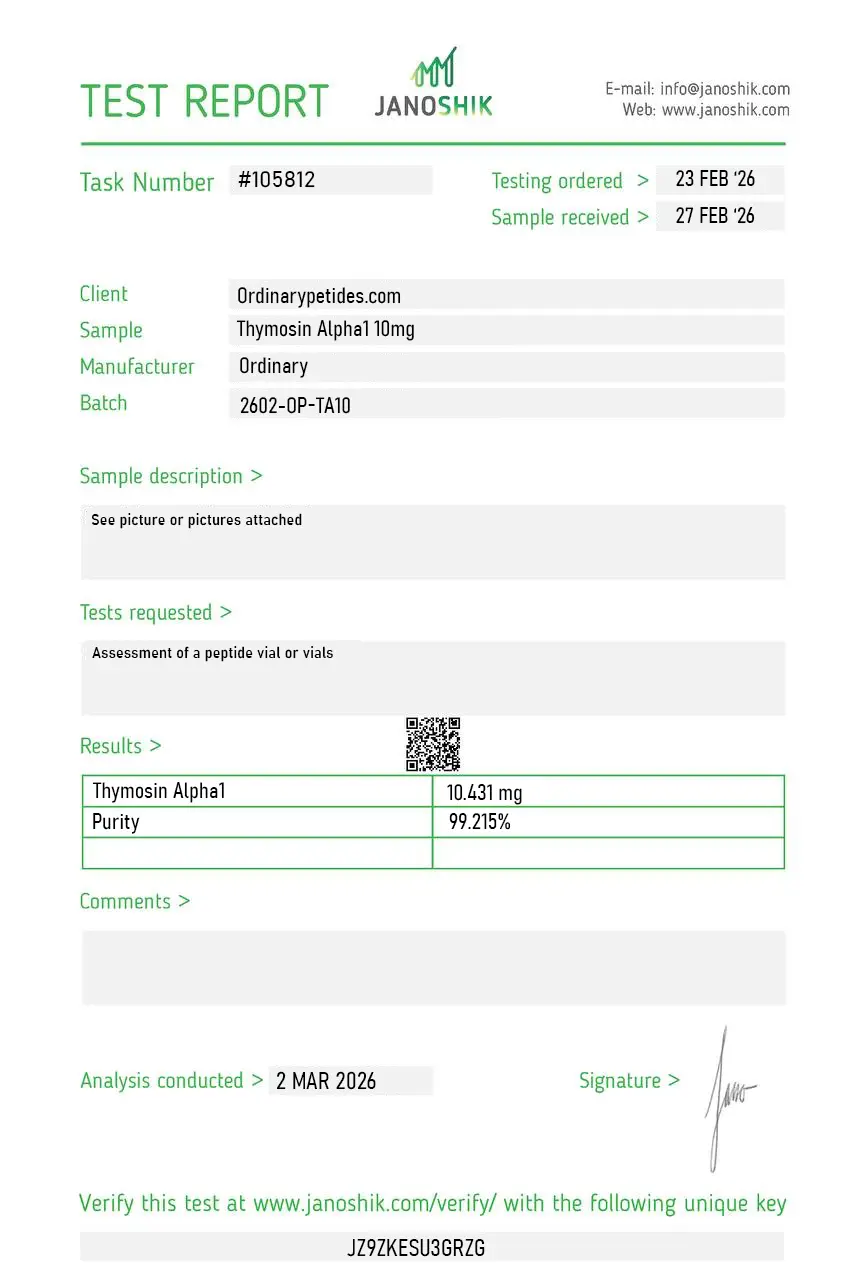
Independent test reports are available for Thymosin Alpha-1 5mg and Thymosin Alpha-1 10mg. These reports provide batch-level documentation and analytical verification information for research reference.
Based on 2 reviews
5.0
-
2
Asked the lab next door whether they could lend us a milligram for one experiment when we ran low, and they couldn't because they'd just ordered from elsewhere and the material had visible inconsistencies vial-to-vial. We ordered fresh from this supplier instead, got it three days later, and the consistency was night-and-day. Sometimes the comparison only becomes obvious when you see a bad batch side-by-side with a good one.
The freeze-dried cake recovered fully when reconstituted, no residual material on the vial walls after the first dissolution. That clean recovery means our measured concentration actually matches what the vial says, which is the part most QC concerns about lyophilized peptides miss.
Thymosin Alpha-1 (Tα1) is a naturally occurring 28-amino acid peptide first isolated from calf thymus tissue in 1977. It is produced endogenously by the thymus gland and is one of the most clinically studied immune-modulating peptides available. Its synthetic form is called Thymalfasin and is sold under the brand name Zadaxin.
It potentiates T-cell-mediated immune responses by promoting the differentiation and maturation of T-cell progenitor cells, activating dendritic and natural killer cells, and stimulating cytokine production. It also modulates inflammation by balancing pro- and anti-inflammatory signals, and blocks steroid-induced apoptosis of thymocytes — preventing premature immune cell death.
Beyond hepatitis treatment, Tα1 has been used to enhance vaccine responses in the elderly, support cancer patients undergoing chemotherapy — particularly those with hepatocellular carcinoma, renal cell carcinoma, and non-small cell lung cancer — reduce mortality in sepsis, help manage autoimmune conditions such as rheumatoid arthritis and lupus, and support recovery from chronic viral infections including HIV. It was also used in China during the COVID-19 pandemic to help restore immune function in severely ill patients.
It is given as a subcutaneous injection, typically at doses between 1 mg and 1.6 mg. Dosing schedules vary by condition but commonly involve injections two to three times per week over cycles of several weeks to months. Consistency in timing is important for maintaining stable immune signaling.
Thymosin Alpha-1 is considered one of the safest peptides available. The most common side effects are mild injection site reactions such as redness, swelling, or temporary discomfort. Rare reports include fatigue, headache, gastrointestinal discomfort, and in very rare cases allergic reactions. Long-term toxicity studies in animals at high doses showed no drug-related adverse effects.
It should not be used by pregnant or breastfeeding women, individuals currently on immunosuppressive therapy, or those with active autoimmune conditions without first consulting a physician. People undergoing immunotherapy for cancer should also seek medical guidance before use, as combining immune-active agents requires careful oversight.