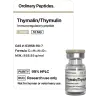
Thymalin/Thymulin
For in vitro testing and laboratory use only. Not for human or animal consumption. Bodily introduction is illegal. Handle only by licensed professionals. Not a drug, food, or cosmetic. Educational use only.
Thymalin / Thymulin: The Zinc-Activated Thymic Peptide That Keeps Researchers Interested
Thymulin is a natural thymic nonapeptide, and its standout feature is almost cinematic: without zinc it is just there, with zinc it becomes biologically active. In the research context, thymulin has been studied as a regulator of T-lymphocyte differentiation, and in preclinical models it was associated with anti-inflammatory and neuroendocrine effects.
Published observations also link its activity to zinc status, which is why thymulin often appears in discussions about immunity, aging, and thymic function.
At the same time, this is not a "ready-made solution" story: the molecule has a very short half-life, no FDA or EMA approval, and its clinical evidence in humans remains limited. That is exactly what makes it interesting for a thoughtful audience — not hype, but a well-characterized thymic peptide with real scientific intrigue.
If you are looking at peptides through a research lens, thymulin is one of those molecules that makes you want to read the footnotes, not just the headline.
Thymalin / Thymulin: A Scientific Review
Based on peer-reviewed literature — see References. Last updated: April 2026.
The Short Version: Two Related But Distinct Compounds
The terms “thymalin” and “thymulin” are used near-interchangeably in the community market, but they describe scientifically distinct things. The evidence base, regulatory status, and quality assurance are substantially different for each.
Thymulin (Facteur Thymique Sérique / FTS) is a specific, chemically defined nonapeptide hormone — one of the very few true thymic hormones — produced exclusively by thymic epithelial cells. Its sequence is Pyr-Ala-Lys-Ser-Gln-Gly-Gly-Ser-Asn. It is unique among thymic peptides in requiring zinc to be biologically active. Thymulin was discovered by Jean-François Bach in 1977, has a defined receptor-level mechanism, and can be synthesised as a pure, characterised peptide.
Thymalin is a polypeptide complex isolated from calf thymus glands — not a single defined molecule but a heterogeneous mixture of short peptides (2–8 amino acids), including thymulin as one component alongside dipeptides KE (Lys-Glu), EW (Glu-Trp), and tripeptide EDP (Glu-Asp-Pro). Thymalin was developed in the USSR in the 1970s and is approved in Russia as a pharmaceutical.
| At a glance — Thymalin | |
|---|---|
| Type | Polypeptide complex extracted from calf thymus |
| Composition | Heterogeneous mixture of short peptides (2–8 AA); includes thymulin, KE, EW, EDP |
| MW | 1,000–10,000 Da (heterogeneous) |
| Russian approval | ✅ Registered drug LS-000267, Feb 26, 2010 |
| FDA/EMA status | ❌ Not approved |
| At a glance — Thymulin | |
|---|---|
| Type | Defined natural nonapeptide; only true thymic hormone in circulation |
| Full name | Thymulin; formerly Facteur Thymique Sérique (FTS) |
| Sequence | Pyr-Ala-Lys-Ser-Gln-Gly-Gly-Ser-Asn |
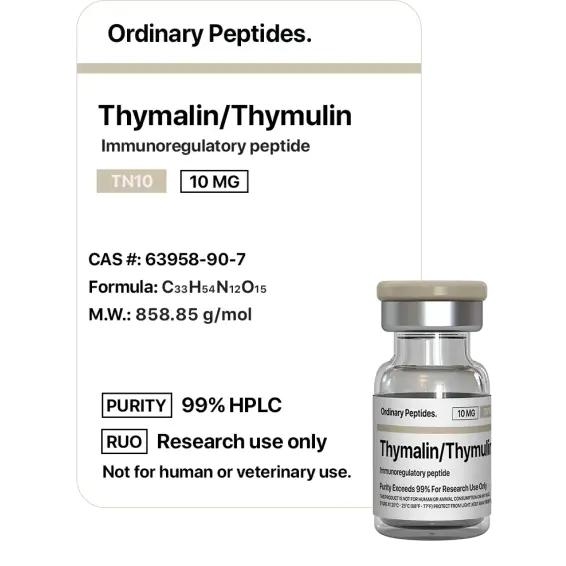
| MW | 858.86 Da |
| Discovery | Jean-François Bach (Hôpital Necker, Paris), 1977 |
| Special requirement | ⚠️ Zinc cofactor — biologically inactive without zinc |
| FDA/EMA status | ❌ Not approved |
The Thymus: Context for Both Compounds
The thymus is a bilobed lymphoid organ in the anterior mediastinum whose primary function is T-lymphocyte maturation — educating immature bone marrow precursors into mature CD4+ helper and CD8+ cytotoxic T-cells capable of recognising self-MHC while not attacking self-antigens.
Thymic function is age-dependent in a particularly striking way. The thymus reaches peak size in infancy/childhood; after puberty, progressive thymic involution begins — fatty replacement of functional thymic tissue. By age 40–50, thymic output of new naïve T-cells is dramatically reduced; by age 70+, residual function is a small fraction of youthful capacity. This involution is considered one of the primary drivers of immunosenescence — reduced vaccine responses, increased susceptibility to infections and cancer, and increased inflammatory tone (inflammaging). The thymic hormones (thymulin, thymosin alpha-1, thymosin beta-4, thymopoietin) are produced by thymic epithelial cells and decline with age in parallel with thymic involution. The central question both thymalin and thymulin research has pursued: can restoring thymic hormone activity in aging individuals reverse or compensate for immunosenescence?
Thymulin: The Molecular Details
Discovery
In 1977, Jean-François Bach and Marie Dardenne at the Hôpital Necker in Paris isolated a circulating thymic hormone from pig serum. Initially called FTS, thymulin is a metallopeptidic hormone selectively produced by thymic epithelial cells and known to induce intra- and extra-thymic T-cell differentiation. Its amino acid sequence was determined as pGlu-Ala-Lys-Ser-Gln-Gly-Gly-Ser-Asn — published in 1977 (Bach et al., Nature), enabling synthetic production and making thymulin one of the first thymic hormones to be chemically synthesised as a defined molecule.[1][2]
The zinc requirement: a unique feature
Thymulin’s zinc dependency is one of the most pharmacologically important and scientifically interesting features of the molecule. It is a nonapeptide whose biological activity is dependent on the presence of zinc, in an equimolecular ratio. The metallopeptide thus formed bears a specific tridimensional conformation detected by NMR studies, yielding a new monoclonal antibody-defined epitope.[3]
This means: thymulin without zinc (apothymulin) is biologically inactive and cannot bind its receptor or signal to T-cells. One zinc atom per thymulin molecule is required; zinc binding creates the specific 3D conformation that the thymulin receptor recognises. Two forms exist: apothymulin (zinc-free; inactive) and thymulin (zinc-bound; active).
The aging paradox: zinc, not production
A critical finding with major therapeutic implications: the age-related decline of thymulin was less pronounced than previously reported, showing still significant production in old age in both mice and humans. When thymic explants from old mice are cultured in vitro in zinc-enriched medium, thymulin secretion is similar to that from young-adult mice. Critically, the in vitro addition of zinc to plasma samples from old donors unmasks all thymulin molecules produced, and it is consistently at normal levels.[4]
This is a paradigm-shifting observation: aged thymic epithelial cells may continue to produce thymulin at near-normal levels, but the circulating hormone is inactive because systemic zinc deficiency with aging renders it unbound and inert. The functional deficiency may be more a zinc deficiency than a thymulin deficiency — with direct therapeutic implications.
Structure and N-terminal pyroglutamate
The N-terminal amino acid of thymulin is pyroglutamic acid (pGlu) — a cyclised form of glutamic acid formed by post-translational modification. This cyclisation protects the N-terminus from aminopeptidase degradation, contributes to zinc-binding geometry, and is required for full biological activity (N-terminal modifications abolish function).
Mechanism of action
Thymulin’s biological activities are mediated through its receptor on T-lymphocyte precursors and mature T-cells. Documented effects include inducing T-cell differentiation markers on bone marrow precursors (converting immature cells to T-cell lineage); promoting expression of T-cell surface markers (CD2, CD3, CD4, CD8, TCR); enhancing T-cell cytotoxic and NK cell function; bidirectional neuroendocrine interactions with the hypothalamic-pituitary axis (thymulin follows circadian rhythms and responds to ACTH); and a second dimension of anti-inflammatory and anti-nociceptive effects identified in the past two decades, including reduction of substance P, CGRP, IL-1β, TNF-α, and IL-6 in inflammatory pain models and rodent models of neuroinflammation.
Age-related thymulin levels
Circulating thymulin levels follow a characteristic age trajectory: undetectable before puberty; peaking in adolescence/early adulthood; declining progressively from ~30 years; near-undetectable in subjects over 60. As noted above, much of the circulating “thymulin” in older people is inactive apothymulin due to zinc deficiency. Zinc nutritional status is therefore a key confounder in any assessment of thymulin function in aging.
Thymalin: The Polypeptide Complex
Thymalin was developed in the early 1970s at the Institute of Experimental Pathology, Oncology and Radiobiology of the National Academy of Sciences of Ukraine and the USSR Institute of Gerontology (under Professor V.G. Morozov), with later extensive work by Vladimir Khavinson at the St. Petersburg Institute of Bioregulation and Gerontology. It is a calf thymus extract — a mixture of thymic peptides and protein fragments produced by partial digestion and purification of thymus tissue. Active fractions include thymulin, KE (Lys-Glu), EW (Glu-Trp), and EDP (Glu-Asp-Pro).
The molecular mechanism of Thymalin’s immunoprotective action is due to the effects of the short peptides KE, EW, EDP in its composition. These short peptides can specifically bind to double-stranded DNA and/or histone proteins and regulate gene expression, synthesis of immune system proteins, activity of gerontogenes, and stimulate stem cell differentiation — a distinct mechanism from thymulin’s receptor-mediated immunology.
Thymalin received Russian Ministry of Health registration in 2010 (LS-000267). It has been used clinically in Russia for decades before formal registration, in immunodeficiency, post-surgical recovery, cancer treatment support, and geriatric care, administered as intramuscular or subcutaneous injections.
Clinical Evidence
The foundational geroprotection study (Khavinson et al.)
The most frequently cited evidence: a long-term observational study in 266 elderly persons over 6–8 years in which thymalin (and Epithalamin) were applied for the first 2–3 years. The results showed normalisation of cardiovascular, endocrine, immune, and nervous system function; a 2.0–2.4-fold decrease in acute respiratory disease incidence; reduced incidence of ischaemic heart disease, hypertension, osteoarthrosis, and osteoporosis; and a 2.0–2.1-fold decrease in mortality rate in the thymalin group. A separate group treated annually for 6 years with both thymalin and Epithalamin showed a 4.1-fold mortality decrease.[6]
⚠️ A 2–4-fold reduction in elderly mortality would, if reproducible, represent one of the most important interventions in geriatric medicine. The caveats are substantial: Russian observational study; conducted at institutions with commercial interest in the compounds; no independent international replication; methodology not reported at RCT quality; control group characteristics unclear. The finding generates hypotheses; it does not constitute proof.
COVID-19 supportive therapy
Patients administered thymalin against the background of standard therapy (N=36) showed more rapid clinical improvement, higher proportions of recovery from lymphopenia, faster normalisation of C-reactive protein, and faster recovery of CD4+, CD3+HLA-DR+, B- and NK-cell subpopulations. These data are consistent with the biological plausibility of thymalin restoring lymphocyte populations depleted by COVID-19’s lymphotrophic effects.[7] This is clinical observation from a known enthusiastic proponent institution, not an RCT.
Evidence landscape summary
| Study type | Compound | Finding | Evidence quality |
|---|---|---|---|
| 6–8 year observational, N=266 elderly [6] | Thymalin ± Epithalamin | 2.0–4.1× mortality reduction | Very low (Russian observational; not replicated) |
| COVID-19 case series, N=36 [7] | Thymalin | Faster lymphopenia recovery vs. standard of care | Very low (non-RCT; single institution) |
| Phase 1/2 immunodeficient children | Thymulin (FTS) | Improved cellular immunity markers | Low (1980s; no Phase 3 follow-up) |
| Zinc correction studies [4] | Thymulin | Restored thymulin activity in zinc-deficient animals and humans | Moderate; mechanistically important |
| Animal models (multiple) | Thymulin | T-cell differentiation, anti-inflammatory, analgesic | Strong preclinical |
The Zinc-Thymulin-Aging Connection: Clinical Implications
Zinc deficiency is common in the elderly — dietary inadequacy, reduced absorption, and increased urinary excretion all contribute. Zinc supplementation to restore serum zinc to the young-adult normal range has been shown in some studies to increase functional thymulin activity in older subjects. This means that ensuring adequate zinc nutrition might be a low-cost, safe way to restore a fraction of thymulin activity without requiring exogenous thymulin administration. It also implies that any exogenous thymulin administered to a zinc-deficient elderly person may remain partially inactive as apothymulin unless zinc is co-administered or zinc status is first corrected.
Comparison: Thymalin vs. Thymulin vs. Thymosin Alpha-1
| Feature | Thymalin | Thymulin | Thymosin Alpha-1 (Tα1) |
|---|---|---|---|
| Type | Polypeptide complex (crude extract) | Defined nonapeptide | Defined 28-AA peptide |
| Defined sequence | No (mixture) | Yes | Yes |
| MW | 1,000–10,000 Da (mixed) | 858.86 Da | 3,108 Da |
| Zinc required | Contains thymulin component (Zn-dependent) | Yes — inactive without Zn | No |
| Primary mechanism | Multiple (DNA/histone gene regulation via KE, EW, EDP + thymulin receptor) | T-cell differentiation via receptor; anti-inflammatory | T-cell, DC, NK activation; TLR signalling |
| Clinical evidence | Russian clinical programmes; geroprotection study | Early Phase 1/2 (1980s) | Approved in ~35 countries; multiple RCTs |
| Western regulatory status | ❌ Not approved | ❌ Not approved | Not approved (FDA); approved in Asia |
Safety Profile
Thymalin: The Russian clinical experience spanning decades reports thymalin as well-tolerated, with mild injection site reactions as the most common adverse effect. No systemic organ toxicity has been reported in decades of clinical use. Immune stimulation theoretically risks worsening autoimmune conditions; used with caution in autoimmune disease contexts. No pregnancy safety data; not recommended in pregnancy. The long Russian clinical experience is reassuring for short-term safety but reflects unsupervised pharmacovigilance from a country with less rigorous adverse event reporting requirements than the FDA/EMA framework.
Thymulin: No human toxicity data from modern trials. Historical Phase 1/2 showed acceptable safety in immunodeficient children. As a zinc-containing metallopeptide, one zinc atom per molecule means the absolute zinc delivered is very small. No carcinogenicity or reproductive toxicity studies published at adequate scale.
Common Misconceptions
“Thymalin and thymulin are the same thing.”
They are related but distinct. Thymulin is a specific nonapeptide with a defined sequence and zinc requirement. Thymalin is a heterogeneous polypeptide complex from calf thymus, of which thymulin is one component. Products sold as “thymalin” in the research chemical market may contain synthetic thymulin, the crude extract, or something else entirely — quality assurance cannot be assumed.
“Thymalin can reverse thymic involution.”
Thymic involution is a structural process of fatty tissue replacement occurring over decades. Thymalin can stimulate residual thymic function and restore activity of existing thymic epithelial cells, but it cannot reverse anatomical involution that has already occurred. The distinction between “restoring function of remaining thymic tissue” and “regenerating involuted thymus” is important.
“The geroprotective mortality data is strong evidence.”
⚠️ The 2.0–4.1-fold mortality reduction reported by Khavinson et al. would be extraordinary if real, but the study design falls far below contemporary evidence standards — single group of investigators, commercial interests, no independent replication, unclear control group characteristics. It generates hypotheses; it does not constitute proof.
Frequently Asked Questions
Why hasn’t thymulin been developed as a drug despite 50 years of research?
Thymulin’s clinical development faced structural barriers: it was championed primarily by Soviet/Russian academic institutions without the commercial infrastructure for international regulatory submissions; the primary indication (immunosenescence/aging) lacks an FDA-accepted regulatory pathway; and early Phase 1/2 data was never followed up with adequately powered Phase 3 trials. The contrast with thymosin alpha-1 — which was brought through clinical development in Asia via institutional investment — illustrates what can be achieved with the right commercial backing.
Is correcting zinc deficiency a substitute for thymulin supplementation?
In older adults whose functional thymulin deficiency is primarily zinc-dependent, zinc supplementation to restore serum zinc may substantially restore thymulin bioactivity without requiring exogenous peptide. Practically: zinc repletion is cheap, safe, and well-studied; its effects on immune function in zinc-deficient elderly are documented. It should be considered before or alongside any thymulin supplementation.[4]
What is the relationship between thymalin and Khavinson peptides?
Vladimir Khavinson’s broader programme at the St. Petersburg Institute of Bioregulation and Gerontology has extended the thymalin concept to many other organ-specific peptide bioregulators (pineal, bone marrow, adrenal, etc.), collectively called “peptide bioregulators.” Thymalin was the first and remains the flagship. The short active peptides (KE, EW, EDP) identified in thymalin have been studied as independent compounds. Epithalon (Epitalon), the pineal bioregulator in the programme, is covered separately in this series.
Key Takeaways
- Thymalin and thymulin are related but distinct. Thymalin is an undefined calf thymus extract mixture; thymulin is the specific, chemically characterised nonapeptide that is the primary circulating thymic hormone. The community conflates them; the distinction matters for quality assurance, mechanism, and evidence attribution.
- ⚠️ Thymulin’s zinc dependency is a defining and clinically important feature. The compound is biologically inactive without zinc, and much of the functional thymulin deficiency in aging appears to reflect zinc deficiency rather than reduced thymulin production. Zinc nutritional status is a critical confounder in any thymulin supplementation context.[3][4]
- ✅ Thymalin has genuine regulatory legitimacy in Russia based on decades of clinical use and formal Ministry of Health registration (LS-000267, 2010). The evidence base is real but methodologically limited for Western regulatory standards.
- ⚠️ The geroprotection mortality data demands replication but cannot be dismissed. A 2–4-fold reduction in elderly mortality over 6–8 years would be transformative if independently confirmed. That this has not occurred in Western populations over the 20+ years since publication is a major scientific gap.[6]
- No thymulin or thymalin product is approved by any Western regulatory authority. The Russian approval for thymalin is meaningful but does not substitute for FDA or EMA review, which requires randomised, placebo-controlled, blinded trials that have not been conducted for either compound in Western settings.
References
Thymulin Discovery and Characterisation
- Bach JF, Dardenne M, Pleau JM, Rosa J. Biochemical characterisation of a serum thymic hormone. Nature. 1977;266(5597):55–57.
- Pleau JM, Dardenne M, Blouquit Y, Bach JF. Structural study of circulating thymic factor: a peptide isolated from pig serum. II. Amino acid sequence. Journal of Biological Chemistry. 1977;252(22):8045–8047.
- Dardenne M, Savino W, Berrih S, Bach JF. A zinc-dependent epitope on the molecule of thymulin, a thymic hormone. Proceedings of the National Academy of Sciences USA. 1985;82(20):7035–7038. PMC2364880
- Interactions between zinc and thymulin. PMC2364880. 2008.
Thymalin Clinical Evidence
- Reviews of thymic peptides and hormones: from properties to clinical application. International Journal of Peptide Research and Therapeutics. 2024.
- Khavinson VK, Morozov VG. Peptides of pineal gland and thymus prolong human life. Neuro Endocrinology Letters. 2003;24(3-4):233–240. PMID 14523363
- Peptide drug thymalin regulates immune status in severe COVID-19 older patients. Advances in Gerontology. 2021. PMC8654498
- Thymic peptides in immune reconstitution and clinical outcome after allogeneic haematopoietic cell transplantation. Blood Neoplasia. 2025;2(2):100090.
Key Investigators
- Jean-François Bach, MD, PhD — Hôpital Necker-Enfants Malades, Paris; Académie des Sciences member; discoverer of FTS/thymulin (1977) with Marie Dardenne; characterised zinc dependency and receptor biology.
- Marie Dardenne, PhD — Institut Necker, Paris; primary co-investigator with Bach on thymulin zinc dependency, aging biology, and immunological characterisation.
- Vladimir G. Morozov, PhD and Vladimir Kh. Khavinson, MD, PhD — St. Petersburg Institute of Bioregulation and Gerontology; original developers of thymalin and the broader peptide bioregulator programme.
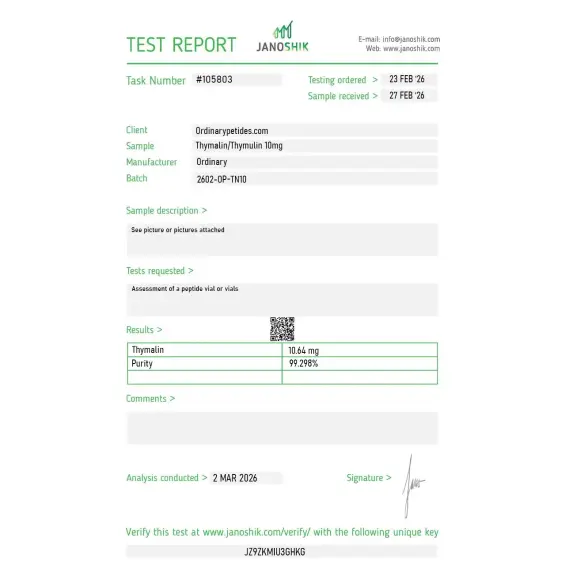
Certificate of Analysis
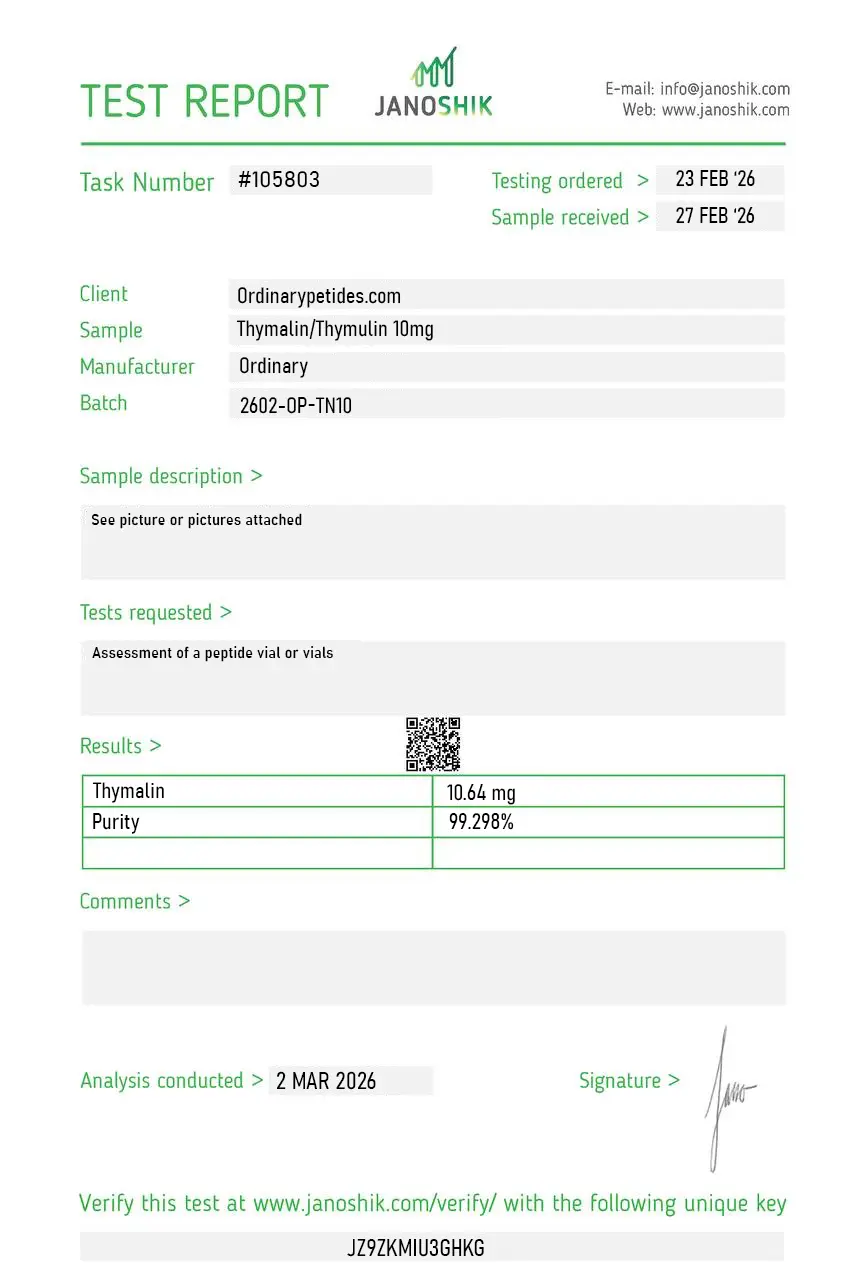
An independent test report is available for Thymalin / Thymulin 10mg. This report provides batch-level documentation and analytical verification information for research reference.
Based on 1 reviews
5.0
-
1
Tested it without supplementing zinc in the buffer first, just to see how dependent the activity actually is — and the result was meaningfully reduced compared to the same conditions with ZnCl₂ added back. The Bach and Dardenne characterization of zinc-dependence wasn't theoretical for our preparation; the compound genuinely requires the metal cofactor for full activity in vitro. Useful confirmation that the published mechanism holds.
Thymalin is a polypeptide complex extracted from the thymus gland of young calves, while Thymulin is a naturally occurring nonapeptide produced by the thymus gland itself. The two names are often used interchangeably, though strictly speaking Thymulin refers to the endogenous hormone and Thymalin to the broader multi-peptide extract. Both regulate immune function and are closely linked to T-cell development.
Thymalin stimulates the thymus gland to produce and differentiate T-lymphocytes, restoring immune balance. At the molecular level it regulates gene expression, cytokine production, heat-shock protein synthesis, and cell apoptosis. Thymulin specifically requires zinc to be biologically active and follows a circadian rhythm tied to the neuroendocrine system.
The primary benefits are immune restoration, anti-aging effects, and reduced inflammation. It helps restore T-cell counts and activity, lowers pro-inflammatory cytokines like TNF-α and IL-6, supports bone marrow and blood cell production, and has shown geroprotective effects — slowing age-related immune decline in elderly patients.
It is not FDA-approved for human therapeutic use in the United States. However, it has been approved for medical use in Russia since the 1980s and has been clinically used for over 40 years in Russia and Eastern Europe, with studies involving thousands of patients across immune deficiency, chronic infections, and aging-related conditions.
It is typically given as an intramuscular or subcutaneous injection, usually in short cycles of 5 to 10 days. Dosages in research range from 0.5 to 5 mg per day depending on the intended use. It is often combined with other bioregulator peptides such as Epitalon.
Research reports practically no side effects even with long-term use, which is considered one of its defining features. However, because it is not FDA-approved and most data comes from Eastern European studies, individuals with active autoimmune conditions, cancer, or those who are pregnant should consult a qualified physician before use.