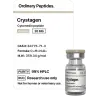
Crystagen
For in vitro testing and laboratory use only. Not for human or animal consumption. Bodily introduction is illegal. Handle only by licensed professionals. Not a drug, food, or cosmetic. Educational use only.
Crystagen (EDP): A Small Peptide With Major Research Interest in Immune Aging
Crystagen is a thymus-targeted tripeptide, EDP, from the Khavinson bioregulator family, studied in research contexts as a molecule associated with the immune system and age-related changes in the thymus. In published observations and preclinical data, it has been linked to preservation of thymic structure, activation of B cells in the spleen, and changes in T-cell markers, including CD3+, CD4+, and the CD4+/CD8+ ratio.
In a clinical observation cited in the review, adding Crystagen to standard therapy was associated with more frequent normalization of the immunogram in elderly patients compared with standard therapy alone. It is also notable that in experimental models, EDP showed activity not only at the level of immune cells, but also in scenarios related to gene expression, thymic architecture, and the cellular stress response.
So this is not simply "another peptide," but rather a subject that appears especially intriguing in the study of immune aging. For those interested in thymic peptides, immunosenescence, and the broader logic of short peptide bioregulators, Crystagen is a very strong candidate for closer attention.
Crystagen (Synthesised Immune System Peptide Bioregulator): A Scientific Review
Based on peer-reviewed literature and available product documentation — see References. Last updated: April 2026.
Preliminary Note: The Identity Problem
| At a glance | |
|---|---|
| Commercial name | Crystagen® |
| Type | Synthesised peptide complex (Cytogen class) |
| Proposed amino acids | Variable by source: Arg-Glu-Asp (AC-5); or Pro-Gln-Asn; Khavinson 2021 review: KEDP studied |
| Primary proposed target tissue | Immune system (thymus-derived; spleen and immune organs) |
| Proposed mechanism | Chromatin/DNA interaction → gene expression modulation in immune cells |
| Developer | St. Petersburg Institute of Bioregulation and Gerontology (Khavinson) |
| FDA/EMA status | ❌ Not approved as drug; sold as dietary supplement |
| Human clinical data | Referenced but not published as RCT |
| WADA | Not prohibited |
Context: The Khavinson Immune Bioregulator Family
To understand Crystagen, it is essential to understand its relationship to the other immune-targeted products in the Khavinson series. Understanding which product is which prevents significant confusion in this product family.
Thymalin (natural extract / Cytomax): A polypeptide complex extracted from calf thymus — a heterogeneous mixture of short peptides. Thymalin is the foundational immune bioregulator with the longest clinical use history and the most published data, including the Khavinson elderly cohort study (N=266) showing claimed mortality reduction. A registered pharmaceutical in Russia.
Vladonix (natural extract / Cytomax): The commercial dietary supplement form of the thymus polypeptide complex, equivalent in principle to Thymalin but formulated as a food supplement.
Vilon (Lys-Glu / KE): The synthetic dipeptide derived from amino acid analysis of Thymalin. Has a PubMed-indexed published study on tumour inhibition and lifespan extension in mice.
Thymogen (Glu-Trp / EW): Another synthetic thymic fragment dipeptide. Separate published clinical use in Russia for immune support.
Crystagen: The third synthesised immune peptide, positioned alongside Vilon and Thymogen as a complementary synthetic Cytogen derived from thymic tissue analysis. As stated in the Khavinson system: Vilon is only one of the three components of Thymalin; the monopeptides Crystagen and Thymogen are also effective drugs. Its exact sequence is less clearly defined in the published literature than Vilon (KE) or Thymogen (EW).
Proposed Mechanism
The mechanism is identical in framework to all Khavinson Cytogen peptides — direct chromatin/DNA interaction, nuclear penetration, and gene expression modulation — described in detail in the Cardiogen and Cortagen articles in this series. For Crystagen specifically, the proposed tissue specificity is immune cells: thymocytes (T-cell precursors in the thymus), splenic lymphocytes (B-cells and T-cells in the spleen), and macrophages.
Thymic gene expression restoration: With ageing, the thymus undergoes progressive involution — it shrinks, produces fewer naive T cells, and becomes less able to support T-cell maturation. Crystagen is proposed to restore gene expression patterns in thymic epithelial cells that support thymocyte development, partially reversing age-related thymic decline. T-cell and B-cell activation: Short thymic peptides activate T-lymphocytes by increasing intracellular calcium concentrations in thymocytes and macrophages, and enhance expression of surface receptors on T- and B-lymphocytes. IL-2 upregulation: Similar to Cortagen, Crystagen is described as stimulating IL-2 mRNA expression in immune cells.
The 2021 Khavinson systematic review in Molecules explicitly notes that the short peptides KE, AEDG, and KEDP — containing a mixture of acidic and basic amino acid residues — affect the melting temperature and double-stranded DNA stability, confirming that KEDP (associated with Crystagen or related sequences) has been studied for direct DNA interaction consistent with the general Khavinson peptide-DNA binding hypothesis.[2]
Published Evidence for Crystagen Specifically
Crystagen’s specific evidence base is thinner than Cardiogen or Cortagen, with fewer individually attributable publications.
Spleen and immune ageing study (Chervyakova et al., 2014): A St. Petersburg group study examining molecular aspects of Crystagen’s immunoprotective activity in splenic tissue during ageing, published in Advances in Gerontology. PMID 28976144. The study found modulation of cellular markers in spleen lymphocyte populations consistent with immune supportive effects; specific quantitative findings are not accessible in the English abstract.[1]
DNA interaction studies (Khavinson systematic review, 2021): The KEDP peptide (associated with Crystagen or related sequences) is explicitly characterised in the Molecules 2021 systematic review for DNA double-strand stability effects — part of the broader characterisation of Khavinson peptide-DNA interactions.[2]
Radiation protection model: Product documentation references animal studies showing Crystagen protected thymic cells from gamma radiation damage — an accelerated ageing model, where ionising radiation induces premature thymic involution. Protection against radiation-induced thymic damage would be consistent with thymus-targeting activity.
Clinical study (manufacturer-referenced, unpublished as RCT): A clinical study is referenced establishing effectiveness of Crystagen in complex treatment of patients with impaired immune function after infectious diseases, radiation and chemotherapy, psycho-emotional stress, and adverse environmental factors, and in maintaining immune function in elderly people. This study has not been published as a systematic, randomised, placebo-controlled trial in a widely indexed journal. Its methodology, patient numbers, endpoints, and statistical analysis are not available for independent evaluation.[5]
What Crystagen Is NOT: Critical Clarifications
Not Visoluten (the retina bioregulator)
Some sources describe a “Crystagen” for eye health and cataract prevention. This is likely based on the name similarity between “Crystagen” and “crystallin” (the lens proteins whose aggregation causes cataracts). The primary Crystagen product from the Khavinson institute is an immune system peptide unrelated to lens crystallins. The Khavinson eye bioregulators are Visoluten (A-11, the retina Cytomax) and Normoftal (synthetic retinal peptide), not Crystagen.
Not Thymalin (the full thymic extract)
Crystagen is a synthetic Cytogen — a defined synthetic peptide. Thymalin and Vladonix are natural Cytomaxes — heterogeneous extracts from calf thymus containing hundreds of different short peptides. Crystagen is described as capturing a specific active fragment from that extract in pure synthetic form. Thymalin’s evidence base, despite being a heterogeneous extract, is the strongest in the Khavinson immune series. Crystagen’s synthetic purity is a pharmaceutical quality advantage, not necessarily an efficacy advantage.
Not Thymogen (EW) or Vilon (KE)
These are the two better-characterised synthetic thymic Cytogens. Thymogen is Glu-Trp (EW); Vilon is Lys-Glu (KE). Crystagen is the third component of the thymic synthetic peptide family with less characterised sequence information in the accessible literature.
Comparison with the Thymic Peptide Family
| Product | Type | Sequence | Evidence tier |
|---|---|---|---|
| Thymalin | Natural extract | Polypeptide complex from calf thymus | Khavinson 6–8 year cohort (N=266); Russian pharmaceutical |
| Vladonix (A-6) | Natural extract (supplement) | Same as Thymalin | Clinical use claims; supplement |
| Vilon (KE) | Synthetic (Cytogen) | Lys-Glu | PubMed study: tumour inhibition + lifespan extension in mice |
| Thymogen (EW) | Synthetic (Cytogen) | Glu-Trp | Published clinical use in Russia; immunostimulatory data |
| Crystagen | Synthetic (Cytogen) | Uncertain (Arg-Glu-Asp or KEDP variant) | Spleen study 2014; DNA interaction; manufacturer-referenced clinical claim |
Within this family, Crystagen is the least well-characterised in terms of accessible English-language peer-reviewed publications with specific quantitative data.
Crystagen in the Broader Khavinson Stacking System
Crystagen appears across multiple Khavinson stacking recommendations for different organ systems, which contributes to the identity confusion but also reflects the framework’s view that immune function is central to the health of every tissue: Immune system primary stack (Crystagen + Vesugen + Ovagen); Locomotor apparatus (Cartalax + Vesugen + Crystagen); Digestive system (Ovagen + Vesugen + Crystagen); Respiratory system (Chonluten + Crystagen + Vesugen); Vascular system (Vesugen + Crystagen). The recurring presence of Crystagen across so many organ system stacks reflects both the genuine cross-tissue relevance of immune function and the Khavinson commercial framework’s encouragement of multi-peptide combination use with immune support as a universal component.
Common Misconceptions
“Crystagen targets the crystallins in the eye lens.”
The name resemblance is misleading. The primary Crystagen product from the Khavinson series is an immune system Cytogen derived from thymic tissue analysis. Retinal and lens health in the Khavinson system are addressed by Visoluten (retina Cytomax) and Normoftal (synthetic retinal peptide) — not by Crystagen.
“Clinical studies prove Crystagen works.”
The manufacturer references a clinical study. That study has not been published as a randomised, placebo-controlled trial with independent monitoring in a widely indexed journal. Its claims cannot be independently evaluated.
“Crystagen is better than Thymalin because it’s synthetic and purer.”
The Cytogen/Cytomax distinction is more nuanced than “synthetic = better.” Thymalin’s evidence base is the strongest in the Khavinson immune series, despite being a heterogeneous extract. Crystagen’s synthetic purity is a pharmaceutical quality advantage, not necessarily an efficacy advantage if the broader sequence context of the full extract contributes to Thymalin’s effects.
Key Takeaways
- Crystagen is the immune system Cytogen in the Khavinson bioregulator family — a synthetic peptide complex derived from amino acid analysis of thymic tissue, designed to complement or replicate the immune-supporting properties of Thymalin. Its exact sequence is inconsistently specified across sources.
- ⚠️ The identity of “Crystagen” is genuinely confused in the market. The name is applied to at least two distinct product concepts (immune system Cytogen and lens/cataract-related peptide) and appears in musculoskeletal stacking protocols inconsistent with either description. Users should verify what they are purchasing from any specific source.
- ⚠️ The evidence base is the thinnest of the three Khavinson bioregulators reviewed in this series (Cardiogen, Cortagen, Crystagen). No PubMed-indexed animal study with quantified primary endpoints is available for Crystagen in the way that the sciatic nerve regeneration study is for Cortagen.[1]
- The immune biology context is legitimate. Age-related thymic involution is a real and well-documented phenomenon with significant consequences for immune competence in older adults. A compound that restored gene expression in thymic tissue to more youthful patterns would have genuine biological value. Whether Crystagen achieves this remains undemonstrated by independent evidence.
- ⚠️ The same epistemic constraints apply as to all Khavinson bioregulators. Single research group provenance, absence of independent replication, no Western regulatory review, and no published RCT — these are the defining limitations of the Crystagen evidence base.
References
Primary Crystagen / Immune Peptide Publications
- Chervyakova NA, Linkova NS, Chalisova NI, Koncevaya EA, Trofimova SV, Khavinson VK. Molecular aspects of immunoprotective activity of peptides in spleen during the ageing process. Advances in Gerontology (Uspekhi Gerontologii). 2014;27(1):224–228. PMID 28976144 [Russian]
Khavinson Systematic Review (Mechanism Context)
- Khavinson VKh, Popovich IG, Linkova NS, Mironova ES, Ilina AR. Peptide regulation of gene expression: a systematic review. Molecules. 2021;26(22):7053. doi:10.3390/molecules26227053 (KEDP and related sequences characterised for DNA interaction)
Related Thymic Peptide Research
- Khavinson VKh, Anisimov VN, et al. A synthetic dipeptide vilon (L-Lys-L-Glu) inhibits growth of spontaneous tumors and increases life span of mice. Experimental Oncology. 2000. (Vilon/KE PubMed-indexed lifespan study — Crystagen’s closest related published compound)
- Linkova NS, Polyakova VO, Trofimov AV, Kvetnoy IM, Khavinson VK. Peptidergic regulation of thymocyte differentiation, proliferation, and apoptosis during aging of the thymus. Bulletin of Experimental Biology and Medicine. 2011;151(2):239–242.
Product Documentation
- Crystagen® usage documentation and clinical study reference. St. Petersburg Institute of Bioregulation and Gerontology affiliated distributors (peptideproduct.com, vita-stream.com, qisupplements.com). Clinical study claim referenced without systematic publication.
Thymalin Context
- See Thymalin/Thymulin article in this series for the Khavinson immune series foundational data, including the N=266 elderly cohort mortality reduction claim.
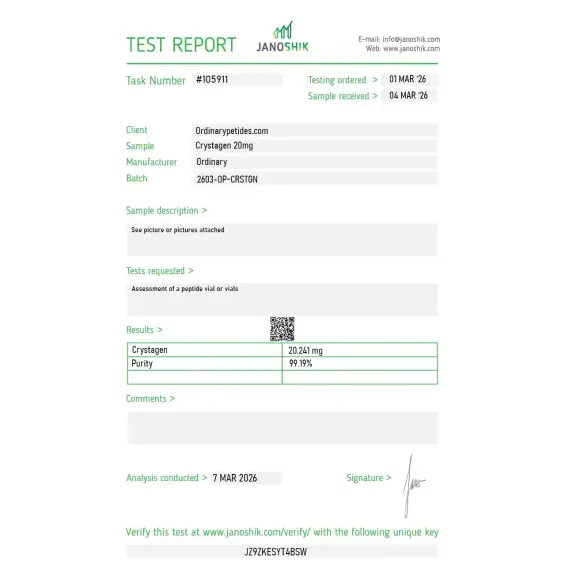
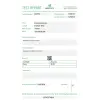
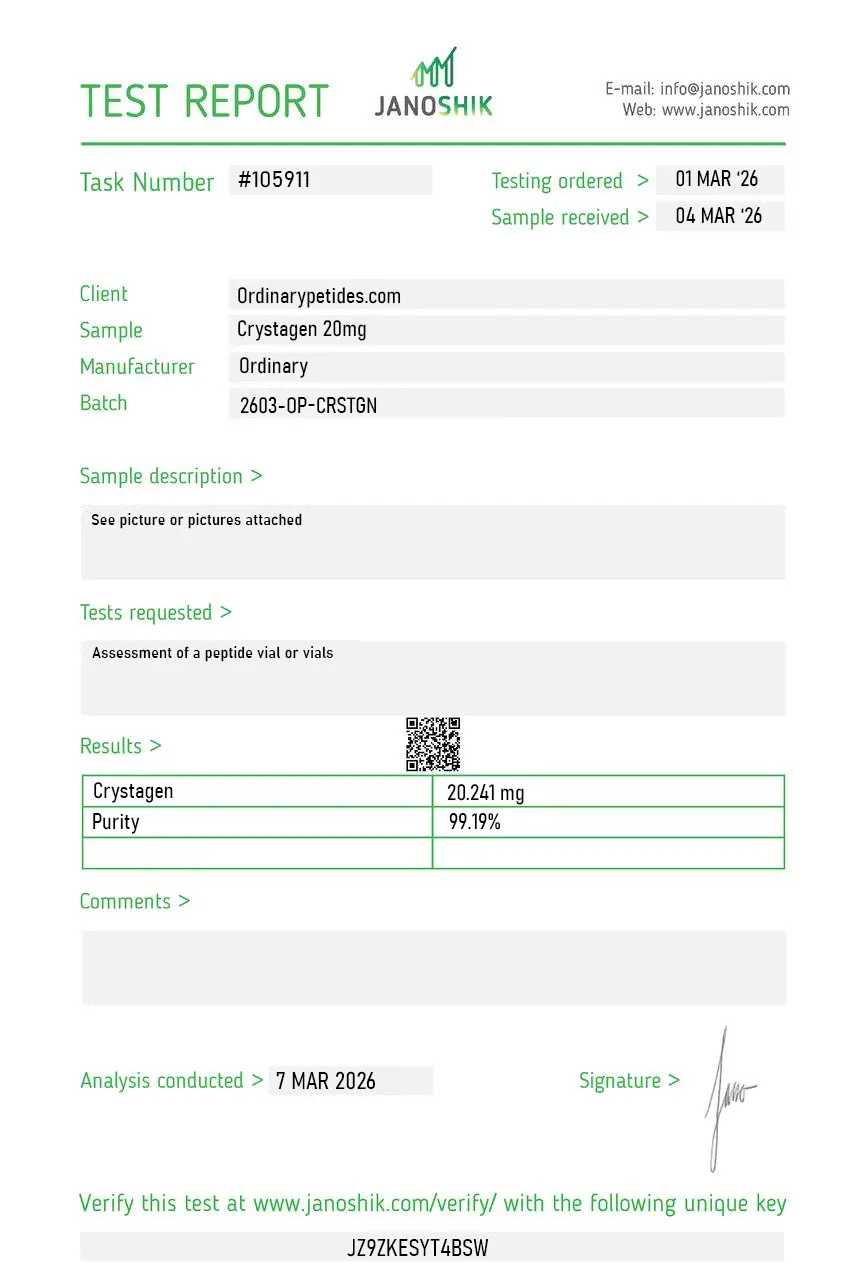
Certificate of Analysis
An independent test report is available for Crystagen 20mg. This report provides batch-level documentation and analytical verification information for research reference.
Based on 1 reviews
5.0
-
1
Crystagen is the immunomodulator entry in the Khavinson tetrapeptide series — EWND sequence, thymic-tissue-specific positioning in the tradition. The listing handles the academic framing reasonably, but the evidence depth for this specific peptide is even thinner than for Epitalon or Thymalin in my reading. Material itself was clean by MS.
Crystagen is a synthetic tripeptide bioregulator with the amino acid sequence Glu-Asp-Pro (EDP) — three amino acids derived from glutamic acid, aspartic acid, and proline. It was developed at the St. Petersburg Institute of Bioregulation and Gerontology by Professor Vladimir Khavinson and colleagues, isolated originally as an active component within Thymalin — the natural thymic extract. It is classified as an immune system-specific cytogen, designed to target and normalize immune function at the gene expression level. Unlike Thymalin and Thymulin which we covered earlier, Crystagen is the ultrashort synthetic distillation of that same immune-regulating activity into just three amino acids.
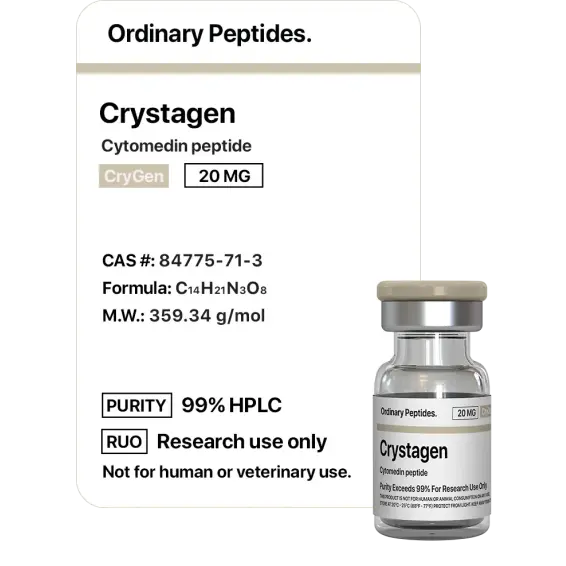
Crystagen operates epigenetically rather than through conventional receptor binding. Due to its ultrashort molecular weight of approximately 359 Da, it is actively transported into cells via peptide transporters and travels to the nucleus where it binds directly to DNA and histone targets. There it modulates the transcription of genes related to immune cell activity, heat-shock responses, and cell cycle control. In aged lymphocytes it promotes heterochromatinization — a process of chromatin reorganization that helps restore a more youthful gene expression profile. It stimulates proliferation of thymic epithelial cells, activates macrophage cytokine secretion including IL-1, IL-6, and TNF-α, and activates B-cell immunity. Importantly it also inhibits proliferation of certain tumor cell lines, suggesting selective pro-apoptotic activity in abnormal cells.
The primary benefit is immune system normalization and restoration. In a clinical study of elderly patients with impaired immunity, Crystagen combined with standard treatment normalized the immunogram in 82% of patients compared to 56% in the control group. It showed particular strength in restoring T-cell immunity — increasing CD3+ and CD4+ cells and normalizing the CD4+/CD8+ ratio. In an accelerated aging model using gamma-irradiated rats, it preserved the thymic cortex-medulla architecture typically lost with aging and stimulated thymocyte proliferation. Additional benefits include reduced incidence of respiratory viral infections in athletes, reduced severity of asthenic syndrome accompanying immunodeficiency, and improved stress resilience. Long-term use of bioregulators in this class has been associated with mean lifespan increases of 20 to 40% in animal studies.
All three target the immune system and thymic function, but at different levels of complexity. Thymalin is a broad multi-peptide extract from calf thymus containing many active fragments. Thymulin is the naturally occurring thymic hormone requiring zinc for activation. Crystagen is the minimal synthetic distillation — just three amino acids — offering highly targeted, tissue-specific gene regulation with minimal off-target effects. Crystagen is considered more of a restoration tool for a compromised immune system, while Thymalin and Thymulin provide broader immunomodulatory support.
Crystagen is available in both oral capsule and sublingual drop forms, making it one of the more convenient bioregulators in this class. Standard oral dosing is 1 to 2 capsules once or twice daily with meals for one month, repeated every 3 to 6 months. Sublingual drops are taken 3 to 4 times daily before meals. An injectable research-grade lyophilized powder is also available. The St. Petersburg Institute recommends using synthetic peptides like Crystagen in early phases of a protocol, followed by natural peptide extracts for ongoing maintenance.
Crystagen has one of the cleanest safety profiles in the bioregulator class. Across decades of Russian clinical observational use, no significant side effects, allergic reactions, drug dependencies, or contraindications have been documented beyond individual component intolerance. Comprehensive long-term human clinical trial data in the Western framework is absent, but the available evidence from Russian research and user reports is consistently favorable.
It is contraindicated during pregnancy and breastfeeding due to the absence of safety data in these populations. People with known intolerance to any of its components should avoid it. Those with active autoimmune conditions or on immunosuppressive therapy should consult a physician before use, as its immune-stimulating properties could theoretically interact with immunosuppressive regimens. As with all bioregulators in this series, it is not FDA-approved and use outside formal research or clinical settings should be under qualified medical supervision.