BPC-157 vs TB-500: Differences, Evidence, Safety, and FDA/WADA Status
Reading Time: 14 mins
Science & Medicine BPC-157 TB-500 FDA/WADA
Peptide Comparison Report BPC-157 vs TB-500: Differences, Evidence, Safety, and FDA/WADA Status Based on peer-reviewed literature and current regulatory records — see References. Last updated: June 2026.
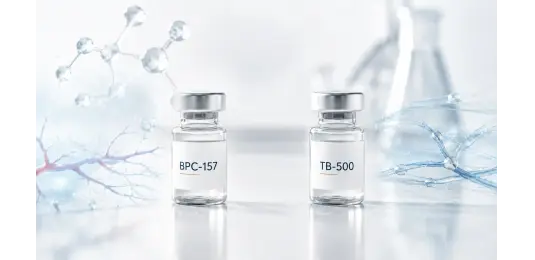
BPC-157 and TB-500 are almost always sold and discussed together — a matched "peptide duo" for recovery. That framing hides a simple fact: they are very different molecules, with different origins, different mechanisms, and very different evidence. This page is not about stacking them (for that, see the combination review). It's about telling them apart. Quick answer
BPC-157 Comes From the Gut; TB-500 Comes From Thymosin Beta-4 BPC-157 is a 15-amino-acid pentadecapeptide derived from a sequence found in human gastric juice protein BPC. It was first described in the early 1990s by Predrag Sikiric and colleagues at the University of Zagreb. A defining feature is that its sequence shows no meaningful homology to any other known peptide, which makes its behavior hard to predict by analogy. It is also unusually stable in gastric acid — which is why it shows oral activity in animal models, a rarity for a peptide of its size. TB-500 comes from a completely different lineage. It is a synthetic 7-amino-acid fragment (Ac-LKKTETQ) corresponding to residues 17–23 of thymosin beta-4 (Tβ4) — a naturally occurring 43-amino-acid protein found in nearly every human cell, with a well-documented role in actin regulation and wound healing. The nuance that popular coverage routinely blurs: TB-500 is not Tβ4. It is a short fragment of it. The parent protein occurs naturally; the specific 7-amino-acid fragment sold as TB-500 does not. A fragment does not automatically inherit the activity or safety profile of the whole protein — and, as we'll see, almost all the human evidence concerns the parent, not the fragment.
The Mechanism Difference: Blood-Vessel Signaling vs Cell Movement The two peptides aim at the same goal (tissue repair) through largely non-overlapping molecular routes. BPC-157 is proposed to act through several pathways at once, none via a known receptor: it upregulates VEGF/VEGFR2 to stimulate new vessel formation early in repair; activates the nitric oxide system (VEGFR2-Akt-eNOS and Src-Caveolin-1-eNOS pathways); is linked to FAK-paxillin signaling in cell migration; upregulates the growth hormone receptor in tendon fibroblasts (shown by an independent Taiwanese group); and touches ERK1/2 / Egr-1 transcription involved in collagen synthesis. TB-500 works primarily through actin dynamics. Its parent region binds monomeric G-actin in a 1:1 ratio, controlling the pool available for polymerization into filaments. By regulating that pool, it governs the cytoskeletal remodeling behind cell migration — moving fibroblasts, keratinocytes, and endothelial cells into a wound. Secondary effects include Notch-mediated angiogenesis and anti-inflammatory activity.
FDA and WADA Status: Why Both Carry Regulatory Risk This is the part most pages get wrong, because it changed in 2026. FDA — a moving target In 2023, the FDA placed roughly 19 peptides — including BPC-157 and TB-500 — into Category 2 of the 503A bulk substances list, which effectively barred compounding pharmacies from preparing them. That is the status most older articles still describe. It is no longer current. Following a 2026 policy shift and nomination withdrawals, BPC-157 and TB-500 no longer appear in FDA's May 14, 2026 Category 2 update — but they were not moved to Category 1 either, FDA's "under evaluation" category. Neither peptide is FDA-approved, and neither has a USP/NF monograph. That leaves both in an unsettled compounding position: no longer on the current Category 2 list, but not placed on Category 1 or the final 503A Bulks List either. The next step is a Pharmacy Compounding Advisory Committee (PCAC) meeting on July 23–24, 2026, where BPC-157 and TB-500 (alongside KPV and MOTs-C) are scheduled to be evaluated for possible inclusion on the 503A Bulks List. Until that process resolves, their legal compounding status is genuinely unsettled. Accurate summary as of mid-2026: Both were previously treated as high-concern Category 2 substances; both no longer appear in FDA's May 14, 2026 Category 2 update, but neither is approved for compounding; both remain under active FDA review pending the July 2026 PCAC meeting. WADA — both prohibited, different categories Both are banned in sport at all times, but under different classes — a detail most pages get wrong:
Because neither is an approved therapeutic medication, athletes should not expect a normal medication-style Therapeutic Use Exemption route. Strict liability applies, sanctions can be severe, and a real anti-doping case has already produced a four-year ban for an athlete who used both compounds. BPC-157 is additionally named on the US Department of Defense prohibited-supplement list.
The Safety Questions They Share — and Don't Both peptides carry the same unresolved theoretical concern: they promote angiogenesis and cell migration, and VEGF-driven neovascularization and enhanced migration are also features of tumor growth. Neither has been evaluated in formal carcinogenicity or chronic-dosing studies in humans. For compounds used continuously over months, this is a real and open question for both. Where they differ: BPC-157 has a curious toxicology footnote (reported tolerability at a very high 2 g/kg dose despite activity claimed at nanogram-to-microgram levels) and the unexplained gap of its unpublished 2015 Phase I trial. TB-500 inherits a "reasonable short-term safety" signal only by extension from full-length Tβ4 IV studies — not from the fragment itself — and adds the prodrug/metabolite uncertainty. In both cases, products sold outside supervised clinical settings are unregulated, and their purity, content, and sterility cannot be assumed.
Common misconceptions "They're basically the same kind of peptide." No. BPC-157 is a gastric-juice-derived pentadecapeptide acting on VEGF/NO pathways with no known receptor. TB-500 is a thymosin-beta-4 fragment acting through actin sequestration. Different origin, size, and mechanism. "TB-500 is natural because thymosin beta-4 is in my body." The parent protein is endogenous; the 7-amino-acid fragment sold as TB-500 is synthetic and does not occur naturally. "Derived from something natural" is not the same as "natural" or "safe." "The human trials prove TB-500 works." Those Phase 2 trials used full-length Tβ4, not TB-500. Evidence for one is not directly transferable to the other, and TB-500 itself has no published human trials. "One is FDA Category 2, the other isn't — so one is safer/legal." Neither appears in FDA's current (May 14, 2026) Category 2 list anymore, and neither is approved or cleared for compounding. There is no "safe regulatory choice" between them.
Frequently asked questions Are BPC-157 and TB-500 the same thing? No. They are distinct molecules from different biological families, with different mechanisms and evidence bases. They're frequently paired commercially, which is the main reason they're confused. BPC-157 vs TB-500 for recovery or injury — which is better? There is no evidence-based answer. They target tissue repair through different routes, and neither has been validated in controlled human trials. Any ranking circulating online reflects marketing or anecdote, not clinical data. Which one is more studied? BPC-157 has the larger animal literature. But "more studied in animals by one lab" is not "more proven in humans" — human evidence is inadequate for both, and TB-500's human data belongs to its parent protein, not the fragment. Which one is riskier for athletes? Both are prohibited at all times, so both carry serious anti-doping risk. They sit in different WADA classes (BPC-157 in S0, TB-500 in S2), but the practical consequence is comparable: strict liability applies, and sanctions can be severe, including multi-year bans depending on the case. A real case produced a four-year ban for using both. Can they be stacked? That's a separate question from this comparison. The combination ("Wolverine Stack") has never been tested against single-compound arms in any controlled animal or human study — see the dedicated combination review for the full breakdown. Is either one safe for long-term use? Unknown for both. There is no long-term human safety data for either, and both share an unresolved theoretical cancer/angiogenesis concern.
Key takeaways
- They are not the same kind of peptide. BPC-157 comes from a gastric-juice protein and works mostly on blood-vessel and tissue signaling. TB-500 is a fragment of thymosin beta-4 and works mostly on cell movement.
- BPC-157 has more animal data; TB-500 has a "parent-protein problem." Most human evidence people cite for TB-500 was actually generated with full-length thymosin beta-4 — a different molecule.
- Human evidence is thin for both. Fewer than 30 documented people for BPC-157 (uncontrolled pilots); zero published human trials of the TB-500 fragment itself.
- Both carry regulatory risk. Neither is FDA-approved. Both are prohibited in sport — BPC-157 under WADA S0, TB-500 under WADA S2 — and both are under active FDA compounding review in 2026.
⚠️ Disclaimer. This article is informational only — not medical advice, and not an instruction for use. Neither peptide is FDA-approved for any indication, and both are prohibited in competitive sport. Human evidence is extremely limited (and for the TB-500 fragment, essentially absent). Nothing here is a promise of efficacy, a safety guarantee, or encouragement to obtain or use either substance. Regulatory status is changing in 2026 — see the FDA/WADA section below.
At a glance — side by side
| BPC-157 | TB-500 | |
|---|---|---|
| Full name | Body Protection Compound 157 | TB-500 (synthetic fragment of thymosin beta-4) |
| Sequence | GEPPPGKPADDAGLV (15 aa) | Ac-LKKTETQ (7 aa, acetylated) |
| Molecular weight | ~1,419 Da | ~889 Da (free base; salt forms may differ) |
| Origin | Fragment of human gastric juice protein BPC | Fragment (residues 17–23) of thymosin beta-4 (Tβ4) |
| Occurs naturally? | Parent protein does; this 15-aa fragment is synthetic | Parent protein (Tβ4) does; this 7-aa fragment does not |
| Primary mechanism | VEGF/eNOS/NO signaling; GH-receptor upregulation | G-actin sequestration → cell migration |
| Known receptor | None identified | Acts via actin binding, not a classical receptor |
| Strongest preclinical area | GI cytoprotection (best-replicated) | Dermal/cardiac wound healing (mostly via full-length Tβ4) |
| Direct human trial data | <30 people, uncontrolled pilots | 0 trials on the fragment itself |
| FDA status (2026) | No longer in FDA's May 14, 2026 Category 2 update; not approved; under PCAC review Jul 2026 | No longer in FDA's May 14, 2026 Category 2 update; not approved; under PCAC review Jul 2026 |
| WADA status | Prohibited — S0 (Non-Approved Substances) | Prohibited — S2 (Growth Factors and Growth Factor Modulators) |
In plain English: BPC-157 is mostly discussed as a blood-vessel and tissue-signaling peptide. TB-500 is mostly discussed as a cell-movement peptide. That's exactly why calling them "the same kind of recovery peptide" is misleading.
A wrinkle unique to TB-500. A 2024 analysis suggested TB-500 may be rapidly metabolized in vivo to a smaller pentapeptide (Ac-LKKTE), and that the wound-healing activity seen in vitro may belong to that metabolite rather than the parent compound. If confirmed, TB-500 would behave as a prodrug — a complication with no equivalent in the BPC-157 literature. The finding is preliminary and needs replication.
The Evidence Gap: BPC-157 Has Animal Data, TB-500 Has a Parent-Protein Problem This is where the online story and the scientific record split apart. On forums and vendor pages, both peptides sound almost interchangeable. In the literature, they are not even standing on the same kind of evidence. BPC-157 has one of the largest preclinical records of any research peptide — a large literature built up over 30+ years. But it is heavily concentrated: the great majority of papers come from one research group, with independent replication that is real but uneven (strongest for gastrointestinal cytoprotection, partial for tendon healing, thin for the cardiovascular and CNS claims). A 2025 systematic review of musculoskeletal use found essentially one clinical study among hundreds of articles. Published human exposure remains extremely limited — fewer than 30 people across a handful of small, uncontrolled pilot reports — and a formal Phase I trial begun in 2015 was never published. TB-500 has the opposite problem. Research on the parent protein Tβ4 is genuinely diverse and independently replicated — seminal wound-healing studies, cardiac regeneration work in Nature, and several Phase 2 human trials (venous stasis ulcers, N=73; dry eye, N=9; cardiac progenitor cells, N=26). But the TB-500 fragment itself has no published direct human clinical trials. Every human dataset cited to support "TB-500" was generated with full-length Tβ4 — a different molecule with partly different activity.
| Evidence dimension | BPC-157 | TB-500 |
|---|---|---|
| Preclinical breadth | Very large | Large — but mostly on parent Tβ4 |
| Independent replication | Uneven; strongest for GI | Good for Tβ4; minimal for the fragment |
| Direct human trials | <30 people, uncontrolled | None on the fragment |
| Best-supported use | GI cytoprotection (animal) | Dermal/cardiac wound healing (animal/Tβ4) |
| Biggest evidence gap | Unpublished 2015 Phase I | No human data on the actual fragment sold |
| BPC-157 | TB-500 | |
|---|---|---|
| WADA class | S0 — Non-Approved Substances | S2 — Growth Factors and Growth Factor Modulators (as a thymosin-β4 derivative) |
| Status | Prohibited at all times (added 2022) | Prohibited at all times |
| TUE | USADA identifies it as S0 and not approved for human clinical use; athletes should verify directly through GlobalDRO or USADA before assuming any TUE route | Athletes should not rely on a normal medication-style TUE route; check directly with the relevant anti-doping authority |
- Different molecules, not two flavors of one. BPC-157 (gastric-juice pentadecapeptide, VEGF/NO mechanism) and TB-500 (thymosin-beta-4 fragment, actin mechanism) share a goal but almost nothing else.
- BPC-157 has the broader animal record; TB-500's pedigree belongs mostly to its parent protein. Most "TB-500" human evidence is actually Tβ4 evidence.
- Human data is inadequate for both — fewer than 30 people for BPC-157, zero direct trials for the TB-500 fragment.
- Regulatory status is unsettled and changing in 2026. Both no longer appear in FDA's May 14, 2026 Category 2 update, were not placed on Category 1 or the final 503A Bulks List, and both face PCAC review in July 2026.
- Both are prohibited in sport — BPC-157 under WADA S0, TB-500 under S2 — with a real four-year-ban precedent for using them together.
- Pairing them is a commercial convention, not a scientific one. Telling the two apart is the first step to reading any claim about either critically.
References BPC-157
- Sikiric P, Seiwerth S, Grabarevic Z, et al. The beneficial effect of BPC 157 on gastric and duodenal lesions. Life Sciences. 1994;54:PL63–68.
- Sikiric P, Seiwerth S, Rucman R, et al. Stable gastric pentadecapeptide BPC 157 pleiotropic beneficial activity. Pharmaceuticals. 2024;17(4):461. PMC11053547
- Brcic L, et al. Modulatory effect of BPC 157 on angiogenesis in muscle and tendon healing. J Physiol Pharmacol. 2009;60(Suppl 7):191–196. PMID: 20388964
- Chang CH, Tsai WC, Lin MS, Hsu YH, Pang JH. The promoting effects of BPC157 on tendon healing. J Appl Physiol. 2011;110(3):774–780.
- Vasireddi N, Hahamyan H, Salata MJ, et al. Emerging Use of BPC-157 in Orthopaedic Sports Medicine: A Systematic Review. Am J Sports Med. 2025. PMID: 40756949. PMC12313605
- Lee E, Padgett B. Intra-articular injection of BPC 157 for multiple types of knee pain. Altern Ther Health Med. 2021;27.
- Malinda KM, Sidhu GS, Mani H, et al. Thymosin β4 accelerates wound healing. J Invest Dermatol. 1999;113(3):364–368. PMID 10469335
- Philp D, Badamchian M, Scheremeta B, et al. Thymosin β4 and a synthetic peptide containing its actin-binding domain promote dermal wound repair. Wound Repair Regen. 2003;11(1):19–24.
- Bock-Marquette I, Saxena A, White MD, DiMaio JM, Srivastava D. Thymosin β4 activates integrin-linked kinase and promotes cardiac cell migration, survival and cardiac repair. Nature. 2004;432:466–472.
- Rahaman KA, et al. Simultaneous quantification of TB-500 and its metabolites by UHPLC-Q-Exactive orbitrap MS/MS. J Chromatogr B. 2024;1235:124033.
- Zhu J, Song J, Yu L, et al. Autologous thymosin β4 pre-treated endothelial progenitor cell transplantation in acute STEMI: a pilot study. Cytotherapy. 2016;18(8):1037–1042.
- FDA. July 23–24, 2026: Meeting of the Pharmacy Compounding Advisory Committee — bulk drug substances considered for the 503A Bulks List (BPC-157, KPV, TB-500, MOTs-C). fda.gov
- FDA. Bulk Drug Substances Nominated for Use in Compounding Under Section 503A of the FD&C Act. Updated May 14, 2026. fda.gov
- USADA. BPC-157: Experimental Peptide Prohibited. usada.org
- WADA Prohibited List 2026 — S0 (Non-Approved Substances) and S2 (Growth Factors and Growth Factor Modulators). wada-ama.org
- DoD / OPSS. BPC-157: Prohibited Dietary Supplement Ingredient. opss.org