SLU-PP-332 Explained: ERR Agonist, Exercise Mimetic, and the Evidence
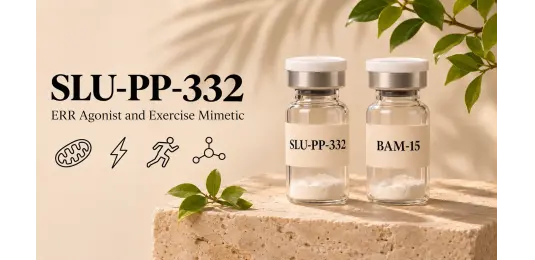
SLU-PP-332 is the compound that made the phrase "exercise mimetic" mainstream. This guide covers what it actually is, how the ERR mechanism works, what the published mouse studies measured, and why it is not a peptide.
SLU-PP-332 is a synthetic small molecule that activates the estrogen-related receptors ERRα, ERRβ and ERRγ, with the highest potency at ERRα. In mice it switches on a gene program resembling acute aerobic exercise, increases endurance and reduces fat mass. It is not a peptide, and no human trials have been published.
What Is SLU-PP-332?
SLU-PP-332 is a synthetic chemical compound developed as a laboratory tool for studying the estrogen-related receptors (ERRs). The "SLU" in its name comes from Saint Louis University, where the chemistry was done; the work was led by Thomas Burris, who has since moved to the University of Florida, together with groups at Washington University in St. Louis and the Salk Institute.
It was first described in a 2023 paper in ACS Chemical Biology as a pan agonist that targets all three ERR subtypes but has the highest potency for ERRα, with pharmacokinetic properties good enough to be used as an in vivo chemical tool.[1] That phrase matters: the compound was built to answer a research question, not to be a product.
The label "exercise mimetic" comes from what it does to gene expression. In mouse skeletal muscle, SLU-PP-332 switches on much of the same transcriptional program that a single bout of aerobic exercise switches on. It does not make an animal move more. It changes what the muscle does while the animal stays still.
Is SLU-PP-332 a Peptide?
No. SLU-PP-332 is a small organic molecule, not a chain of amino acids. It is sold alongside peptides and is frequently filed under "SLU-PP-332 peptide" in online stores and search queries, but chemically the two categories have nothing in common.
The distinction is not pedantic, and it has three practical consequences:
- Different regulatory track. The FDA actions and the October 2026 HHS policy that reshaped the peptide market this year apply to peptide bulk substances. SLU-PP-332 is not among them, in either direction.
- Different handling. It is not reconstituted from lyophilized powder the way a peptide vial is, and peptide storage and stability rules do not transfer to it.
- Different literature. Searching it alongside peptide research returns the wrong papers. The relevant field is nuclear receptor pharmacology.
How It Works: the ERR Family
Estrogen-related receptors are orphan nuclear receptors: proteins that sit inside the cell, bind DNA and control transcription, but whose natural activating ligand has never been identified. Despite the name, they are not activated by estrogen. There are three of them, ERRα, ERRβ and ERRγ.
Their day job is energy metabolism. ERRs regulate genes for mitochondrial biogenesis, oxidative phosphorylation, fatty acid oxidation and the Krebs cycle, and their activity rises during exercise. Genetic work established the link in the other direction too: mice lacking ERRα have reduced muscle mass and reduced exercise endurance.[1]
For years ERRs were considered undruggable as agonist targets. Compounds that activate ERRβ and ERRγ existed; ERRα resisted. SLU-PP-332 was the compound that broke that, which is why the 2023 paper is cited as a starting point rather than as a finished story.
The chain of events in mouse muscle
- SLU-PP-332 binds ERRα and, with lower potency, ERRβ and ERRγ.
- In C2C12 muscle cells, mitochondrial function and cellular respiration increase.[1]
- In mice, the proportion of type IIa oxidative muscle fibres rises — the fibre type that endurance training favours.[1]
- Whole-body metabolism shifts towards fatty acid oxidation, with higher energy expenditure.[2]
The cleanest piece of evidence for the mechanism is a negative result. In mice engineered to lack ERRα in skeletal muscle, SLU-PP-332 produced no endurance benefit at all: treated knockout animals performed the same as untreated knockout animals.[1] The effect is not a general stimulant effect. It runs through one receptor.
What the Research Shows
The foundational paper. SLU-PP-332 induced an acute aerobic exercise gene program in skeletal muscle, increased mitochondrial respiration in muscle cells, and increased type IIa oxidative fibres in mice. Normal-weight treated mice ran roughly 70% longer and about 45% further before exhaustion than untreated controls. The endurance effect was abolished in muscle-specific ERRα knockout mice.[1]
Diet-induced obese and ob/ob mice. SLU-PP-332 increased energy expenditure and fatty acid oxidation, decreased fat mass accumulation and improved insulin sensitivity. Food intake was not reduced, which separates the mechanism from appetite-suppressing drugs. In the accompanying university release, obese mice treated for a month gained roughly ten times less fat than controls.[2]
The limitation that matters most
Every efficacy result above is from mice. There are no published human trials of SLU-PP-332, no human pharmacokinetic data, and no clinical safety data. The compound has not entered formal drug development in humans.
The oral bioavailability problem
This is the detail most product pages leave out. In the published mouse work, SLU-PP-332 was given by intraperitoneal injection, not by mouth. In 2026 the same research group published a chemically distinct successor compound, SLU-PP-915, and described it as orally bioavailable — explicitly noting that SLU-PP-332 "lacks oral bioavailability" while producing comparable exercise-mimetic effects when both are given intraperitoneally.[3]
That is a direct statement from the group that created the compound, and anyone evaluating SLU-PP-332 as a research tool should weigh it. It does not say the molecule is inactive; it says the route used in the published studies is not the oral one, and that a follow-up molecule was designed partly to solve that.
Doses Used in Published Research
The figures below are the amounts reported in the published animal studies, given for reference when reading those papers. They are not a protocol, and animal dosing does not translate to any other species.
| Study | Model | Amount / route | Schedule |
|---|---|---|---|
| Billon et al., 2023 [1] | Male mice, C2C12 cells | 50 mg/kg, intraperitoneal | Single dose 1 h before treadmill test; also repeated dosing |
| Billon et al., 2024 [2] | Diet-induced obese and ob/ob mice | Intraperitoneal | Twice daily, approximately one month |
| SLU-PP-915 comparison, 2026 [3] | Mice | Intraperitoneal and oral (915 only) | Per study protocol |
| Alexopoulos et al., 2020 (BAM-15) [4] | Diet-induced obese mice | Oral | Chronic feeding study |
No dose has been established for any species other than the rodents used in these experiments.
Research material: SLU-PP-332 capsules · SLU-PP-332 + BAM-15 · BAM-15 capsules · All metabolic research compounds
SLU-PP-332 vs BAM-15
These two compounds are often discussed together and sold together, because both reduced fat mass in obese mice without reducing food intake. The mechanisms, however, are opposites in an important sense.
SLU-PP-332 works upstream, at the level of transcription: it tells muscle cells to build more oxidative machinery. BAM-15 works downstream, at the mitochondrial membrane: it is a protonophore uncoupler, meaning it lets protons leak across the inner membrane so that nutrients are burned to produce less ATP per unit of fuel. In the 2020 Nature Communications paper, BAM-15 decreased body fat mass in mice without altering food intake, lean body mass or body temperature, and improved insulin sensitivity across several tissues.[4]
| Feature | SLU-PP-332 | BAM-15 |
|---|---|---|
| Class | Nuclear receptor agonist (ERRα/β/γ) | Mitochondrial protonophore uncoupler |
| Level of action | Gene transcription | Mitochondrial membrane |
| Reported in mice | Endurance, oxidative fibres, fat loss | Fat loss, insulin sensitivity, liver fat |
| Food intake | Not reduced | Not altered |
| Oral bioavailability | Described as lacking it [3] | Described as orally bioavailable [4] |
| Human trials | None published | None published |
Worth noting on the uncoupler side: the historical reference point for mitochondrial uncoupling in humans is 2,4-dinitrophenol (DNP), a compound with a well-documented record of serious harm. BAM-15 was designed specifically to separate the metabolic effect from that toxicity profile in animal models, and the published work is encouraging on that point, but it remains animal work.
Safety and Regulatory Status
SLU-PP-332 is not approved by the FDA, the EMA or any other regulator, for any purpose. It is not a dietary supplement and not a compounded medication. There is no published human safety data of any kind, and no toxicology programme has been reported.
Because it is a small molecule rather than a peptide, it sits outside the 2026 peptide regulatory changes entirely: it was never on the FDA Category 2 list, was not part of the April 2026 withdrawals, and is not covered by the October 2026 HHS peptide policy. It is not specifically named on the WADA Prohibited List, though athletes should check the current list directly, since compounds with exercise-mimetic activity have historically attracted anti-doping attention as a class.
Frequently Asked Questions
What is SLU-PP-332?
A synthetic small molecule that activates the estrogen-related receptors ERRα, ERRβ and ERRγ, with the highest potency at ERRα. It was developed at Saint Louis University as a chemical tool for studying ERR biology in vivo.
Why is SLU-PP-332 called an exercise mimetic?
Because in mouse skeletal muscle it activates much of the same gene program that a bout of aerobic exercise activates, including genes for mitochondrial function and fatty acid oxidation, without the animal exercising.
Is SLU-PP-332 a peptide?
No. It is a small organic molecule, not a chain of amino acids. It is commonly grouped with peptides by vendors and search engines, but it belongs to nuclear receptor pharmacology rather than peptide chemistry.
What did the mouse studies actually measure?
Treadmill endurance, muscle fibre type, mitochondrial respiration in cultured muscle cells, energy expenditure, fatty acid oxidation, fat mass and insulin sensitivity. Treated normal-weight mice ran about 70% longer and 45% further than controls.
Are there human trials of SLU-PP-332?
None have been published. There is no human efficacy, pharmacokinetic or safety data, and the compound has not entered formal clinical development.
What is SLU-PP-915?
A chemically distinct ERR pan-agonist from the same research group, reported in 2026 as orally bioavailable. The paper describes SLU-PP-332 as lacking oral bioavailability while producing comparable effects when both are given by injection in mice.
How does SLU-PP-332 differ from BAM-15?
SLU-PP-332 acts on gene transcription through ERR receptors. BAM-15 is a mitochondrial uncoupler that acts directly at the inner mitochondrial membrane. Both reduced fat mass in obese mice without reducing food intake, but through unrelated mechanisms.
Related Research
- 5-Amino-1MQ: Purity, Applications, Research Doses
- GLP-1 Non-Responders: Why Weight-Loss Drugs Fail
- MOTS-c — a mitochondria-derived peptide studied in the same metabolic space
All products are sold strictly for laboratory research. Not for human or veterinary use. This article summarizes published scientific literature and is not medical advice.
Sources
- Billon C, Sitaula S, Banerjee S, et al. Synthetic ERRα/β/γ Agonist Induces an ERRα-Dependent Acute Aerobic Exercise Response and Enhances Exercise Capacity. ACS Chemical Biology. 2023;18(4):756–771. pubmed.ncbi.nlm.nih.gov/36988910
- Billon C, Schoepke E, Avdagic A, et al. A Synthetic ERR Agonist Alleviates Metabolic Syndrome. Journal of Pharmacology and Experimental Therapeutics. 2024;388(2):232–240. pmc.ncbi.nlm.nih.gov/articles/PMC10801787
- An orally active estrogen receptor-related receptor agonist, SLU-PP-915, enhances aerobic exercise capacity. Journal of Pharmacology and Experimental Therapeutics. 2026;393(1):103787. pubmed.ncbi.nlm.nih.gov/41421047
- Alexopoulos SJ, Chen SY, Brandon AE, et al. Mitochondrial uncoupler BAM15 reverses diet-induced obesity and insulin resistance in mice. Nature Communications. 2020;11:2397. pmc.ncbi.nlm.nih.gov/articles/PMC7224297
- Axelrod CL, King WT, Davuluri G, et al. BAM15-mediated mitochondrial uncoupling protects against obesity and improves glycemic control. EMBO Molecular Medicine. 2020;12(7):e12088.