5-Amino-1MQ Overview for Researchers: Purity, Applications, and Scientific Background
Reading Time: 8 mins
Science & Medicine GLP-1 Obesity Medicine Treatment Response
Clinical Science Report The GLP-1 Non-Responder Problem: Why These Drugs Work Brilliantly for Some People—and Barely Work for Others Weight-loss injections are often presented as predictable. Biology is not.
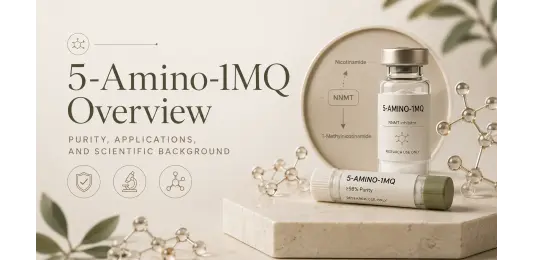
5-Amino-1MQ Overview for Researchers: Purity, Applications, and Scientific Background 5-Amino-1MQ is a synthetic small‑molecule inhibitor of nicotinamide N‑methyltransferase (NNMT). Online, it's commonly mislabeled a "5 amino 1mq peptide," but it's not a peptide, not a fat burner, and not an enzyme — and the vendors calling it all three rarely mention that every claim of human benefit comes exclusively from rodent studies. Here's what the compound actually does, what it cannot do, and why the gap between a mouse cage and a human body matters more than the internet tends to admit. What 5-Amino-1MQ Actually Is — and What It Is Not 5-Amino-1MQ is 5‑amino‑1‑methylquinolinium iodide, a quinolinium salt with a molecular weight of roughly 286 grams per mole (as the iodide salt). It selectively blocks the enzyme NNMT, which normally attaches a methyl group to nicotinamide — a process that burns through molecules needed to build NAD+ and maintain cellular methylation. The compound is a small molecule, structurally unrelated to chain‑of‑amino‑acid peptides like GHK‑Cu. No human clinical trial has tested this molecule. Every reported effect — fat loss, improved glucose tolerance, greater muscle performance — comes exclusively from cell cultures and rodent models. The compound is not FDA‑approved, not available through compounding pharmacies, and sold online only as an unverified research chemical. How 5‑Amino‑1MQ Blocks NNMT and Shifts Metabolism NNMT attaches a methyl group to nicotinamide (a form of vitamin B3). That reaction consumes nicotinamide itself (which the body needs to produce NAD+, the central energy currency) and S‑adenosylmethionine (SAM), the cell's universal methyl donor. In obesity, NNMT activity ramps up in fat tissue, draining both. A 2014 Nature study first tied NNMT to obesity. The hypothesis: when NNMT is overactive, fat cells stay locked in a storage‑focused state. By inhibiting NNMT, 5‑Amino‑1MQ spares nicotinamide so NAD+ synthesis can continue, and it preserves SAM for the epigenetic machinery that depends on it. In mouse fat tissue, this shift appears to tilt metabolism toward fat oxidation instead of lipid accumulation, shrink adipocytes, and improve the body's response to insulin. The biology is consistent, but whether blocking NNMT helps people lose weight or gain muscle is entirely untested. If You've Taken 5‑Amino‑1MQ: Side‑Effect Information to Give Your Doctor This article is for general education only and does not replace medical advice from a licensed healthcare professional. We do not endorse human use. But if someone has already self‑administered the compound and is worried about a reaction, their doctor will need context. Anyone experiencing chest pain, difficulty breathing, loss of consciousness, or other life‑threatening signs must seek emergency help immediately; do not wait for a clinic visit. No human safety studies exist. The published mouse study that is cited most often (Neelakantan et al., 2018) reported no observable adverse effects at the doses tested. Unverified online anecdotes mention GI upset, nausea, and fatigue, but no frequencies can be assigned to those reports. Because there are no standard treatment protocols, a physician benefits from knowing:
- The full name of the compound: 5‑amino‑1‑methylquinolinium iodide That it is an NNMT inhibitor — not a peptide That only preclinical animal safety data are available The source and any claimed purity, if known
- No FDA approval for obesity, aging, or any other indication. Not on the FDA 503A bulk substances list, so compounding pharmacies cannot legally prepare it for human patients. No Investigational New Drug (IND) application and no Phase 1, 2, or 3 trial has ever been registered on ClinicalTrials.gov. Vendors selling "research grade" material typically claim ≥98–99% purity by HPLC (high‑performance liquid chromatography). Those claims are not independently verified by any regulatory body, and no FDA‑registered manufacturing facility is known to produce pharmaceutical‑grade material for human use.
- Diet‑induced obese mice injected subcutaneously with the inhibitor for 11 days lost body weight and white fat mass. Their adipocytes shrank, and glucose tolerance improved (Neelakantan et al., 2018). Food intake did not change, suggesting a metabolic effect rather than appetite suppression. A follow‑up 2024 mouse study found that NNMT inhibition dose‑dependently reduced body weight, fat mass, and fatty‑liver markers. In aged, sedentary mice, NNMT inhibitor treatment alone boosted grip strength by about 40% over untreated controls. When combined with exercise, the same inhibitor pushed grip strength roughly 60% above sedentary aged mice — an additive gain beyond what either achieved on its own (Dimet‑Wiley et al., 2024). The compound also helped sustain muscle performance over time.