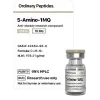

5-Amino-1MQ
For in vitro testing and laboratory use only. Not for human or animal consumption. Bodily introduction is illegal. Handle only by licensed professionals. Not a drug, food, or cosmetic. Educational use only.
5-Amino-1MQ: A Research-First Look at Metabolic Reprogramming
5-Amino-1MQ is a small synthetic molecule being studied as a selective inhibitor of NNMT, an enzyme linked in published research to NAD⁺ and SAM depletion in white adipose tissue and liver under obesogenic conditions. In cell studies and diet-induced obese mouse models, inhibition of NNMT with 5-Amino-1MQ was associated with higher intracellular NAD⁺ and SAM, reduced lipogenesis, increased GLUT4 expression, and meaningful reductions in fat mass without reduced food intake.
That makes it interesting in a research context not because it promises a shortcut, but because it targets metabolic efficiency rather than appetite. Published observations also connect NNMT biology to aging, sarcopenia, and cancer-related pathways, which broadens the scientific interest around this mechanism.
At the same time, the boundaries here matter: 5-Amino-1MQ has not entered human clinical trials, has no approved medical use, and all efficacy and safety questions in people remain open. For anyone looking at it seriously, the real story is not "proven solution," but a mechanistically intriguing compound still living entirely on the preclinical side of science.
5-Amino-1MQ (5-Amino-1-Methylquinolinium): A Scientific Review
Based on peer-reviewed literature — see References. Last updated: April 2026.
The Short Version
5-Amino-1MQ (5-amino-1-methylquinolinium) is a small-molecule inhibitor of the enzyme nicotinamide N-methyltransferase (NNMT) — a cytosolic methyltransferase linking nicotinamide (vitamin B3) metabolism to the broader methionine cycle and NAD♠ salvage pathway. It was first characterised as an NNMT inhibitor by Neelakantan, Watowich, and colleagues at the University of Texas Medical Branch in 2017 and 2018.
The compound appears in this series because it is routinely discussed alongside peptides in the wellness and metabolic optimisation community and represents a genuinely novel mechanism of action for metabolic disease. Where GLP-1 agonists reduce energy intake, 5-amino-1MQ — at least in animal models — appears to increase energy expenditure without altering food intake. That is a mechanistically distinct and scientifically interesting phenotype. The preclinical evidence is substantive: NNMT knockdown and 5-amino-1MQ treatment in diet-induced obese mice reduce body weight, white adipose mass, adipocyte size, and plasma cholesterol; improve insulin sensitivity; and do not alter food intake. More recent work (2024) shows additive benefits over exercise in aged mice for grip strength and endurance.
The honest statement that follows: there are no published human clinical trials, no human pharmacokinetic data, no human safety data, and no regulatory approval anywhere in the world. Clinics administering 5-amino-1MQ to humans are doing so without any of the safety information that normally precedes first-in-human use. The preclinical profile is genuinely promising; the clinical situation is genuinely unknown.
| At a glance | |
|---|---|
| Full chemical name | 5-amino-1-methylquinolinium (typically as iodide salt) |
| Abbreviation | 5-amino-1MQ; NNMTi; 5A-1MQ |
| Type | Small molecule; quaternary ammonium compound; NOT a peptide |
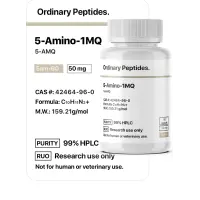
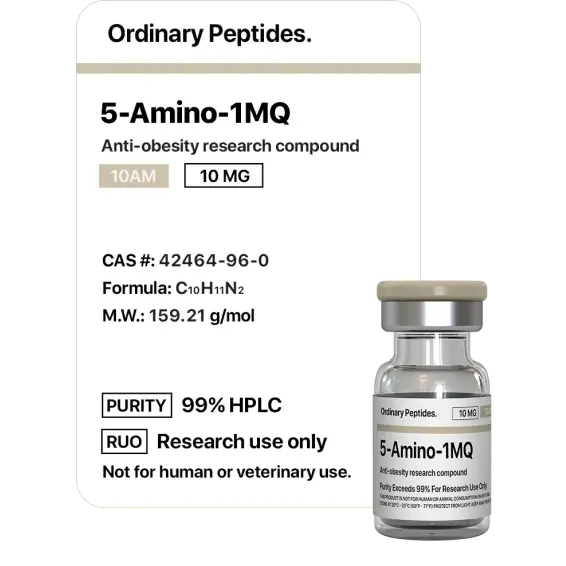
| Molecular formula | C&sub1;&sub0;H&sub1;&sub1;N&sub2;♠ (free cation); iodide salt MW ~286 Da; CAS 42464-96-0 |
| Target | NNMT (nicotinamide N-methyltransferase; EC 2.1.1.1) |
| Mechanism | Competitive NNMT inhibitor → ↑NAD♠ + ↑SAM → metabolic reprogramming of adipocytes |
| Route | Oral (capsule; high oral bioavailability — key advantage over most peptides) |
| Discovery | Neelakantan et al., University of Texas Medical Branch, 2017/2018 |
| FDA status | ❌ Unapproved new drug; not for human consumption |
| Human clinical trials | ❌ None published or registered as of April 2026 |
What Is NNMT and Why Does It Matter?
NNMT’s enzymatic reaction
NNMT (nicotinamide N-methyltransferase) catalyses the transfer of a methyl group from S-adenosyl-L-methionine (SAM) to nicotinamide (NAM), producing 1-methylnicotinamide (MNA) and S-adenosyl-homocysteine (SAH). This looks like a simple detoxification reaction, but NNMT’s metabolic significance extends far beyond detoxification through two critical connections.[3]
Connection 1 — NAD♠ salvage pathway: Nicotinamide is a key precursor in the NAD♠ salvage pathway (NAM → NAMPT → NMN → NAD♠). When NNMT methylates NAM to MNA, it diverts NAM away from NAD♠ synthesis. Elevated NNMT activity therefore reduces NAD♠ availability — impairing sirtuin (SIRT1, SIRT3) activity, PARP, and the mitochondrial electron transport chain.
Connection 2 — Methionine cycle / SAM depletion: SAM is the universal methyl donor for hundreds of methylation reactions (DNA, histones, RNA capping, metabolites). When NNMT consumes large amounts of SAM, it depletes the methyl donor pool. SAH also directly inhibits most SAM-dependent methyltransferases. High NNMT activity therefore creates a dual drain: depleting both NAD♠ and SAM simultaneously.
NNMT expression patterns: where it matters
NNMT is expressed in liver, kidney, lung, brain, heart, and skeletal muscle — but critically, it is highly expressed in white adipose tissue (WAT) and dramatically upregulated in the WAT of obese and diabetic animals and humans. Plasma levels of the NNMT reaction product 1-methylnicotinamide (1-MNA) correlate with adipose NNMT expression, individuals’ BMI, and waist circumference, suggesting the target to be clinically relevant.[4] In obesity, elevated WAT NNMT → more NAM converted to MNA → less NAD♠ in adipocytes → reduced sirtuin activity → impaired fatty acid oxidation → adipocytes locked in a fat-storing, metabolically hypoactive state. High NNMT creates a self-reinforcing cycle of adipose metabolic dysfunction.
The Discovery of 5-Amino-1MQ
Most NNMT inhibitors developed before 2017 were charged bisubstrate analogues — large, polar molecules that could not cross cell membranes and therefore could not reach the cytosolic NNMT enzyme. The Watowich group at UTMB systematically explored 1-methylquinolinium (1MQ) scaffold analogues with amine substitutions at different positions, balancing membrane permeability and NNMT binding via PAMPA and Caco-2 bidirectional transport assays.
5-Amino-1MQ emerged as the lead compound: an amine at the 5-position produced high passive membrane permeability, high active bidirectional transport (favourable oral absorption), potent competitive NNMT inhibition, and crucially — high selectivity. 5-amino-1MQ does not inhibit related SAM-dependent methyltransferases or enzymes in NAD♠ salvage pathways. This selectivity profile is critical: an NNMT inhibitor that also disrupted DNMT or HMT enzymes would have serious genotoxic and epigenetic concerns.[1]
Mechanism of Action: From NNMT Inhibition to Metabolic Reprogramming
When 5-amino-1MQ inhibits NNMT in white adipocytes: ↓ MNA (less NAM methylated; measurable surrogate for NNMT inhibition); ↑ NAD♠ (less NAM diverted from the salvage pathway); and ↑ SAM (less consumed by NNMT; restored cellular methylation capacity).
With restored NAD♠: SIRT1 activation deacetylates PGC-1α (promoting mitochondrial biogenesis and fatty acid oxidation) and FOXO1 (improving insulin sensitivity); SIRT3 activation activates fatty acid oxidation enzymes (LCAD, VLCAD) and antioxidant enzymes (MnSOD); AMPK activation inhibits lipogenesis (ACC, FASN) and promotes fatty acid oxidation; and the combined SIRT1-AMPK-PGC-1α axis promotes new mitochondria formation in adipocytes. The net result: adipocytes shift toward increased fatty acid oxidation, reduced lipogenesis, and decreased fat accumulation.
Additionally, 5-amino-1MQ increases GLUT4 transporter expression, improving glucose clearance from blood and reducing glucose-to-fat conversion — improving insulin sensitivity independently of body weight reduction.[4]
Preclinical Evidence: What the Animal Data Shows
Key 2017/2018 studies (Neelakantan, Watowich et al.)
In vitro (3T3-L1 adipocytes): NNMT protein expression was found to be ~37-fold higher in adipocytes vs. pre-adipocytes. 5-amino-1MQ (30 μM) in both pre-adipocytes and adipocytes resulted in significant reduction in intracellular 1-MNA, increased intracellular NAD♠ and SAM, and suppressed lipogenesis in adipocytes.[1]
In vivo (diet-induced obese mice; 11 days SC injection at ~34 mg/kg/day): 5-amino-1MQ-treated mice had significantly reduced body weights, white adipose masses, and adipocyte sizes. Notably, 5-amino-1MQ treatment did not show a significant impact on food intake and showed no observable adverse effects. Key quantitative results: ~35% reduction in epididymal WAT mass and adipocyte size; significant reduction in plasma total cholesterol; no change in food intake.[2] This “weight loss without appetite suppression” phenotype is mechanistically distinct from all GLP-1-based therapies.
2021 study (Sampson et al.)
NNMT inhibition combined with low-fat diet promoted dramatic whole-body adiposity and weight loss in diet-induced obese mice, rapidly normalising these measures to levels statistically indistinguishable from lean control mice — suggesting additive benefit when combined with dietary intervention.[7]
2024 muscle/exercise study (Dimet-Wiley, Watowich et al.; Scientific Reports)
Mechanistic basis: NNMT inhibition → ↑NAD♠ in muscle → SIRT1/SIRT3 activation → improved mitochondrial function → reduced muscle fatigue and faster recovery. In aged mice, satellite cell (muscle stem cell) activation was also observed, with treated mice showing 2-fold larger myofibre size and 70% stronger contractile force in healed muscle — positioning NNMT inhibition as a potential approach for age-related sarcopenia, a condition with no currently approved pharmacological treatment.
The NNMT Target in Broader Disease
Cancer: NNMT is overexpressed in multiple cancer types (thyroid, bladder, kidney, colorectal, gastric, lung, and others), associated with altered energy metabolism, drug resistance, enhanced invasiveness, and epigenetic silencing of tumour suppressors via SAM depletion. In cancer cell lines, NNMT inhibition reduces proliferation and restores drug sensitivity. However, the cancer biology of NNMT is complex: 1-MNA (the product NNMT generates) has been proposed to have independent anti-inflammatory and vasoprotective effects, and reducing MNA by inhibiting NNMT might not be uniformly beneficial. The cancer biology remains an active research area where simplistic conclusions are unwarranted.
Cardiovascular disease: NNMT-mediated NAD♠ depletion impairs mitochondrial function, sirtuin activity, redox balance, and energy metabolism, creating a pro-atherogenic environment. NNMT upregulation also elevates homocysteine: SAH (produced when NNMT consumes SAM) can be hydrolysed to homocysteine — a well-established cardiovascular risk factor via endothelial damage and thrombosis promotion.[5] Fibrosis: NNMT is upregulated in fibrotic tissues (hepatic, renal, cardiac); high NNMT → depleted SAM → impaired methylation → epigenetic dysregulation promoting fibroblast activation. NNMT inhibition has shown anti-fibrotic effects in liver and kidney fibrosis models.
What 5-Amino-1MQ Is Not
Not a peptide: 5-amino-1MQ is a small-molecule quinolinium salt (MW ~159 Da free cation; ~286 Da iodide salt) with no peptide bonds and no amino acid sequence. The frequent description of it as a “peptide” in wellness contexts is incorrect. Not interchangeable with NMN or NR: NMN and NR directly supplement NAD♠ precursors; 5-amino-1MQ inhibits the enzyme that diverts NAM away from NAD♠ synthesis — a different point of intervention. These approaches may be complementary rather than substitutable. The safety profile of NAD♠ precursors does not extend to NNMT inhibitors by any logical transference.
Oral Bioavailability: A Practical Advantage
Unlike most peptides covered in this series, 5-amino-1MQ is a small, stable, membrane-permeable molecule that survives oral administration and achieves meaningful systemic exposure. The Caco-2 bidirectional transport data from the 2017 characterisation study confirmed active transport-mediated absorption — a significant practical advantage: oral dosing, stable at room temperature, no reconstitution, no injection. The most widely cited community dosing is 50–150 mg daily orally, based on allometric scaling from mouse doses, but this calculation has not been validated in human pharmacokinetic studies.
Regulatory Status
Multiple wellness clinics and online supplement vendors are selling 5-amino-1MQ for human consumption despite this regulatory classification. The questions that standard drug development answers — maximum tolerated dose, human half-life, metabolites produced, tissue accumulation, drug interactions — are entirely unanswered for this compound. The absence of observable adverse effects in rodents over 11-day treatment periods is reassuring but profoundly insufficient to establish human safety, particularly for long-term use.
Common Misconceptions
“5-amino-1MQ is a peptide.”
It is not. It is a small quaternary ammonium molecule with no peptide bonds. The confusion arises from its appearance in peptide research communities and clinic “peptide programmes.”
“Human trials have confirmed it works.”
No human clinical trials have been published or registered. Community anecdotes and clinic reports are not clinical trials.
“Since NAD♠ boosting is safe (NMN, NR), 5-amino-1MQ is also safe.”
NMN and NR supplement NAD♠ precursors directly. 5-amino-1MQ inhibits an enzyme with roles in methylation, detoxification, and complex tumour biology. These are mechanistically distinct interventions with different risk profiles. The safety of NAD♠ precursors does not extend to NNMT inhibitors.
Key Takeaways
- ✅ 5-Amino-1MQ is a mechanistically novel NNMT inhibitor with a compelling preclinical profile. The target is well-validated as a metabolic regulator; the compound is potent, selective, membrane-permeable, and orally bioavailable — genuine drug-development advantages.[1]
- ✅ The preclinical evidence is substantive and mechanistically coherent. Diet-induced obese mice show significant body weight and adipose mass reduction, improved insulin sensitivity, and reduced cholesterol — without changes in food intake. This “energy expenditure without appetite suppression” phenotype is mechanistically distinct from all approved obesity pharmacotherapy.[2]
- The 2024 muscle data is the most recent and clinically interesting preclinical finding. NNMT inhibition improved grip strength more than exercise alone in aged mice and sustained running endurance, with satellite cell activation providing mechanistic relevance to sarcopenia.[6]
- ⚠️ No human data exists. No pharmacokinetics, no safety, no efficacy. The complete absence of any human trial data means the jump from promising rodent results to human use is unsupported — not a minor regulatory technicality, but a genuine unknown regarding human safety.
- ⚠️ The regulatory status is clear. FDA has classified 5-amino-1MQ as an unapproved new drug. Human administration outside a registered trial is a federal regulatory violation. Clinics administering it are doing so without the safety foundation that informed consent requires.
References
Discovery and Mechanism
- Neelakantan H, Wang HY, Vance V, et al. Selective and membrane-permeable small molecule inhibitors of nicotinamide N-methyltransferase reverse high fat diet-induced obesity in mice. Biochemical Pharmacology. 2017;147:141–152. PMC5826726
- Neelakantan H, Vance V, Wetzel MD, et al. Selective and membrane-permeable small molecule inhibitors of nicotinamide N-methyltransferase reverse high fat diet-induced obesity in mice. Scientific Reports. 2018;8(1):8630. (In vivo obesity reversal data)
NNMT Biology
- Liu M, Li L, Chu J, et al. Roles of nicotinamide N-methyltransferase in obesity and type 2 diabetes. BioMed Research International. 2021;2021:9924314. PMC8337113
- Nicotinamide N-methyltransferase (NNMT): a novel therapeutic target for metabolic syndrome. Frontiers in Pharmacology. 2024;15:1410479.
- Nicotinamide N-methyltransferase in cardiovascular diseases: metabolic regulator and emerging therapeutic target. MDPI Biomolecules. September 2025.
Muscle/Exercise Evidence
- Dimet-Wiley AL, Latham CM, Brightwell CR, Neelakantan H, et al. Nicotinamide N-methyltransferase inhibition mimics and boosts exercise-mediated improvements in muscle function in aged mice. Scientific Reports. 2024;14(1):15554.
Microbiome Study
- Sampson JN, et al. Reduced calorie diet combined with NNMT inhibition establishes a distinct microbiome in DIO mice. PubMed 35013352. 2022.
Key Investigator
- Stanley Watowich, PhD — Professor of Biochemistry and Molecular Biology, University of Texas Medical Branch, Galveston; founding investigator of 5-amino-1MQ as an NNMT inhibitor; corresponding author on the 2017/2018 discovery papers and 2024 muscle study. All primary mechanistic work on 5-amino-1MQ originates from his laboratory.
Certificate of Analysis
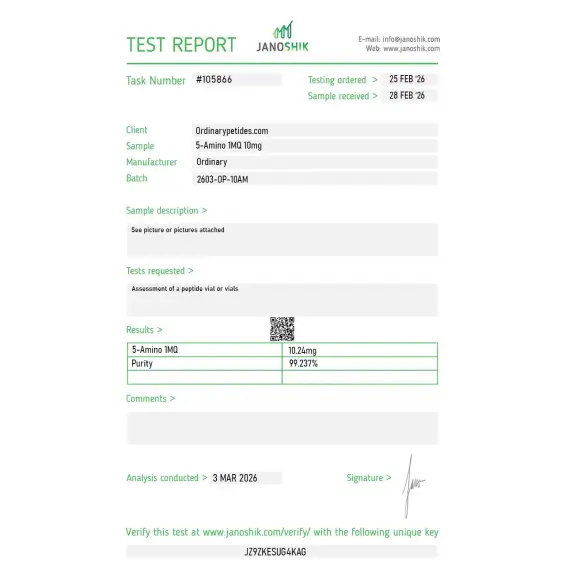
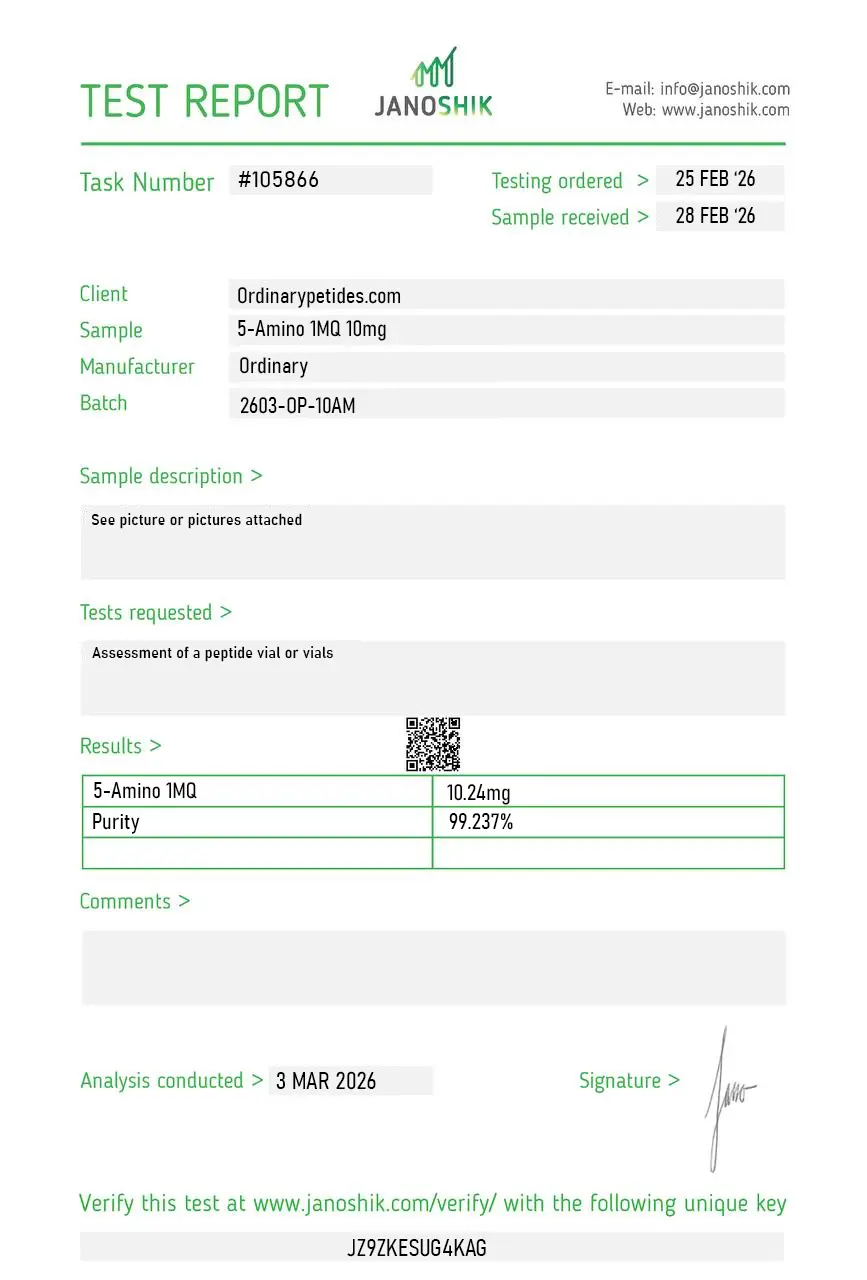
An independent test report is available for 5-Amino-1MQ 10mg. This report provides batch-level documentation and analytical verification information for research reference.
Based on 1 reviews
5.0
-
1
We use it in NNMT-overexpressing 3T3-L1 adipocyte cultures to characterize 1-methylnicotinamide accumulation under enzyme inhibition. Material delivered expected MNA suppression in our LC-MS readouts
5-Amino-1MQ (5-amino-1-methylquinolinium) is a small synthetic molecule classified as an NNMT inhibitor. While technically not a peptide in the traditional amino acid chain sense, it is often grouped in the peptide therapy category due to its targeted cellular signaling mechanism. It was developed through structure-activity relationship studies and is notable for being both highly selective and membrane-permeable — meaning it passes directly through cell walls to reach its target enzyme inside fat cells, liver, and muscle tissue.
It works by inhibiting nicotinamide N-methyltransferase (NNMT) — an enzyme that is overexpressed in fat tissue and plays a central role in slowing metabolism and promoting fat storage. When NNMT is active it consumes cellular methyl donors and depletes NAD+ — the critical coenzyme that powers mitochondrial energy production. By blocking NNMT, 5-Amino-1MQ preserves and elevates NAD+ levels, which in turn activates SIRT1 — often called the longevity gene — supporting DNA repair, improved mitochondrial function, reduced inflammation, and accelerated fat metabolism. Importantly, animal studies showed it reduced body weight and fat mass without significantly affecting food intake.
The primary benefit is metabolic — it promotes fat burning, reduces fat cell size and fat accumulation, increases basal metabolic rate, and supports body recomposition without relying on appetite suppression or stimulants. Additional benefits include improved mitochondrial energy efficiency, preserved lean muscle mass during caloric deficits, lowered cholesterol through SIRT1-mediated metabolism, improved insulin sensitivity, and potential muscle stem cell activation which may support recovery and combat age-related muscle loss. Some early research also suggests anti-cancer properties through disruption of energy supply to cancer cells, though this remains very preliminary.
It works through a completely different pathway. GLP-1 medications like semaglutide suppress appetite and slow gastric emptying to reduce calorie intake. 5-Amino-1MQ does not suppress appetite at all — it operates entirely at the cellular metabolic level, improving how efficiently cells burn fat and produce energy. This makes it a complementary tool that some clinics use alongside GLP-1 therapy to enhance overall results, particularly for patients hitting weight loss plateaus.
Unlike most peptides in this series, 5-Amino-1MQ is taken orally as a capsule — no injection required. This makes it one of the more convenient options in the peptide therapy space. Common dosing protocols used in wellness clinics are typically 50 mg taken one to three times daily with meals. Cycling is recommended — commonly two months on followed by one month off — to maintain effectiveness and allow the body to recalibrate.
It is generally well tolerated. Reported side effects are mild and may include nausea, temporary fatigue, dizziness, occasional drowsiness, and mild gastrointestinal discomfort, typically during the initial adjustment period. Animal studies showed no genotoxicity and no observable adverse effects at therapeutic doses. Long-term human safety data is still limited as it remains an investigational compound.
Pregnant or breastfeeding women should not use it. People with active cancer should exercise caution given the compound's effects on cellular energy pathways, and should only consider it under direct oncological supervision. Those with significant liver disease should consult a physician, as NNMT is highly expressed in liver tissue and inhibiting it may affect liver metabolism. As it is not FDA-approved and most human data comes from early-stage research, it should only be used under the guidance of a qualified healthcare provider.