Tirzepatide News in 2026: Research, Regulation, and Market Updates
Reading Time: 13 mins
Tirzepatide News in 2026: Research, Regulation, and Market Updates
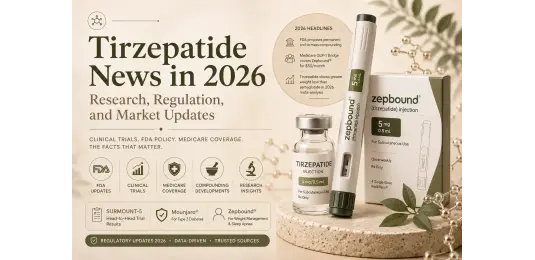
2026 has not been a quiet year for tirzepatide. Medicare just started covering Zepbound at $50 a month. The FDA began the process of permanently ending mass compounding. A landmark head‑to‑head trial showed tirzepatide delivers significantly more weight loss than semaglutide. And Eli Lilly's quarterly revenue beat even the most optimistic Wall Street forecasts. Online, the story is less clear. Viral posts still blur the line between pharmacy‑compounded vials and FDA‑approved pens, reference an "oral tirzepatide" that does not exist, and treat a single before‑and‑after photo as proof of cause and effect. This article separates what's real from what's rumor — drawing solely on published clinical data, regulatory records, and 2026 policy shifts — so you can see where tirzepatide actually stands. This article is for general education only and does not replace medical advice from a licensed healthcare professional. Quick Answer: The 2026 Tirzepatide Landscape The active ingredient tirzepatide is FDA‑approved as two branded injectables — Mounjaro (type 2 diabetes) and Zepbound (weight management, obstructive sleep apnea). The biggest story of 2026 is regulatory: the FDA formally proposed removing tirzepatide from the list of substances that large compounding pharmacies can use, effectively ending the era of mass‑produced compounded copies. At the same time, Medicare's new GLP‑1 Bridge program now covers Zepbound KwikPen for $50 a month, changing who can access the drug. And a 2026 meta‑analysis confirms tirzepatide yields greater weight loss than semaglutide in direct comparisons. What Tirzepatide Is — and How It Differs from Single‑Action GLP‑1 Drugs Tirzepatide is a synthetic peptide of 39 amino acids that mimics not one but two gut hormones: GIP (glucose‑dependent insulinotropic polypeptide) and GLP‑1 (glucagon‑like peptide‑1). Most weight‑loss shots — semaglutide (Ozempic, Wegovy) included — only hit the GLP‑1 receptor. Tirzepatide activates both, and it does so asymmetrically: it binds more tightly to GIP, and at the GLP‑1 receptor it preferentially triggers one signaling pathway over another. Researchers call it a "biased" dual agonist.[^1] That dual action means the drug lowers blood sugar, slows gastric emptying, and reduces appetite. Its unique receptor profile likely explains why it outperforms a pure GLP‑1 agonist. With a half‑life of about five days, a single weekly injection provides sustained effect. It's a distinct class — dual GIP/GLP‑1 receptor agonist. Calling it "just a stronger Ozempic" misrepresents the mechanism and sets the wrong expectations. How the FDA‑Approved Titration Works — and Why the Structure Matters Tirzepatide is not a one‑size‑fits‑all medication. The FDA‑approved regimen starts low and escalates in a slow, stepwise climb — from an initiation dose to a maximum of 15 mg, with at least four weeks at each step. This gradual uptitration helps the body adjust and keeps gastrointestinal side effects manageable. It's a built‑in safety feature, not a suggestion. The exact step‑by‑step tirzepatide dosage chart is detailed in the prescribing information; a clinician uses it to guide progression based on tolerance and response. By comparison, semaglutide (Wegovy) also titrates but tops out at 2.4 mg weekly — a difference in potency and receptor targets, not a measure of "strength." Starting at a high dose or skipping steps deviates from the studied, evidence‑backed pathway and introduces risks the trials did not measure. Where the Legal Status Stands: FDA‑Approved, Compounded, and Medicare Coverage FDA‑approved products are clear. Mounjaro (type 2 diabetes, approved May 2022) and Zepbound (weight management, November 2023; obstructive sleep apnea, December 2024) are the only legal, fully regulated tirzepatide injections. Both are made by Eli Lilly. No generic version exists, and no oral tirzepatide has ever been approved. Compounded tirzepatide is where confusion reigns. Compounded drugs are not generics; they are unapproved copies made by pharmacies. By law, compounding in large volumes is permitted only when a drug is in shortage. Tirzepatide was removed from the FDA shortage list on October 2, 2024. That triggered a wind‑down: traditional 503A compounding pharmacies had to stop by February 18, 2025, and larger 503B outsourcing facilities by March 19, 2025. In April 2026, the FDA went further, formally proposing to exclude tirzepatide, semaglutide, and liraglutide from the 503B bulks list — stating there is "no clinical need" for mass‑compounded versions.[^3] The public comment period ended July 30, 2026. If finalized, this will permanently end large‑scale compounding. Meanwhile, the FDA sent 30 warning letters to telehealth companies in February 2026 and, in May, issued a warning to a 503B facility that continued producing tirzepatide after the deadline. At the same time, access shifted. On July 1, 2026, Medicare's GLP‑1 Bridge program launched, covering Zepbound (KwikPen only) for $50 a month. The negotiated price for the drug is $245 per month, making it dramatically more affordable for millions of Medicare beneficiaries who previously had no coverage for weight‑loss medications. If you're searching "tirzepatide near me," the availability now hinges on whether your local pharmacy can fill a Zepbound KwikPen prescription under Medicare or commercial insurance — not on whether a compounding pharmacy still offers a gray‑market vial. What Large Clinical Trials Tell Us — and What Anecdotes Miss Tirzepatide's reputation rests on large Phase 3 trials, not social media. The most definitive head‑to‑head evidence came from SURMOUNT‑5, published in The New England Journal of Medicine in May 2025. That trial randomized 751 adults with obesity to tirzepatide or semaglutide for 72 weeks. The result: an average weight loss of 20.2% on tirzepatide versus 13.7% on semaglutide — a 47% greater reduction with the dual agonist.[^4] Nearly one in three tirzepatide users lost at least 25% of their body weight. The earlier SURMOUNT‑1 trial delivered another landmark: over 176 weeks, tirzepatide reduced the risk of developing type 2 diabetes by 94% among people with prediabetes and obesity. Only 1.3% on tirzepatide progressed to diabetes, compared with 13.3% on placebo — a number needed to treat of just nine to prevent one case of diabetes, a rare result in preventive medicine.[^5] This year's pooled analysis gave tirzepatide the edge on weight and blood sugar. It also noted that semaglutide still holds the strongest heart‑protection data — a gap the internet tends to skip when pitting tirzepatide vs semaglutide head‑to‑head. A separate systematic review confirmed an average 4.6% greater body weight reduction and roughly 4.8 kg more absolute weight loss with tirzepatide. None of this guarantees every individual will see those numbers. Trial participants had structured dietary counseling, careful dose escalation, and close monitoring. Real‑world results vary. A before‑and‑after photo cannot prove the drug caused the change, or by how much, or that the outcome is safe and sustainable. Side Effects Worth Watching and Discussing with a Doctor Tirzepatide side effects are well documented. The most common are gastrointestinal: nausea (up to 18% in trials), diarrhea (up to 17%), vomiting, constipation, and abdominal discomfort. These are usually mild to moderate, appear early, and often ease as the body adapts. Hair loss and injection‑site reactions are also reported. Serious risks are less common but demand attention. Gallbladder disease — gallstones and inflammation — shows up in meta‑analyses, and the drug label warns of acute pancreatitis. The boxed warning addresses medullary thyroid carcinoma, based on rodent studies; anyone with a personal or family history of that cancer or the genetic syndrome MEN2 should not take the drug. Diabetic retinopathy has been observed in people with type 2 diabetes, and kidney injury can occur with severe dehydration from prolonged vomiting or diarrhea. What you won't find in the medical literature is a unique "tirzepatide death" signal. Plaintiff attorney websites may use that language, but the only verified safety data come from trial adverse event reporting and the FDA label — which lists known risks, none of them new or mysterious. Severe abdominal pain, signs of pancreatitis, or a lump in the neck warrant immediate medical attention, not a forum search. Because side effects are dose‑dependent, skipping steps in the FDA‑approved escalation — or jumping from a low compounded dose to an unknown‑potency vial — can provoke more severe reactions. The safest course is to discuss any new or worsening symptom with a clinician who knows your full medical history. What the Internet Often Gets Wrong About Tirzepatide The gap between online conversation and clinical reality is large. These are the most persistent myths circulating in 2026:
- "Oral tirzepatide is available." It is not. No oral form has ever been FDA‑approved. Any pill, drop, or sublingual claiming to be tirzepatide is an unapproved, untested compounded product — or a completely different drug. The oral GLP‑1 medicine approved in April 2026 is orforglipron (Foundayo), not tirzepatide.
- "Compounded tirzepatide is the same as generic." There is no generic tirzepatide. Compounded versions are unregulated copies with no FDA quality oversight. A March 2026 study even found a novel tirzepatide‑B12 chemical adduct in some products — a substance never studied for safety.
- "Tirzepatide is just a stronger Ozempic." Different drug class, different receptors. Erasing the GIP component by calling it "GLP‑1" obscures the mechanism that makes it distinct.
- "Everyone loses 20% of their body weight." That was the average in a controlled trial, not a guarantee. Real‑world adherence, dose escalation speed, and baseline health all influence results.
- "Cardiovascular protection is proven." As of mid‑2026, semaglutide still has the most mature cardiovascular outcomes data; tirzepatide's large CV outcomes trials are ongoing. The 2026 meta‑analysis authors flagged this gap explicitly.
- "Research‑use only tirzepatide is a safe alternative." Peptide vendors selling "not for human use" vials operate outside any regulatory framework. Identity, purity, and sterility are unverified — and legal risks are real.
- "The FDA ban on compounding doesn't matter because online pharmacies still sell it." Those sales are increasingly illegal. FDA enforcement has intensified with warning letters and facility inspections. The legal pathway for mass compounding is almost gone, and what remains online offers no patient protections.
Sources
1. JCI Insight — "Tirzepatide is an imbalanced and biased dual GIP and GLP‑1 receptor agonist" (https://insight.jci.org/articles/view/140532)
2. FDA prescribing information, Mounjaro label revised January 2026 (https://www.accessdata.fda.gov/drugsatfda_docs/label/2026/215866s009lbl.pdf)
3. FDA proposal via Medical News Today (https://www.medicalnewstoday.com/articles/fda-proposes-ban-bulk-compounding-semaglutide-tirzepatide)
4. NEJM abstract, SURMOUNT‑5 (https://www.nejm.org/doi/abs/10.1056/NEJMoa2416394)
5. SURMOUNT‑1 176‑week data on PubMed (https://pubmed.ncbi.nlm.nih.gov/39536238)