ARA-290 Peptide: What It Is, What It Isn’t, and Why It Matters
Reading Time: 10 mins
Science & Medicine ARA-290 Cibinetide Research
Peptide Research Report ARA-290 Peptide: What It Is, What It Isn't, and Why It Matters
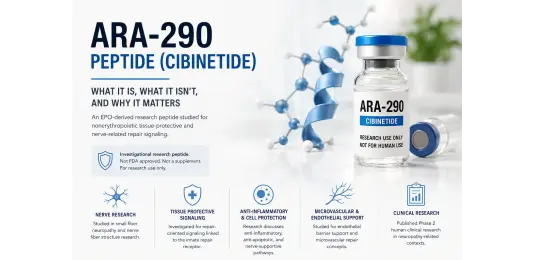
ARA-290 is one of those peptides that sounds simple at first and becomes more interesting the closer you look. At first glance, it is just an EPO-derived peptide. But that phrase hides the real story. ARA-290, also known as Cibinetide, was designed around a very specific scientific question: can researchers separate the tissue-repair side of erythropoietin from the blood-cell-stimulating side? That question is why ARA-290 became interesting. Full erythropoietin, or EPO, is best known for helping the body produce red blood cells. ARA-290 is different. It was designed to study the repair-oriented signaling linked to EPO biology without triggering the classic red-blood-cell effect.
The better question is not "which is stronger?" The better question is:
Important note: ARA-290 is investigational. It is not an FDA-approved medication, not a supplement, and not a treatment recommendation. This article is for research and educational purposes only.
What Is ARA-290 Peptide? ARA-290 is a short synthetic peptide derived from the helix-B region of erythropoietin. It is also known as Cibinetide, HBSP, or helix-B surface peptide. The easiest way to understand it is this: EPO has two sides. One side stimulates red blood cell production. The other side appears to be involved in tissue protection, inflammatory control, endothelial support, and nerve-related repair signaling. ARA-290 was designed to study the second side without activating the first. That is the whole appeal. It is not "EPO in peptide form." It is a smaller, more targeted research molecule built from one region of EPO biology.
Why ARA-290 Is Called Cibinetide Cibinetide is the clinical-development name for ARA-290. You may see the same molecule described as ARA-290, Cibinetide, HBSP, helix-B surface peptide, pHBSP peptide, or an EPO-derived research peptide. The simplest description is this: ARA-290, or Cibinetide, is an EPO-derived research peptide studied for nonerythropoietic tissue-protective signaling. That word "nonerythropoietic" matters. It means the compound is not intended to stimulate red blood cell production like full EPO.
ARA-290 Benefits: What the Word Really Means People search for "ARA-290 benefits," but that phrase needs context. ARA-290 is not approved as a therapy, so "benefits" should not be read as proven medical outcomes. In research language, the word usually refers to areas where ARA-290 has shown scientific interest. The main research areas include:
- small fiber neuropathy
- neuropathic symptom research
- nerve fiber structure
- inflammatory signaling
- tissue-protective pathways
- endothelial and microvascular repair concepts
Can a short EPO-derived peptide influence repair signaling in damaged small nerve fibers?
That is why searches like "ARA-290 nerve regeneration" exist.
ARA-290 Effects: The Simple Version The main idea behind ARA-290 is the innate repair receptor. In simple language, this receptor is part of a repair-response system that becomes relevant when tissue is stressed, inflamed, or injured. ARA-290 is studied because it may activate repair-oriented signaling without activating the classical EPO pathway that increases red blood cells. Researchers discuss ARA-290 in relation to anti-inflammatory signaling, anti-apoptotic cell protection, nerve-supportive pathways, endothelial barrier support, microvascular repair, and pain-signaling research. The important point is not that ARA-290 "does everything." It does not. The important point is that it has a specific mechanism. That makes it easier to study, explain, and compare with other peptides.
ARA-290 Clinical Trials: Why the Evidence Is Unusual for a Peptide Many research peptides have mostly animal data, theory, or online anecdotes. ARA-290 has something more serious: published human clinical research. Cibinetide has been studied in Phase 2 clinical settings, especially around sarcoidosis-associated small fiber neuropathy and diabetic neuropathy-related research. That is meaningful, but it is not the same as approval. Phase 2 trials can show promising signals. Phase 3 trials are needed to confirm whether those signals hold up in larger, more demanding studies. So the balanced view is this:
- ARA-290 has more clinical background than many peptides in its category.
- Its nerve-related research is genuinely interesting.
- It remains investigational.
- It is not an approved treatment.
- interesting research compound;
- published clinical background;
- not approved;
- not proven as a marketed therapy.
| Category | ARA-290 / Cibinetide | BPC-157 |
|---|---|---|
| Core idea | EPO-derived repair-signaling peptide | Repair-associated peptide discussed in gut and soft-tissue research |
| Main research angle | Innate repair receptor, nerve-related research, tissue-protective signaling | Angiogenesis, soft tissue, gut, tendon, and growth-factor-related models |
| Clinical trace | Published human Phase 2 research in specific neuropathy-related contexts | Much less developed human clinical record |
| Best-known discussion | Small fiber neuropathy, nerve fiber structure, inflammation | Injury repair, gut models, tendon/ligament discussion |
| Key caution | Not approved; Phase 3 confirmation absent | Not approved; human evidence remains limited |
Which mechanism is being studied, and what evidence supports it?
What Reddit Gets Right and Wrong About ARA-290 Reddit discussions about ARA-290 usually focus on nerve pain, neuropathy, dosage experiences, and comparisons with BPC-157. That can be useful for seeing what people are curious about. But anecdotes are not evidence. For ARA-290, the strongest discussion should start with mechanism, trial data, and the limits of what is actually known. The internet often wants a miracle story. ARA-290 is more interesting as a research story.
What ARA-290 Is Not
- ARA-290 is not a supplement.
- It is not an approved neuropathy treatment.
- It is not regular EPO.
- It is not a red-blood-cell booster.
- It is not a proven anti-aging therapy.
- It is not a dosage protocol.
- It is not a miracle peptide.
ARA-290 is an investigational EPO-derived peptide studied for nonerythropoietic tissue-protective and nerve-related repair signaling.
Why ARA-290 Matters ARA-290 matters because it has a cleaner scientific story than many peptides in the research market. It starts with a real biological problem: EPO has tissue-protective potential, but full EPO also affects red blood cells. ARA-290 was designed to separate those two ideas. That is why the molecule is interesting. Not because it is proven. Not because it is a shortcut. But because it asks a precise question about how repair signaling works. For readers looking for product specifications, purity information, and batch documentation, Ordinary Peptides lists ARA-290 Peptide (Cibinetide) as a research-use-only product: ARA-290 Peptide (Cibinetide) This product is for research use only. Not for human or veterinary use.
Final Thought ARA-290 is not a miracle. It is not a shortcut. But it is one of the few peptides in its category with a real research story behind it. And that story is still only half-written. Whether ARA-290 becomes a therapy or remains a research clue, it tells us something important: the body's repair signals may be more specific than we once thought. We just have to learn how to listen.
FAQ What is ARA-290 peptide? ARA-290, also known as Cibinetide, is an EPO-derived research peptide studied for nonerythropoietic tissue-protective signaling, especially in nerve and inflammation-related research. Is ARA-290 the same as Cibinetide? Yes. Cibinetide is another name for ARA-290. It may also be called HBSP or helix-B surface peptide. What are ARA-290 peptide benefits? In research discussions, ARA-290 benefits usually refer to potential signals in nerve-related research, tissue-protective signaling, inflammatory pathways, and small fiber neuropathy studies. These are not proven consumer health benefits. What does ARA-290 peptide do? ARA-290 is studied for repair-oriented signaling linked to the innate repair receptor. It is mainly discussed in relation to inflammation, nerve fiber research, and tissue-protective pathways. Is ARA-290 FDA approved? No. ARA-290 / Cibinetide is not FDA approved for therapeutic use. Is ARA-290 used for neuropathy? ARA-290 has been studied in neuropathy-related clinical research, including small fiber neuropathy contexts. It is not approved as a neuropathy treatment. What are ARA-290 side effects? Short-term studies generally reported a favorable safety profile, with mostly mild issues such as injection-site reactions and occasional headaches. Long-term safety remains insufficiently established. Is there an ARA-290 dosage chart? This article does not provide dosage charts, injection instructions, protocols, or reconstitution guidance. ARA-290 is investigational and not approved as a medication. What is the difference between ARA-290 and BPC-157? ARA-290 is an EPO-derived peptide studied around innate repair receptor signaling and nerve-related research. BPC-157 is discussed through different repair mechanisms. They are not interchangeable. Is ARA-290 the same as EPO? No. ARA-290 is derived from a region of EPO biology, but it was designed to avoid the red-blood-cell-stimulating activity associated with full erythropoietin.
References
- Heij L, Niesters M, Swartjes M, et al. Safety and efficacy of ARA 290 in sarcoidosis patients with symptoms of small fiber neuropathy. Molecular Medicine. 2012.
- Brines M, Dunne AN, van Velzen M, et al. ARA 290, a nonerythropoietic peptide engineered from erythropoietin, improves metabolic control and neuropathic symptoms in patients with type 2 diabetes. Molecular Medicine. 2015.
- Culver DA, Dahan A, Bajorunas D, et al. Cibinetide improves corneal nerve fiber abundance in patients with sarcoidosis-associated small nerve fiber loss and neuropathic pain. Investigative Ophthalmology & Visual Science. 2017.
- O'Leary OE, et al. A Phase 2 Clinical Trial on the Use of Cibinetide for the Treatment of Diabetic Macular Edema. Journal of Clinical Medicine. 2020.
- FDA Orphan Drug Designations and Approvals database: Cibinetide / ARA-290.
- European Medicines Agency orphan designation: Cibinetide for treatment of sarcoidosis.