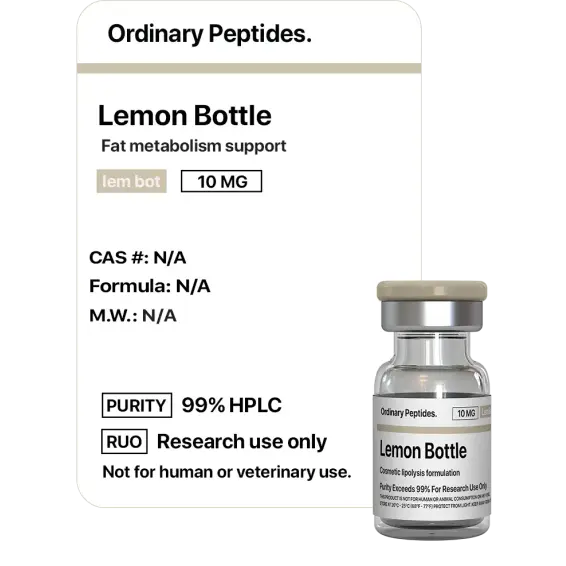
Lemon Bottle
For in vitro testing and laboratory use only. Not for human or animal consumption. Bodily introduction is illegal. Handle only by licensed professionals. Not a drug, food, or cosmetic. Educational use only.
Lemon Bottle: When the Hype Is Louder Than the Evidence
Lemon Bottle is an injectable cosmetic product that made a loud entry into the aesthetic industry as a "fat dissolver," but in a scientific context it looks considerably more modest. The claimed composition features riboflavin, lecithin, and bromelain, and in theory such components can be linked to lipid metabolism and interaction with fat cells.
However, the published data contain neither completed clinical trials nor peer-reviewed studies confirming its efficacy or safety for this particular application. Moreover, in the regulatory context there are many red flags surrounding the product: the full composition has not been publicly disclosed, and Swissmedic found none of the claimed ingredients in the tested samples.
Lemon Bottle is therefore more interesting as an example of how viral marketing can outpace science than as a product with a solid evidence base. If it is to be considered at all, then only with a clear head and an understanding that there is currently far more noise here than confirmed data.
Lemon Bottle (Injectable Fat-Dissolving Solution): A Scientific Review
Based on peer-reviewed literature and regulatory communications — see References. Last updated: April 2026.
The Short Version
Lemon Bottle is not a pharmaceutical product in any meaningful sense — it is a South Korean cosmetic injectable that became a social media sensation in 2023, accumulating over 50 million TikTok views and becoming one of the fastest-growing aesthetics procedures at unlicensed and licensed clinics across the UK, Australia, and online globally. Its appeal: injectable fat reduction using “natural” ingredients, marketed as gentler and less painful than established alternatives, available from non-medical practitioners and online marketplaces.
The scientific assessment is straightforward: there are no published randomised controlled trials, no peer-reviewed efficacy studies, and no regulatory approval supporting its use for fat reduction. The mechanism claims made for its three advertised ingredients — riboflavin (vitamin B2), bromelain (a pineapple enzyme), and lecithin (a phospholipid) — are either misrepresented, unvalidated in the context of injection lipolysis, or based on properties that do not translate to injectable fat-dissolving activity.
The contrast with the only genuinely evidence-based injectable fat-reduction option — deoxycholic acid (Kybella, FDA-approved 2015) — is stark. Kybella underwent Phase 3 clinical trials in thousands of subjects with pre-specified primary endpoints and histological validation of fat cell destruction. Lemon Bottle has none of this.[1]
| At a glance | |
|---|---|
| Brand name | Lemon Bottle |
| Manufacturer | SID Medicos, South Korea |
| Category | Cosmetic injectable (not classified as pharmaceutical/medical device) |
| Claimed active ingredients | Riboflavin (B2), bromelain, lecithin |
| Other potential ingredients | Unknown — full INCI list not publicly disclosed |
| FDA status | ⚠️ Not approved; covered by December 2023 FDA consumer warning |
| Swissmedic | ⚠️ March 2024 warning: “no medicinal effect” |
| GPhC (UK) | ⚠️ Warning issued on sales |
| Published RCTs | ❌ None |
| Histological validation | ❌ None published |
Context: What Is Injection Lipolysis?
Injection lipolysis refers to the subcutaneous injection of a pharmacological agent to induce fat cell disruption or death in localised areas of adipose tissue, allowing the body to clear the resulting cellular debris through normal inflammatory and lymphatic processes. It is not weight loss — it is localised body contouring for small, defined fat deposits.
The field originated in the early 2000s with “lipodissolve” — off-label injections of phosphatidylcholine (PC) combined with sodium deoxycholate (DC). The respective roles of PC and DC were debated for two decades. The conclusion: DCA acts as a detergent and rapidly induces necrosis while PDC induces TNF-α release, apoptosis, and subsequent enzymatic lipolysis. It was subsequently proven that DCA is the bioactive component of the formula.[3]
Kybella (deoxycholic acid, ATX-101): FDA-approved in 2015 for reduction of moderate-to-severe submental fat in adults. Deoxycholic acid is a secondary bile acid — a naturally occurring surfactant used by the body to emulsify dietary fat. When injected into fat tissue at pharmacological concentrations, its detergent action disrupts fat cell membranes, causing adipocyte death; once destroyed, fat cells do not regenerate. The REFINE clinical programme involved multiple Phase 2 and Phase 3 trials with thousands of subjects, histological biopsies confirming adipocyte destruction, and pre-specified clinical endpoints (79% patient satisfaction vs. 34% placebo). The caveat: deoxycholic acid is cytolytic and non-selective — at incorrect injection depth, injections that are too superficial may result in skin ulceration, necrosis, and infection; some cases have required IV antibiotics and incision/drainage. Kybella requires precise anatomical knowledge, which is why it is a prescription drug, not a product sold on eBay.[2]
Lemon Bottle: The Product
Lemon Bottle is manufactured by SID Medicos, a South Korean cosmetics company. It entered Western markets primarily through TikTok, accumulating tens of millions of views through before-and-after videos from practitioners and, alarmingly, non-medically trained individuals. It was marketed as “world’s fastest fat dissolving,” “100% safe and made from premium ingredients,” “virtually painless,” and a “natural” alternative to deoxycholic acid treatments.
⚠️ The only ingredient mentioned on the company’s website is riboflavin, with a footnote referring to “premium ingredients.” Drop-down menus on the product page continue to display placeholder text. The full INCI list has never been publicly disclosed by SID Medicos. Independent chemical analysis has found inconsistencies between labelled and actual contents. The manufacturer’s claim of “100% safe” is scientifically indefensible for any injectable product before systematic safety testing.[5]
The central regulatory tactic is classification as a cosmetic product rather than pharmaceutical or medical device. Cosmetic products do not require clinical trial data demonstrating efficacy or safety before market entry, are not subject to pre-market approval requirements, and quality controls on manufacturing, sterility, and batch consistency are less rigorous. This is precisely why Lemon Bottle can be sold on eBay and Etsy — no pharmaceutical licence is required, no clinical trial requirement exists, and no systematic pre-market review has occurred.
Examining the Mechanism Claims
Bromelain: “breaks down fat cells”
Bromelain is a mixture of cysteine proteases from pineapple stem with genuine biological activity: it cleaves peptide bonds in proteins and has documented anti-inflammatory properties. What bromelain does not do in any published evidence: break down adipocyte membranes (which are phospholipid bilayers, not protein structures — proteases cleave proteins, not lipid membranes); or cause adipocyte-specific lipolysis in vivo when injected subcutaneously. No published study has demonstrated that bromelain injection into subcutaneous fat causes meaningful, lasting fat cell disruption in humans or animals. The claim that bromelain “breaks down the protein structures supporting fat cells” is an extrapolation with no direct experimental support in the context of adipose tissue.
Lecithin: “emulsifies fat”
Lecithin is a mixture of phospholipids (primarily phosphatidylcholine) found in egg yolks, soy, and other biological materials. This is where Lemon Bottle’s mechanism has its strongest — though still limited — scientific grounding. Research has shown that phosphatidylcholine can induce adipocyte apoptosis through TNF-α-dependent pathways in cell culture models. However, the lipolytic/cytotoxic effects of phosphatidylcholine in vitro occurred in combination with deoxycholate as a membrane-permeabilising co-agent. In Lemon Bottle, there is no deoxycholate. Lemon Bottle contains lecithin but, on top of that, adds riboflavin and bromelain, claiming that they “activate fat metabolism and help to break down the fat,” which is not, by any means, accurate. There is no scientific data that backs up its effects, as is the case for deoxycholic acid-containing agents, which are well researched.[8]
Riboflavin: “activates fat metabolism”
Riboflavin (vitamin B2) is an essential cofactor for flavoenzymes involved in the mitochondrial electron transport chain and fatty acid β-oxidation. The claim that injecting riboflavin “activates fat metabolism” and “helps the body metabolise and eliminate fatty acids released from fat breakdown” is the weakest of the three claims. Riboflavin’s role in fat metabolism is as a mitochondrial cofactor — injecting it subcutaneously near a fat depot does not increase the rate at which adipocytes oxidise fatty acids; mitochondrial function is not rate-limited by riboflavin availability in non-deficient individuals. There is no credible pathway from “subcutaneous injection of riboflavin near fat tissue” to “enhanced fat cell metabolism.” Notably, riboflavin gives Lemon Bottle its characteristic bright yellow colour — a visual marker with no therapeutic implication.
Regulatory Warnings
In March 2024, Swissmedic warned the public against using Lemon Bottle, describing it as having “no medicinal effect.”[6] The FDA issued a December 2023 consumer warning about unapproved fat-dissolving injections sold online and at med spas, specifically noting documented adverse events including infected nodules, persistent scarring, and nerve injury.[7] The GPhC (UK General Pharmaceutical Council) issued specific warnings about registered pharmacies selling Lemon Bottle, noting concerns about safety, quality, and the inappropriateness of pharmacy supply of a product without clinical evidence.[5]
Adverse Events
The adverse event record is distorted by underreporting (typical of cosmetic procedures outside medical reporting frameworks) and the heterogeneous practitioner base (ranging from plastic surgeons to unlicensed beauticians). Common adverse effects include injection site pain, bruising, redness, swelling, and induration (hardness) at injection sites. Serious adverse events reported: severe bruising with prolonged healing; infections at injection sites ranging from cellulitis to abscess formation; abscesses requiring incision and drainage and/or IV antibiotics; skin necrosis (at least one documented case); and persistent subcutaneous nodules requiring medical management.
Many of these adverse events reflect non-sterile technique by untrained practitioners or self-injectors, incorrect injection depth (too superficial into dermis), and unknown formulation stability and sterility from products purchased online through non-pharmaceutical channels. The claim of “100% safe” and “virtually painless with little to no swelling” is directly contradicted by these documented events.
Comparison: Lemon Bottle vs. Deoxycholic Acid (Kybella)
| Feature | Lemon Bottle | Kybella (deoxycholic acid) |
|---|---|---|
| Active ingredient | Riboflavin, bromelain, lecithin (+ undisclosed) | Synthetic deoxycholic acid 10 mg/mL |
| Regulatory approval | ❌ None (cosmetic classification) | ✅ FDA-approved 2015; CE marked |
| Clinical trials | ❌ None published | Phase 3 REFINE programme; thousands of patients |
| Histological evidence | ❌ None | ✅ Adipocyte destruction confirmed |
| Full ingredient disclosure | ❌ No | ✅ Yes (prescription label) |
| Efficacy data | ❌ None | 79% patient satisfaction vs. 34% placebo |
| Serious adverse events | Abscess, necrosis, infection documented | Nerve injury, necrosis (injection depth error) |
| Practitioner requirement | None (cosmetic product) | Prescriber / trained practitioner |
The Social Media Problem
Lemon Bottle’s rise illustrates a systemic problem in aesthetics: social media marketing of cosmetic procedures precedes regulatory oversight by years. Its “viral marketing sensation” status was built on before-and-after photos of uncertain provenance, testimonials from practitioners with financial interest in selling procedures, and the aesthetic appeal of a naturally-named injectable that sounds safer than “deoxycholic acid.” The product’s website is sadly lacking in any robust clinical evidence and safety data that supports efficacy; there is no ingredient (INCI) list available on the website, nor any credible scientific evidence available to support the idea that riboflavin acts as a fat-dissolving solution.[9]
Crucially, the placebo arm of the Kybella REFINE trials showed 34% patient satisfaction without any active ingredient — demonstrating that procedure, attention, and expectation alone produce substantial perceived improvement. Social media evidence (before-and-after photos, testimonials) is not a substitute for controlled clinical data.
Common Misconceptions
“It’s natural so it’s safer.”
Natural ingredients are not inherently safe when injected subcutaneously in undisclosed concentrations. The bacterial sources of infection, abscess formation, and necrosis documented with Lemon Bottle injections are not caused by bromelain or lecithin — they result from the act of penetrating skin barriers, which carries infection risk regardless of what the injectable contains.
“It’s gentler because it doesn’t contain deoxycholic acid.”
Gentler and less effective are functionally the same in this context. If lecithin without deoxycholate does not produce meaningful adipocytolysis, the “gentleness” may simply reflect the absence of any meaningful effect at all.
“Swissmedic said it has ‘no medicinal effect’ but it’s not meant to be a medicine.”
Swissmedic’s characterisation reflects that the product makes medical claims (fat reduction) without being able to substantiate them. The cosmetic/pharmaceutical classification distinction is a regulatory technicality that reflects the absence of clinical evidence, not evidence that the treatment is effective through some non-medical mechanism.
Key Takeaways
- ⚠️ Lemon Bottle is a cosmetic injectable product with no published clinical trial evidence of efficacy for fat reduction. The absence of evidence reflects genuine lack of investigation. The product has been in widespread use since 2022–2023 without a single controlled study.
- ⚠️ The mechanism claims do not hold up to scientific scrutiny. Bromelain does not break down fat cells; riboflavin does not enhance fat metabolism when injected near adipose tissue; lecithin/phosphatidylcholine has some mechanistic basis but its efficacy without deoxycholate is unvalidated. The “three-phase mechanism” is marketing language, not pharmacology.
- ⚠️ Multiple regulatory authorities have issued safety warnings. Swissmedic (“no medicinal effect”), GPhC, and the FDA’s broader warning on unapproved fat-dissolving injectables collectively represent a clear regulatory posture.[6][7]
- ⚠️ Documented adverse events include abscess, necrosis, and severe infection. The claim of “100% safe” is false on its face for any injectable product.
- The only genuinely evidence-based injectable fat-reduction option is deoxycholic acid (Kybella). It has Phase 3 clinical trial data, histological proof of mechanism, FDA approval, and a standardised dosing protocol administered by trained practitioners — with documented risks precisely because it has been properly studied.[1]
References
Deoxycholic Acid / Kybella Evidence Base
- Kybella (deoxycholic acid) Prescribing Information. AbbVie/Allergan. FDA approved April 2015. Updated 2018.
- Management of serious adverse events following deoxycholic acid injection for submental and jowl fat reduction: a systematic review and management recommendations. PMC11381091. 2024.
- The role of fat-reducing agents on adipocyte death and adipose tissue inflammation. PMC8988282. Frontiers in Endocrinology. 2022.
- Comparison of cholic acid (MT921) and deoxycholic acid in fat reduction efficacy and skin adverse reactions. MDPI Pharmaceuticals. 2025.
Lemon Bottle
- GPhC issues warning on sales of fat-dissolving Lemon Bottle injections. Pharmacy Magazine. April 2025.
- Swissmedic public warning on Lemon Bottle. March 2024. (Characterisation: “no medicinal effect”)
- FDA consumer warning: potential side effects from unapproved fat-dissolving injections. December 20, 2023.
- Professional Beauty: Lemon Bottle fat dissolving expert assessment. Includes chemical engineer and clinician commentary.
- Injection lipolysis: Lemon Bottle dangers. RealSelf News. February 2024.
Lemon Bottle is a brand of fat-dissolving injectable solution that gained rapid popularity primarily through social media. It is marketed as a non-surgical cosmetic treatment for reducing localized fat deposits in areas such as the chin, jaw, abdomen, arms, thighs, and back. It is classified as a cosmetic treatment rather than a medical one, which means it is subject to less regulatory oversight than pharmaceutical fat dissolvers.
The three main advertised ingredients are riboflavin (vitamin B2), bromelain — a digestive enzyme derived from pineapple — and lecithin, a fat-emulsifying compound. Manufacturers state there are additional ingredients but have not disclosed a full ingredient list, which is a significant concern raised by many medical professionals. Unlike established fat dissolvers such as Kybella or Aqualyx, Lemon Bottle does not contain deoxycholic acid, the compound in most clinically validated injectable fat dissolvers.
The claimed mechanism is lipolysis — the solution is injected directly into the fatty tissue beneath the skin, where the active ingredients are said to break down fat cell membranes, releasing their contents. The freed fatty acids are then supposedly eliminated through the body's lymphatic system and excreted via urine. Staying well hydrated after treatment is recommended to support this process. However, the exact mechanism is not fully understood, and no clinical studies specifically validate how these particular ingredients work together in this formulation.
Proponents claim it reduces stubborn localized fat that resists diet and exercise, with minimal downtime and results visible after as few as one session. Additional claims include improved skin firmness, collagen stimulation, and boosted metabolism. Sessions typically take around 30 minutes. However, it is important to note that these claims are largely based on anecdotal reports and have not been validated by peer-reviewed clinical research.
No. Lemon Bottle is not FDA-approved, has no large-scale clinical trials supporting its safety or efficacy, and its full ingredient list has not been publicly disclosed. It is not regulated as a medical product in most countries. This stands in contrast to Kybella, which is the only FDA-approved injectable for submental fat reduction, and Aqualyx, which is widely used in Europe with an established clinical track record.
Common side effects include bruising, swelling, redness, warmth, soreness, and temporary small nodules or firmness under the skin — most of which resolve within a few days. More serious but less common complications reported include infections, prolonged pain, uneven fat removal, skin irregularities, nerve damage, and in rare cases tissue necrosis if injections are placed incorrectly near blood vessels.
It is not recommended for pregnant or breastfeeding women, people with severe allergies — particularly to pineapple or bromelain — those with active skin infections or inflammation in the treatment area, or anyone with blood clotting disorders, as bromelain may affect coagulation. Given the unknown full ingredient list and lack of clinical evidence, anyone with underlying health conditions should consult a qualified medical professional before proceeding.