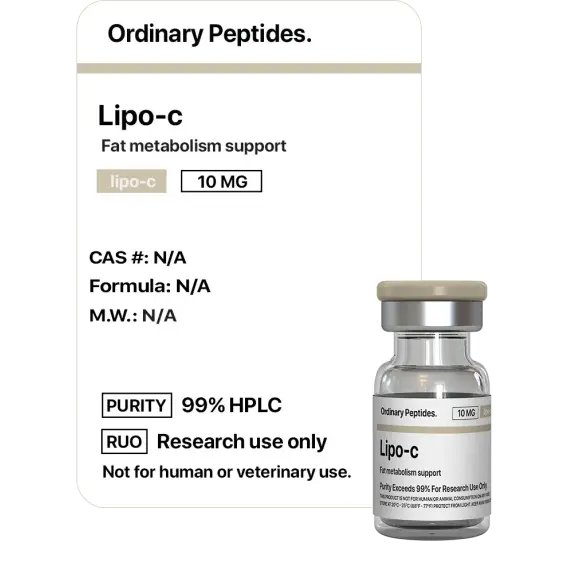
Lipo-c
For in vitro testing and laboratory use only. Not for human or animal consumption. Bodily introduction is illegal. Handle only by licensed professionals. Not a drug, food, or cosmetic. Educational use only.
Lipo-C: A Lipotropic Formula Where the Biochemistry Is More Interesting Than the Marketing
Lipo-C is not a single "magic injection," but a compounded lipotropic formula with a varying composition, which typically includes methionine, choline, L-carnitine, and B vitamins. In a research and biochemical context, these components are associated with fat metabolism, fatty acid transport, and support of liver function — so the underlying idea looks logical.
But here is where the conversation gets honest: the published data contain no large clinical evidence base for Lipo-C as a finished product specifically, and the effect is often discussed against the backdrop of diet, physical activity, and correction of nutritional deficiencies. In simple terms, the formula looks more like a metabolic "support team" than a "burn fat" button.
This is precisely why Lipo-C may be of interest to those who want to look at nutrient injections without illusions: with an understanding of the composition, the mechanistics, and the real boundaries of the evidence.
Lipo-C (Lipotropic Injection / MIC + Carnitine + B Vitamins): A Scientific Review
Based on peer-reviewed literature — see References. Last updated: April 2026.
The Short Version
Lipo-C is not a single compound with a defined structure and mechanism — it is a category of compounded injectable formulations sold under various names at weight-loss clinics and wellness centres, typically combining methionine, inositol, choline (the “MIC” core), L-carnitine (the “C”), and B vitamins. No standardised composition exists; concentrations and ratios vary between compounding pharmacies and prescribing clinicians.
The honest summary: the individual biochemical rationale for each component is real and well-described. Choline deficiency demonstrably causes fatty liver in humans; inositol has RCT-level evidence for insulin sensitivity improvement in PCOS; L-carnitine has a modest meta-analysis signal for weight loss as an adjunct to exercise; B12 deficiency is genuinely associated with metabolic dysfunction. The clinical evidence for the combined injectable formulation as a weight-loss or fat-mobilisation intervention in adequately nourished adults is essentially non-existent — no randomised, placebo-controlled trial of Lipo-C injections as marketed has been published. The gap between “these nutrients matter biochemically” and “injecting them causes meaningful fat loss in well-nourished people” is wide, and the marketing from weight-loss clinics persistently overstates what the evidence supports.
| At a glance | |
|---|---|
| Trade name | Lipo-C (also Lipo-MIC, MIC-B12, lipotropic injections) |
| Type | Compounded multi-ingredient injectable formulation |
| Core components | Methionine + Inositol + Choline (MIC) + L-Carnitine + B vitamins |
| Variable additions | Vitamin C, chromium picolinate, procaine HCl, B-complex |
| FDA status | ⚠️ Not approved; unapproved compounded product |
| Clinical trials for formulation | ❌ None (as combined injectable) |
| WADA | Not prohibited |
History and Naming
The “lipotropic” concept originates in early 20th-century nutritional biochemistry. Charles Best and James Ridout at the University of Toronto (1932) demonstrated that lecithin and later choline could prevent or reverse fatty liver in rats fed high-fat, high-cholesterol diets. By the 1940s, inositol and methionine had been added to the “lipotropic” category after similar protective effects in rodent liver models.
The injectable formulation as marketed today became popular in US weight-loss clinics in the 1990s–2000s, typically injected weekly alongside calorie-restricted diet programmes. The specific “Lipo-C” name (with “C” denoting carnitine) has been widely adopted by compounding pharmacies and telehealth weight-loss programmes, particularly as an adjunct to GLP-1 agonist programmes in recent years.
The Components: Individual Evidence
Methionine
L-methionine is one of the two sulphur-containing essential amino acids. It is the primary precursor to S-adenosylmethionine (SAMe) — the universal methyl donor for hundreds of transmethylation reactions. In hepatic lipid metabolism, SAMe-dependent methylation of phosphatidylethanolamine (PE) to phosphatidylcholine (PC) is a critical step in VLDL assembly: phosphatidylcholine is a required component of the VLDL envelope, and when it is not available, triglycerides cannot be exported from the liver and hence accumulate in the cytosol.[3] Methionine also feeds into the glutathione pathway (via transsulphuration), producing the liver’s primary antioxidant. In rodent models, methionine-and-choline-deficient (MCD) diets are the gold standard for producing non-alcoholic steatohepatitis precisely because they deprive the liver of both the methyl group supply and the direct choline source simultaneously.
⚠️ There is no convincing evidence that adding methionine above adequate dietary intake enhances fat metabolism or promotes weight loss in people who are not deficient. A further caution: methionine is a precursor to homocysteine; while the body normally converts homocysteine back to methionine (via betaine/B12) or to cysteine (via B6), high-dose methionine can transiently increase circulating homocysteine — an independent cardiovascular risk factor. This is why B6 and B12 are co-included in most Lipo-C formulations: they support homocysteine clearance.
Inositol
Myo-inositol is a cyclic sugar alcohol ubiquitous in mammalian cell membranes as a phospholipid component (phosphatidylinositol) and a second-messenger precursor (IP3 signalling). Despite being called “vitamin B8” in community contexts, inositol is not classified as a vitamin; the body synthesises it from glucose and dietary intake is typically adequate. Inositol modulates insulin signalling as a mediator of the insulin signal transduction cascade.
Clinical evidence: Inositol has the strongest evidence base of any Lipo-C component, specifically in women with PCOS. In this population, supplementation appeared particularly effective for improving insulin sensitivity and body fat distribution, with longer intervention durations (>8 weeks) associated with greater effects on BMI and insulin levels. The 2:1 ratio of myo-inositol to D-chiro-inositol is widely studied in PCOS, showing improvements in ovulation rate, androgen levels, and metabolic markers.[6] However, the mechanism in PCOS is correction of a specific defect in inositol utilisation — extrapolating from these PCOS RCTs to general weight loss in non-PCOS adults is not scientifically supported.
Choline
Choline is an essential nutrient (conditionally essential — the body synthesises some but typically insufficient amounts). Adequate intake for adults: 550 mg/day (males) and 425 mg/day (females). Most Americans consume less than this. Dietary sources: eggs (~150 mg/egg, the richest single source), liver, meat, fish, cruciferous vegetables.
The choline-fatty liver connection is one of the most robustly demonstrated relationships in nutritional biochemistry: humans eating diets low in choline develop fatty liver and liver damage. The likely mechanism is related to VLDL synthesis — phosphatidylcholine is a required component of the VLDL envelope, and when it is not available, triglycerides cannot be exported from the liver and accumulate in the cytosol.[3] Buchman et al. randomised patients on long-term total parenteral nutrition to IV choline chloride 2 g/day or placebo for six weeks; choline repletion normalised plasma choline, reduced ALT by approximately 50%, and halved intrahepatic fat on CT scans.[4] However, the parenteral route and severe baseline deficiency in TPN patients restrict generalisability.
The important nuance: the evidence for choline is strongest in correcting deficiency. No randomised study has evaluated chronic choline supplementation in biopsy-proven NAFLD or NASH, and addressing these evidence gaps should be prioritised before broad clinical implementation. Supraphysiological choline in non-deficient adults as a fat-burning intervention is not similarly validated.[5]
L-Carnitine
L-carnitine is a quaternary ammonium compound synthesised from lysine and methionine in the liver, kidney, and brain — not an essential nutrient in healthy adults who consume adequate protein. Its primary role: transport of long-chain fatty acids across the inner mitochondrial membrane for β-oxidation (energy production from fat). Supplementation is most relevant in populations with low baseline carnitine status: vegans, elderly individuals, and patients on certain medications.
A 2020 meta-analysis of 37 randomised controlled trials found L-carnitine supplementation resulted in modest but significant weight loss of approximately −1.21 kg and fat mass reduction of approximately −2.08 kg, primarily when combined with exercise — consistent but small effects.[7] The injectable route bypasses gastrointestinal absorption limits (oral bioavailability ~14–18%), delivering substantially more carnitine than equivalent oral dosing. Whether this produces clinically meaningful benefits above the modest oral supplementation effect is not known.
B Vitamins (B1, B2, B3, B5, B6, B12)
Water-soluble cofactors essential for energy metabolism. B12 (cyanocobalamin or methylcobalamin) is the most frequently included. B12 deficiency is common in strict vegans/vegetarians, the elderly (impaired intrinsic factor), and patients on metformin (which impairs B12 absorption). For people with documented B12 deficiency, IM B12 injection is clinically beneficial and an established medical treatment. For people with adequate B12 status, there is no evidence that supraphysiological B12 injection improves energy, metabolism, fat loss, or any clinical outcome. The body excretes excess water-soluble vitamins rapidly — the argument that injection “bypasses absorption” and delivers them more efficiently is true, but if you are not deficient, more efficient delivery of more vitamin than you need does not produce a clinical benefit.
The Combined Formulation: Evidence Review
No randomised, double-blind, placebo-controlled trial has evaluated the specific Lipo-C combination for weight loss, fat metabolism, energy, or any patient-relevant outcome. This is the central evidence gap. What does exist: animal studies from the 1930s–1970s demonstrating lipotropic effects of individual components in diet-deficient rodents; small clinical studies of individual components in specific deficiency or disease states; and observational data from weight-loss clinic programmes where Lipo-C is given alongside caloric restriction and lifestyle modification — confounders are insurmountable. The absence of controlled human trials reflects a genuine lack of rigorous investigation, not merely a regulatory technicality. The formulation has been administered to hundreds of thousands of patients for decades without the foundational controlled study that would confirm or refute efficacy.
Why Injection Rather Than Oral?
B12 injection is clinically necessary for patients with pernicious anaemia, atrophic gastritis, or post-gastric surgery who lack intrinsic factor for oral B12 absorption — IM delivery bypasses the absorption requirement entirely. L-carnitine has genuinely limited oral bioavailability (~14–18%), so IM delivery does provide substantially higher circulating concentrations. For inositol and choline, however, oral bioavailability is high (>80–90%); injecting them bypasses no meaningful absorption barrier for most people. The claim that injection produces a “more bioavailable” effect for these components is not well-supported.
| Feature | Oral MIC/Carnitine | Injectable Lipo-C |
|---|---|---|
| B12 absorption (non-deficient) | Adequate | No clinical advantage |
| B12 absorption (deficient) | Impaired | ✅ Clinically superior |
| Carnitine bioavailability | 14–18% | ~100% |
| Inositol bioavailability | High (>80%) | No meaningful advantage |
| Choline bioavailability | High (~90% from food) | No meaningful advantage |
| Cost | Low | High (clinic/pharmacy) |
| Risk | Minimal (GI upset) | Injection site reactions, infection, nodule formation |
| Evidence base | Individual components — moderate for specific populations | ❌ None as combined formulation |
Safety Profile
Most common adverse effects: injection site reactions (pain, bruising, redness); GI effects including nausea and mild diarrhoea (from choline and carnitine, which generate trimethylamine via gut bacteria, excreted as TMAO and potentially causing a fishy body odour); headache from niacin flush if high-dose niacinamide is included.
⚠️ Documented serious adverse effect: A 2021 case report documented severe skin inflammation and hard nodules at injection sites following choline injections, consistent with the known skin irritant properties of choline chloride — raising questions about the suitability of certain choline salt forms for IM injection.
⚠️ Homocysteine elevation: High-dose methionine without adequate B6 and B12 cofactors can transiently raise homocysteine. The co-inclusion of B6 and B12 in standard Lipo-C formulations is specifically intended to mitigate this — but product quality variation at compounding pharmacies means this protection cannot be assumed for all products.
TMAO: Choline and carnitine are both converted by gut bacteria to trimethylamine (TMA), which the liver oxidises to trimethylamine N-oxide (TMAO). Elevated TMAO has been associated in epidemiological studies with increased cardiovascular risk. This is a reason why the “more is better” argument for these compounds is oversimplified. Product quality: As compounded formulations not subject to FDA quality review, Lipo-C products vary in concentration, sterility, excipient profiles, and ingredient identity.
The Marketing-Evidence Gap
The marketing language used by weight-loss clinics consistently exceeds what the evidence supports. Phrases like “proven fat-burning injection,” “accelerates metabolism,” “boosts liver function to melt fat,” and “synergistic fat-mobilisation formula” are not supported by controlled clinical trial data. What the evidence actually supports: correcting genuine deficiency in choline, B12, or carnitine may improve metabolic function in individuals who are deficient; inositol supplementation (oral) improves insulin sensitivity in women with PCOS; L-carnitine produces modest weight and fat mass reduction as an adjunct to exercise. What the evidence does not support: supraphysiological injections of these nutrients in adequately nourished people produce meaningful fat loss; the injectable combination produces synergistic effects beyond individual components; the injectable route provides meaningful advantage over oral supplementation for most of these compounds.
Common Misconceptions
“It works because each ingredient has a role in fat metabolism.”
Having a role in a metabolic pathway does not mean that more of that molecule accelerates the pathway in someone who is not deficient. The liver does not export more triglycerides just because it receives more choline than it needs; the rate-limiting steps in VLDL assembly are regulated by multiple factors beyond choline availability.
“The injection is much more bioavailable than oral.”
This is true for B12 in specific deficiency states, partially true for L-carnitine, and essentially false for inositol and choline. Bioavailability advantages do not automatically translate to clinical benefits.
“Clinics have been using it for years so it must work.”
Longevity of use is not evidence of efficacy. These formulations are administered where patients simultaneously undergo caloric restriction and lifestyle modification. Attributing weight loss outcomes specifically to the Lipo-C injection versus the diet and exercise programme is not possible without a controlled trial.
Key Takeaways
- Lipo-C is a compounded multi-ingredient formulation, not a single defined compound. Compositions vary; no standardised product exists; no FDA approval or review has occurred for the combination.
- Individual components have real biochemical roles. Choline’s role in hepatic fat export via phosphatidylcholine/VLDL is the most robustly documented.[3] Inositol has RCT evidence for PCOS.[6] L-carnitine has a modest meta-analysis signal.[7] B12 correcting deficiency is well-established medicine.
- ⚠️ The leap from “deficiency causes problems” to “supplementation above adequacy enhances fat burning” is not supported by clinical evidence. The strongest case for each component is in correcting deficiency, not in providing supraphysiological doses to adequately nourished adults.
- ⚠️ No controlled trial of the combined injectable formulation for weight loss or any clinical endpoint exists. This is the fundamental evidence gap. Decades of clinical use have not been accompanied by the controlled studies that would confirm the marketed claims.
- For patients with genuine deficiencies (B12 in vegans or metformin users; carnitine in specific populations), targeted supplementation is clinically appropriate. The evidence supports repletion, not blanket co-administration of everything in the mixture.
References
Choline and Hepatic Fat Metabolism
- Zeisel SH. Choline: essential for brain development and function. Advances in Pediatrics. 1997.
- Choline's role in maintaining liver function: new evidence for epigenetic mechanisms. PMC3729018. 2013.
- Choline metabolism provides novel insights into non-alcoholic fatty liver disease and its progression. PMC3601486. 2013.
- Buchman AL, et al. Randomised trial of intravenous choline chloride in patients on total parenteral nutrition. Gastroenterology. 1995.
- Choline supplementation on oxidative stress and outcomes in NAFLD patients: randomised controlled study. PMC12361734. 2025.
Inositol
- Inositol supplementation efficacy in improving cardiometabolic and anthropometric indices: systematic review and meta-analysis. PMC12574088. 2025.
L-Carnitine
- Pooyandjoo M, Nouhi M, et al. The effect of (L-)carnitine on weight loss in adults: a systematic review and meta-analysis of randomized controlled trials. Obesity Reviews. 2016.
Key Historical Lipotropic Research
- Best CH, Ridout JH. The lipotropic action of methionine. Journal of Physiology. 1939;97:489–494.
Lipo-C is a compounded lipotropic injection containing a blend of amino acids, vitamins, and metabolic cofactors. It is not a single peptide but a formulated combination — most commonly methionine, inositol, choline, and L-carnitine, often alongside vitamin C, B vitamins, and sometimes chromium or procaine depending on the compounding pharmacy. It is primarily used in medically supervised weight loss programs to support fat metabolism and liver function.
Each component plays a specific role. Methionine is an essential amino acid that breaks down fat and prevents fat buildup in the liver. Inositol supports fat metabolism, regulates insulin sensitivity, and has cognitive and mood-balancing effects. Choline is essential for transporting fat out of the liver and supporting liver health. L-carnitine shuttles fatty acids into cells so they can be burned for energy, which also supports muscle recovery and reduced fatigue. B vitamins, particularly B12, support energy production and red blood cell formation.
The lipotropic compounds in Lipo-C directly target fat stored in the liver and surrounding tissues, breaking it down and converting it into usable energy. This reduces strain on the liver, improves metabolic efficiency, and supports the body's ability to process and eliminate excess fat. The combination is designed to work synergistically — each component enhancing the effectiveness of the others — particularly when paired with diet and exercise.
Reported benefits include accelerated fat burning, improved energy levels, enhanced liver function, preservation of lean muscle mass during calorie restriction, improved digestion and nutrient absorption, and support for cognitive clarity. Some formulations containing L-carnitine also aid athletic recovery. Lipo-C is also used alongside GLP-1 medications like semaglutide or tirzepatide to augment their fat-loss effects.
It is given as an intramuscular injection, typically in the thigh, upper arm, or buttocks. Most weight loss protocols recommend once-weekly injections during an active program, reducing to monthly maintenance injections once a goal weight is reached. It is a compounded medication, meaning it is prepared by a licensed compounding pharmacy to a physician's specification.
Most people tolerate Lipo-C well. The most common side effects are mild injection site soreness, redness, or temporary bruising. Some people experience nausea, upset stomach, or dizziness. Rare but more serious concerns include allergic reactions, and with excessive or prolonged use, high-dose methionine can raise homocysteine levels — a cardiovascular risk factor — and choline in excess can potentially stress liver function rather than support it.