SLU-PP-332
For in vitro testing and laboratory use only. Not for human or animal consumption. Bodily introduction is illegal. Handle only by licensed professionals. Not a drug, food, or cosmetic. Educational use only.
SLU-PP-332: A Synthetic ERR Agonist at the Crossroads of Exercise Mimetic Research, Mitochondrial Biology, and Metabolic Science
SLU-PP-332 is a synthetic small molecule (CAS 303760-60-3) best known in the field of metabolic research, where it has been studied as a pan-agonist of the estrogen-related receptors (ERRα, ERRβ, ERRγ) and linked to the biology of cellular energy metabolism. In the research context, the main interest in this compound grew out of studies reporting an acute aerobic exercise genetic program, enhanced mitochondrial function, and increased oxidative muscle fibers in preclinical models. That sounds dramatic — and that is precisely why it attracts so much attention.
Published reports have also discussed its relationship with fat oxidation, endurance capacity, and weight regulation independent of appetite, while preclinical data have connected it to a broader exercise mimetic framework. Still, a sober filter is essential here: a compelling molecular story is not yet ready-made fitness-in-a-bottle. If only biology were that cooperative.
What makes SLU-PP-332 genuinely interesting is that it sits at the crossroads of longevity hypotheses, mitochondrial biology, and the newer tradition of nuclear receptor pharmacology. For readers who care not just about bold promises but about the actual scientific grounds for interest, this is exactly the kind of compound worth examining carefully — and without illusions.
SLU-PP-332: A Scientific Review of the "Exercise Mimetic"
Based on peer-reviewed literature — see References. Last updated: May 2026.
The Short Version
SLU-PP-332 is one of those molecules where the biohacker press generates excitement faster than the ink dries on the original papers. "Exercise in a pill," "cardio without cardio," "the future of metabolic therapy" — the headlines run in that direction. The reality, as usual, is more nuanced.
The molecule itself is genuinely interesting. A small synthetic compound that activates the ERR family of nuclear receptors (estrogen-related receptors) — and through them, switches on a transcriptional program in skeletal muscle that closely resembles the one triggered by aerobic exercise. In mice, this works: more oxidative muscle fibers, better endurance, fat loss, improved cardiac function in heart failure models.
Now for the context that usually gets left out of the marketing materials.
First — no human has ever received SLU-PP-332 in a registered clinical trial. No Phase 1. No human pharmacokinetics. No documented adverse event data at the doses used by "enthusiasts."
Second, the overwhelming majority of published studies come from a small group of connected labs — Thomas Burris's team (originally at Saint Louis University, now Washington University) and collaborators at Baylor College of Medicine. This is not a conspiracy — it's the normal state of a new chemical tool in its early years. But it does mean independent replication is still minimal.
Third, and probably most important — ERRα, the primary target of SLU-PP-332, has been known in the oncology literature for over a decade as a marker of aggressive breast, prostate, ovarian, and colorectal cancers. Not as a coincidental correlation. As a documented association with worse prognosis.
| At a glance | |
|---|---|
| Other names | SR9861, TBI3948 |
| Chemical class | Small molecule (NOT a peptide), hydrazone |
| Formula | C₁₈H₁₄N₂O₂ |
| Molecular weight | 290.3 Da |
| CAS | 303760-60-3 |
| Target | Pan-agonist of ERRα/β/γ (highest potency at ERRα) |
| EC50 (reporter assays) | ERRα = 98 nM, ERRβ = 230 nM, ERRγ = 430 nM |
| Developer | Thomas P. Burris lab, Saint Louis University |
| First in vivo paper | Billon et al., ACS Chem Biol, 2023 |
| FDA status | ❌ Not approved. No human clinical trials. |
| WADA status | ⚠️ Falls under class S4.5 (metabolic modulators); detection methods actively developed (2026) |
| Route in published studies | Intraperitoneal in mice; oral bioavailability partially confirmed |
The Biological Foundation: What ERRs Are and Why They Matter
Nuclear receptors without a ligand
Estrogen-related receptors (ERR) are a family of three nuclear receptors (α, β, γ), named after their structural similarity to the estrogen receptor. The name is misleading: estrogens do not activate them. They are "orphan" receptors — for a long time it was thought they had no natural ligand at all, operating in a constitutively active mode, regulated mainly by expression levels and coactivators like PGC-1α.
ERRα is the master regulator of mitochondrial biogenesis and oxidative metabolism in skeletal muscle, heart, and brown adipose tissue. It sits at the center of the same transcriptional network that long aerobic work activates: PGC-1α wakes up after training, drags ERRα along with it, and ERRα turns on the genes for oxidative phosphorylation, fatty acid β-oxidation, mitochondrial biogenesis. This is the same mitochondrial-biogenesis axis engaged by MOTS-c, the mitochondrial-derived peptide, though via a different mechanism.
In other words — it's the node through which the cell "remembers" that you've been running.
Why ERRs were considered "undruggable" for so long
Until recently, the consensus was that ERRα was not a tractable drug target. Inverse agonists like XCT790 existed, but real agonists — ones that activate all three ERRs at nanomolar concentrations — simply weren't in the literature. The Baylor cardiology group, in their 2024 Circulation paper, states plainly that SLU-PP-332 and SLU-PP-915 "disproved the long-held belief in the field that ERRα is not possible to target."[3]
This is important context. SLU-PP-332 is not "yet another peptide" made by tweaking something familiar. It's a fundamentally new class of pharmacological tool. And that's why it gets so much academic attention.
Chemistry
SLU-PP-332 is a synthetic small organic molecule, not a peptide (though vendors often sell it under the "peptide" label — that's either an error or deliberate mislabeling). Chemically, it's a hydrazone built from 4-hydroxybenzoic acid and 2-naphthaldehyde. Formula C₁₈H₁₄N₂O₂, molecular weight around 290 Da. Solubility: good in DMSO, poor in water, which dictates how the compound has to be handled in research.
| Property | Detail |
|---|---|
| Chemical class | Aryl hydrazone |
| Molecular weight | 290.3 Da |
| Solubility | Good in DMSO (up to 75 mg/mL); limited in water |
| Development route | Rational design from ERRα agonist screen |
| Affinity | Highest for ERRα; also activates ERRβ and ERRγ |
Origin: The Burris Lab
Thomas P. Burris has been working on nuclear receptors for over twenty years — first at the Pennington Biomedical Research Center, then Scripps Florida, then Saint Louis University, now Washington University. His lab previously developed modulators for REV-ERB, LXR, and PPAR — the same receptors that underpin most "exercise mimetic" research programs. SLU-PP-332 emerged as the result of that long arc of work. The name, unsurprisingly, comes from "Saint Louis University, prototype-prototype-332."
The first major in vivo paper — Billon et al., ACS Chemical Biology, 2023 — showed the compound triggered an acute exercise-like transcriptional response in skeletal muscle, in an ERRα-dependent manner. Subsequent work expanded the picture: metabolic syndrome (Butler et al., JPET 2024), heart failure (Xu et al., Circulation 2024), aging kidney (Wang et al., Am J Pathol 2023).
The dominance of the Burris group in SLU-PP-332 literature is a factor worth keeping in mind. It doesn't mean the data are wrong. It does mean methodological diversity is still limited.
Proposed Mechanisms of Action
1. Activation of the ERRα transcriptional program (primary mechanism)
After binding ERRα, the molecule stabilizes a receptor conformation that allows more efficient recruitment of coactivators (notably PGC-1α) and activation of target gene transcription. In skeletal muscle, this raises the expression of genes for fatty acid β-oxidation, the Krebs cycle, oxidative phosphorylation, and mitochondrial biogenesis.
Separately — induction of DDIT4, a gene normally induced within minutes of a short bout of aerobic exercise and responsible for the cascade of physiological adaptations that follows. This is what gives SLU-PP-332 the "acute aerobic exercise mimetic" label.[1]
2. Shift toward oxidative muscle fibers
In mice at 30 mg/kg intraperitoneal daily for several weeks, the proportion of type IIa fibers increased — fast but oxidative fibers with high mitochondrial density. That's the same phenotype endurance training produces. On a treadmill-to-exhaustion test, treated mice ran roughly 70% longer than vehicle controls.[1]
3. Metabolic effects in obesity
In a diet-induced obesity (DIO) model, 50 mg/kg twice daily for 28 days produced: ~12% body weight reduction, decreased fat mass, normalized glucose tolerance, lowered total cholesterol and triglycerides, smaller adipocytes. Food intake didn't change meaningfully — so the effect comes from increased energy expenditure, not appetite suppression.[2] This positions SLU-PP-332 differently from appetite-targeting compounds in the metabolic research space such as cagrilintide, which works on satiety rather than energy expenditure.
4. Cardioprotection through ERRγ
In a pressure overload heart failure model (TAC — transaortic constriction), SLU-PP-332 improved ejection fraction, reduced fibrosis, and extended survival — without affecting hypertrophy. Interestingly, this effect is mediated primarily by ERRγ, not ERRα. The mechanism: enhanced fatty acid β-oxidation and restored mitochondrial function in cardiomyocytes, which are the first cells to suffer in heart failure.[3]
5. Protection of the aging kidney
In mice with age-related kidney dysfunction, 25 mg/kg/day for 8 weeks reduced albuminuria, normalized kidney mass, and restored podocin levels. Again — through reduced mitochondrial dysfunction in kidney cells.[4]
| Proposed mechanism | Evidence type | Independently replicated |
|---|---|---|
| ERRα-dependent activation of aerobic program | In vitro + mice (Burris lab) | ⚠️ Mostly one group |
| Increased oxidative fibers, ↑ endurance | Mice (Burris lab) | ⚠️ Mostly one group |
| ↓ body weight, ↓ fat, ↑ glucose control (DIO) | Mice (Burris lab) | ⚠️ Mostly one group |
| Cardioprotection via ERRγ | Mice (Baylor + Burris) | ✓ Two collaborating groups |
| Aging kidney protection | Mice | ⚠️ Separate lab, single paper |
| Human pharmacokinetics | — | ❌ Does not exist |
| Human safety | — | ❌ Not studied |
Preclinical Evidence: What Has Actually Been Shown
Endurance and muscle phenotype (Billon 2023)
This is the foundation paper. C57BL/6J mice received SLU-PP-332 intraperitoneally at doses ranging from 10 to 50 mg/kg. On treadmill-to-exhaustion testing, treated mice ran substantially longer. Histology showed more IIa fibers; RNA-seq showed activation of an "exercise gene set."
Pharmacokinetics at 30 mg/kg IP: plasma concentration ~0.2 μM, skeletal muscle ~0.6 μM at 6 hours post-injection. So the compound accumulates in muscle tissue — useful for an exercise mimetic, but it also means rapid clearance shouldn't be expected.
Metabolic syndrome (Butler/Billon 2024)
DIO mice, 50 mg/kg IP twice daily, 28 days, n=8–10 per group. Results:
- Body weight: ~12% lower than control
- Fat mass: decreased
- Energy expenditure: increased
- Fatty acid oxidation: increased
- Glucose tolerance: improved
- Food intake: unchanged
In ob/ob mice (severe diabetes model), the effects were qualitatively similar, with lower fasting glucose.[2]
Heart failure (Xu 2024, Circulation)
This is probably the highest-impact paper — top-tier journal, Baylor collaboration. Model: TAC-induced heart failure in adult male mice. SLU-PP-332 and the structurally distinct analog SLU-PP-915 both improved ejection fraction, reduced fibrosis, and extended survival. Unlike classical inotropes — without exacerbating hypertrophy. Metabolomic analysis showed significant normalization of fatty acid and TCA cycle metabolite profiles.
The fact that the effect is primarily mediated by ERRγ is independently interesting. It means the "useful" isoform for the heart is exactly the one whose activation, as we'll see below, raises separate concerns in other tissues.
Aging kidney (Wang 2023)
Notable work from outside the Burris group. 18-month-old mice with age-related kidney dysfunction, 25 mg/kg/day for 8 weeks. Reduced albuminuria, normalized mitochondrial function, decreased inflammatory markers. It adds a meaningful argument that the effects of SLU-PP-332 aren't a single-lab artifact.[4]
Human Evidence
Short section: none.
No Phase 1, no registered clinical trial on ClinicalTrials.gov as of May 2026. No published human PK. No human RCT.
What does exist: self-reports on forums and subreddits, plus marketing copy from "research chemical" vendors selling powder or tablets with citations back to the same mouse studies. That's zero-tier evidence. It's not even "low-quality evidence" — it's "no evidence."
Regulatory Status and Anti-Doping Context
| Jurisdiction | Status |
|---|---|
| FDA (USA) | ❌ Not approved for any indication. No active IND for human clinical trials in public databases. |
| EMA (Europe) | ❌ Not approved |
| WADA | ⚠️ Not named explicitly on the 2026 Prohibited List, but as an ERR agonist and "exercise mimetic" it falls under class S4.5 (metabolic modulators) — prohibited at all times in sport. |
| Doping-control analytics | ✓ Developed: two independent groups (Möller et al. 2026, Cologne; Avliyakulov et al. 2026, US-based) have published mass spectrometric methods for detecting SLU-PP-332 and its metabolites in biological samples.[6][7] |
Worth noting separately: the speed with which anti-doping labs picked this molecule up. Developing detection methods for a substance that hasn't even reached human trials is fairly atypical. It signals that authorities expect the compound to show up in extra-judicial use, and they're preparing to catch it.
Safety: What's Actually Known, and What Isn't
SLU-PP-332 was well-tolerated in mice
In the published preclinical work at 25–50 mg/kg IP, over up to 28 days, investigators did not report:
- Overt toxicity
- Sickness-related weight loss (the weight loss in obesity models was "at the expense of fat," not catabolic)
- Liver enzyme elevation
- Cardiac dysfunction (the opposite — cardioprotection)
That's reassuring. But mice aren't humans, 28 days isn't years, and research protocols aren't obligated to look for everything a proper Phase 1 would look for.
The questions that have no answers
Oncological safety. This is the big one. ERRα is overexpressed in a substantial fraction of breast, prostate, ovarian, endometrial, colorectal, and cervical cancers. High ERRα in a tumor is associated with worse prognosis, more aggressive behavior, higher recurrence. This has been demonstrated across multiple independent studies since the 2000s.[8] For broader context on compounds studied in cancer-relevant settings, see the oncology research category.
What does this mean for a pan-ERR agonist? There's no direct answer. You could argue that expression of ERRα in tumors is a marker, not a cause, and that pharmacologic activation of the receptor over a short period doesn't necessarily "feed" a tumor. You could argue the opposite.
What is known for certain: no long-term oncology endpoint study on animals has been published for SLU-PP-332. No human observational data exist. The question is open, and this isn't rhetorical caution — it's a substantive biological concern.
ERRγ and hypertrophy. ERRγ, via GATA4 signaling, has been linked to cardiac hypertrophy markers in some preclinical models. In Xu 2024, SLU-PP-332 improved function without worsening hypertrophy in the TAC model — but that's one model. Whether the same holds in other cardiac contexts is unknown.
Tachyphylaxis, long-term exposure. No data beyond a few weeks of continuous exposure. Do the effects persist? Does receptor desensitization develop? Not studied.
Drug interactions. Not characterized at all.
Material quality. What's sold as a "research chemical" carries no purity guarantees. Independent third-party testing of vendor samples has repeatedly shown inconsistent dosing, impurities, and in some cases outright misidentification.
| Safety area | Status |
|---|---|
| Acute toxicity in mice (28 days) | ✓ Not seen in published work |
| Liver, kidneys in mice | ✓ No toxicity signal |
| Cardiotoxicity | ✓ Opposite — cardioprotection in HF models |
| Human safety | ❌ Not studied |
| Cancer risk | ⚠️ Uncharacterized; biologically plausible concern (ERRα + cancer) |
| Chronic exposure (>1 month) | ❌ Not studied |
| Drug interactions | ❌ Not characterized |
| Vendor material quality | ⚠️ Not guaranteed |
Common Misconceptions
"It's a peptide, like BPC-157 or MOTS-c."
It isn't. SLU-PP-332 is a small organic molecule, a hydrazone. Not a peptide. Vendor sites often place it in the "peptides" category — that's either error or deliberate marketing. Structurally and pharmacologically, it's a completely different class.
"It's safe because it's not a hormone or a stimulant."
ERRs are not activated by estrogens and don't act as classical stimulants. But "not a hormone" doesn't equal "not a systemic modulator." ERRα/β/γ are expressed in heart, brain, kidneys, liver, gut, and adipose tissue. Pan-agonism is, by definition, not tissue-selective.
"The preclinical data are convincing enough to use it now."
Preclinical data are convincing enough to continue development. They are never equivalent to human data. Pharmacology history is full of molecules that worked beautifully in mice and failed or proved unsafe in humans.
"If WADA banned it, it must work."
WADA bans substances based on potential for performance enhancement on mechanistic grounds, not based on confirmed clinical effect. The prohibition signals that anti-doping regulators take the molecule seriously, not that the effect in athletes has been demonstrated.
Frequently Asked Questions
Will SLU-PP-332 itself be developed as a drug?
Probably not as such. It's a chemical tool — an instrument for investigating ERR pharmacology. For an actual drug, a pharmaceutical company will likely develop a structurally optimized molecule with better PK and narrower tissue selectivity. SLU-PP-915, a structurally distinct pan-agonist from the same group, is moving in that direction.
Does oral versus injectable matter?
All published in vivo work used IP injection. Oral bioavailability is discussed in the literature, but the published PK for the oral route isn't sufficient to calculate a reliable bioequivalent human dose. Tablets sold by "research vendors" are essentially an experiment on the consumer.
Does it protect against cancer because it improves metabolism?
There's no developed evidence for this. Metabolic phenotype improvements have been shown in metabolic syndrome models, but no one has measured oncology endpoints. Given the known association of ERRα with tumor progression, assuming a protective effect without data is unjustified.
Will this be in the clinic soon?
SLU-PP-332 itself — almost certainly not. The ERR agonist class as a whole — possibly, but it's too early for specific timelines. As of May 2026, no Phase 1 trial for any ERR agonist is publicly registered.
Key Takeaways
- SLU-PP-332 is genuinely interesting science. It's the first truly potent pan-ERR agonist that works in vivo, and it has enabled a series of new experimental studies in metabolism and cardiology.
- In mice, the compound does many things that look like "training in a pill": more oxidative muscle fibers, better endurance, fat loss, cardio- and renoprotection in disease models.
- ⚠️ This is purely mouse science. No human clinical trials. No human pharmacokinetics. No human safety data. Every "human dose" circulating online is allometric guesswork, not measured values.
- ⚠️ The oncology context of ERRα is real and unresolved. High ERRα expression in tumors is associated with worse prognosis across several common cancers. Whether pharmacologic activation of ERRs increases cancer risk in a healthy person is unknown. The uncertainty here isn't safety theater — it's an honest assessment of the evidence base.
- WADA-grade analytics for detecting SLU-PP-332 already exist (2026). For tested athletes, this means one thing: use is a guaranteed violation.
- Regulatorily — this is a research chemical, nothing more. Not a "peptide," not a supplement, not "experimental therapy" in any legally meaningful sense. In most jurisdictions, purchase and use outside a research institution sits in the grey or black zone.
- In short: the science is mature enough to be interesting. For a healthy person to weigh risk against benefit — that takes years more work.
Related Compounds
For other compounds investigated for mitochondrial function and metabolic regulation, see the Metabolic Research category. Two relevant companions in this space are the mitochondrial-derived peptide MOTS-c and the anti-obesity peptide fragment AOD9604.
References
Foundation studies
- Billon C, Sitaula S, Banerjee S, et al. Synthetic ERRα/β/γ Agonist Induces an ERRα-Dependent Acute Aerobic Exercise Response and Enhances Exercise Capacity. ACS Chem Biol. 2023;18(4):756–771. doi: 10.1021/acschembio.2c00720
- Billon C, Schoepke E, Avdagic A, et al. A Synthetic ERR Agonist Alleviates Metabolic Syndrome. J Pharmacol Exp Ther. 2024;388(2):232–240.
Cardiac, renal, other tissues
- Xu W, Billon C, Li H, et al. Novel Pan-ERR Agonists Ameliorate Heart Failure Through Enhancing Cardiac Fatty Acid Metabolism and Mitochondrial Function. Circulation. 2024.
- Wang XX, Myakala K, Libby AB, et al. Estrogen-Related Receptor Agonism Reverses Mitochondrial Dysfunction and Inflammation in the Aging Kidney. Am J Pathol. 2023.
- Frontiers in Physiology pilot study: Targeting ERRs to counteract age-related muscle atrophy associated with physical inactivity. Front Physiol. 2025.
Doping analytics
- Möller T, Krug O, Thevis M. In Vitro Metabolism and Analytical Characterization of SLU-PP-332 and SLU-PP-915: Novel Pan-ERR Agonists With Doping Potential. Rapid Commun Mass Spectrom. 2026. doi: 10.1002/rcm.70039
- Avliyakulov NK, Sobolevsky T, Ahrens E. Analysis and Identification of In Vitro Metabolites of Exercise Mimetic SLU-PP-332 ERRα/β/γ Agonist for Doping-Control Purposes. Drug Test Anal. 2026;18(3):439–450. doi: 10.1002/dta.70035
ERR in oncology
- Estrogen-Related Receptors in Breast Cancer and Prostate Cancer. Front Endocrinol. 2015.
- ERRα regulates the growth of triple-negative breast cancer cells via S6K1-dependent mechanism. Oncogene. 2017.
Key investigators
- Thomas P. Burris, PhD — Professor, Washington University in St. Louis (previously Saint Louis University, Scripps Florida). Developer of the SLU-PP series.
- Cyrielle Billon, PhD — first author on key in vivo SLU-PP-332 papers.
- Weiyi Xu, PhD; Lilei Zhang, PhD — Baylor College of Medicine, cardiac studies.
Certificate of Analysis
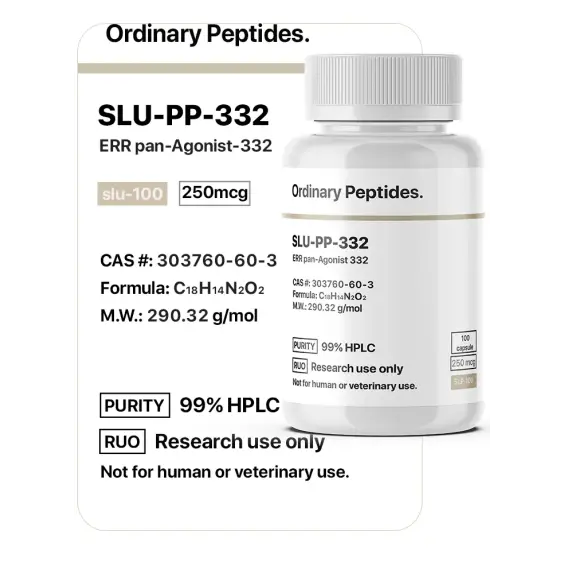
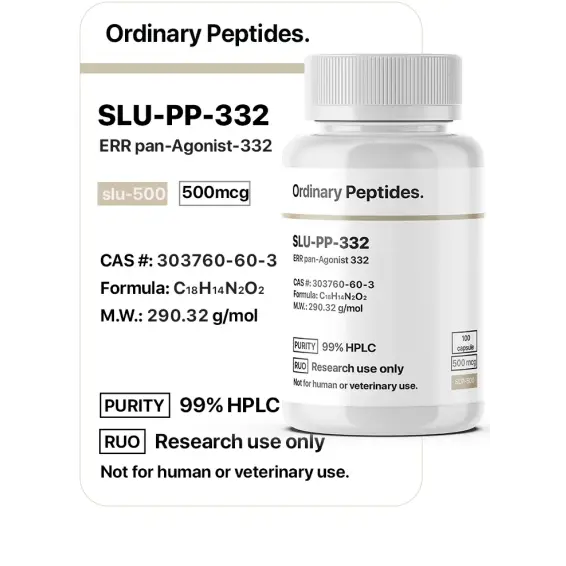
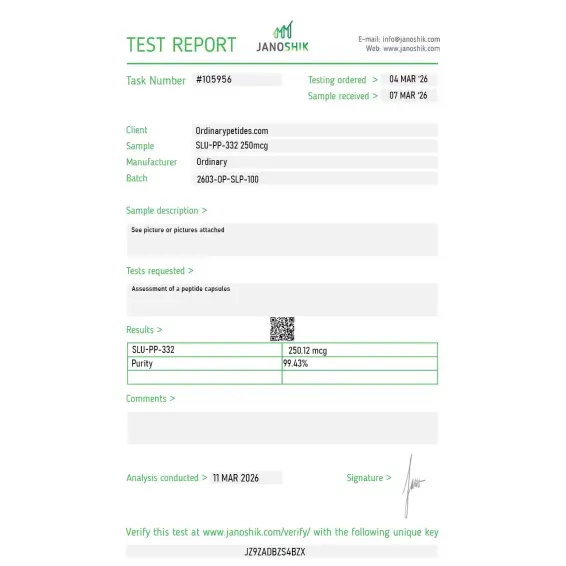
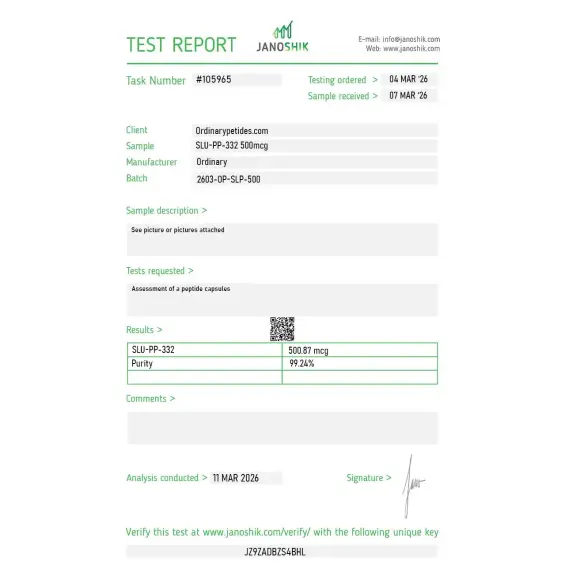
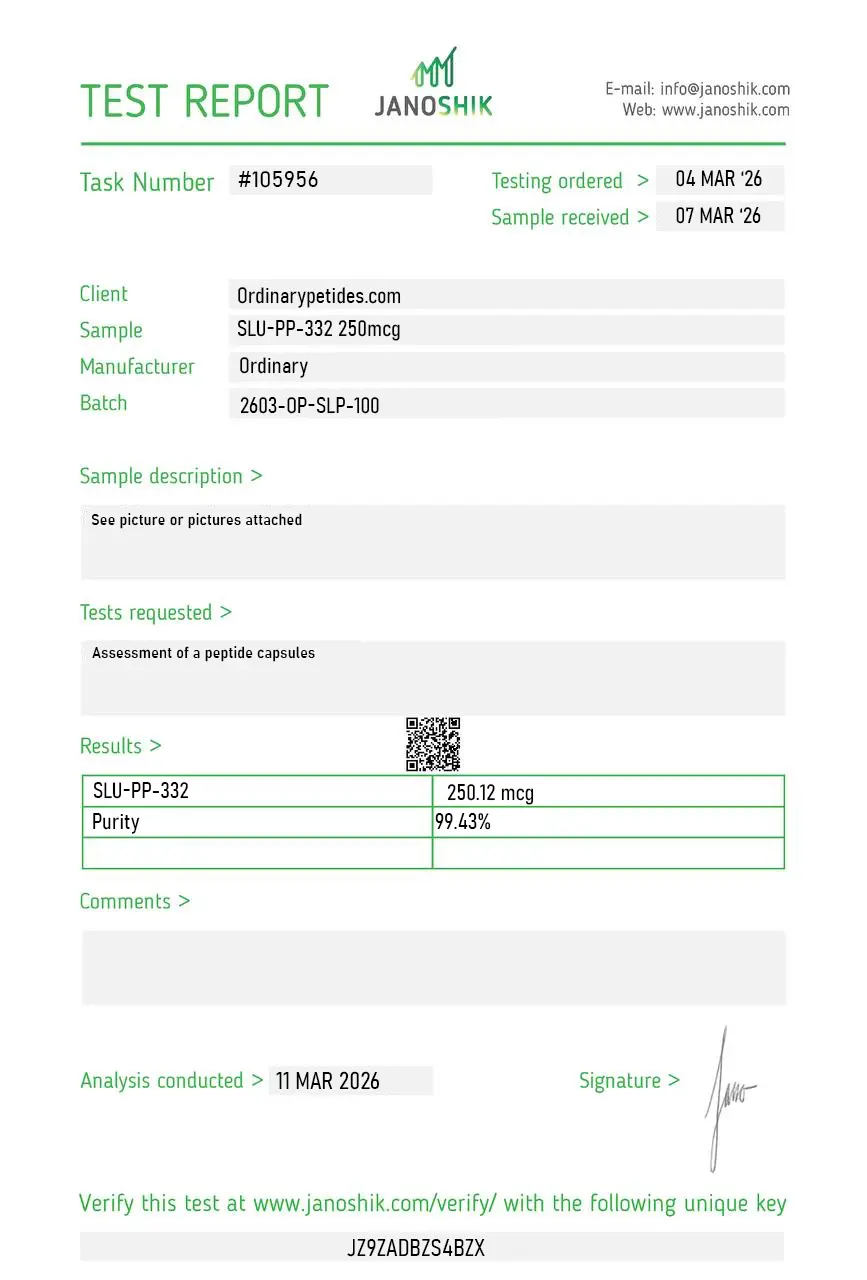
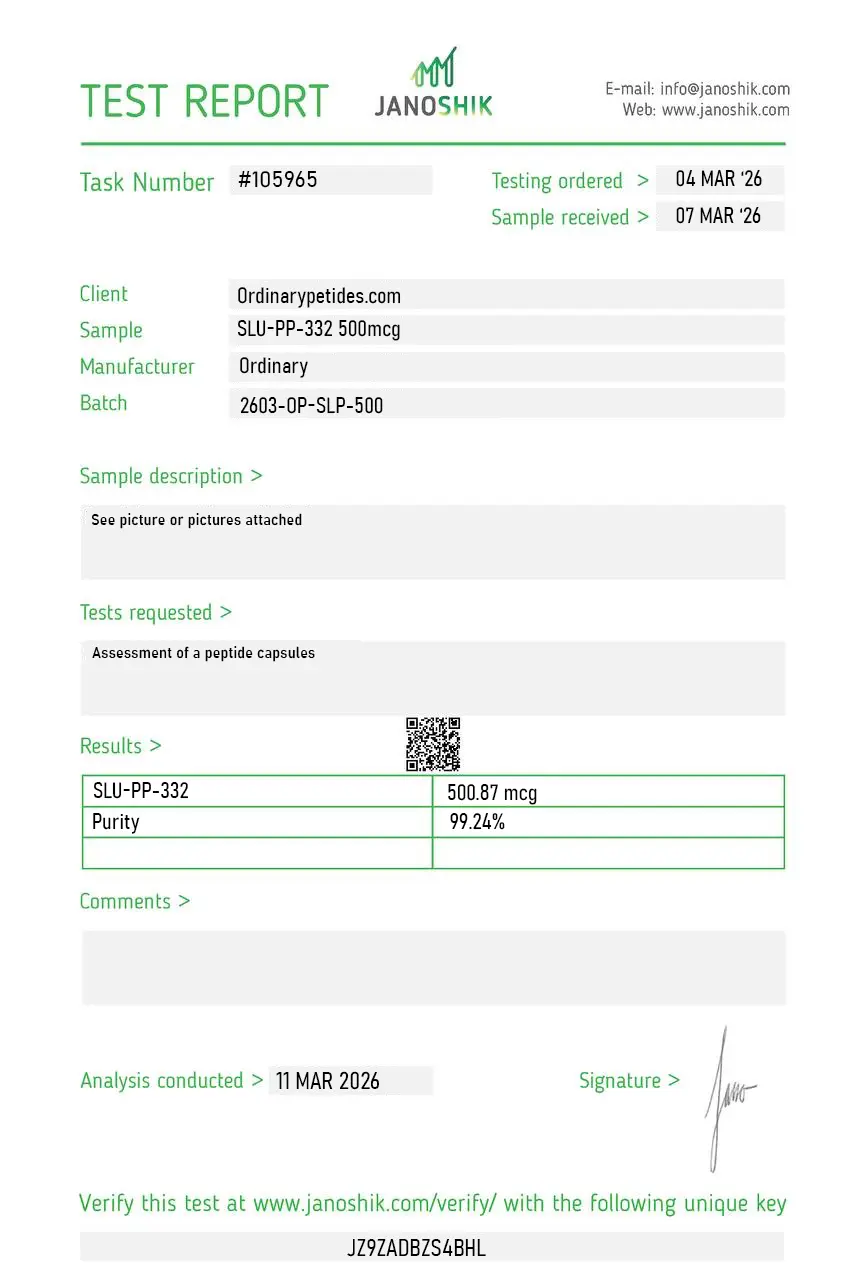
Independent test reports are available for SLU-PP-332 250mcg and SLU-PP-332 500mcg. These reports provide batch-level documentation and analytical verification information for research reference.
SLU-PP-332 is a synthetic small-molecule compound (C₁₈H₁₄N₂O₂, MW 290.32 g/mol) developed at Saint Louis University as a pan-agonist of estrogen-related receptors (ERRs). It binds to the ligand-binding domain of ERRα, stabilizes its active conformation, and enhances its interaction with PGC-1α — the master regulator of mitochondrial biogenesis. In simple terms, it signals cells to behave as though the body is performing sustained aerobic exercise, even at rest.
SLU-PP-332 activates the same genes that prolonged aerobic training does. In the study by Billon et al. (2023), it induced an ERRα-dependent aerobic exercise gene program in sedentary mice with no physical activity: running endurance increased by up to 70%, fat oxidation rose markedly, and mitochondrial activity was upregulated in skeletal muscle. This makes it particularly interesting for elderly or bedridden patients unable to exercise.
SLU-PP-332 is a pan-ERR agonist, activating all three estrogen-related receptor subtypes: ERRα (EC₅₀ = 98 nM, primary target), ERRβ (EC₅₀ = 230 nM), and ERRγ (EC₅₀ = 430 nM). ERRα is most highly expressed in skeletal muscle, heart, and brown adipose tissue. These receptors are not classical estrogen receptors and do not drive estrogenic effects.
Mouse studies published between 2023 and 2025 found: approximately 12% body weight reduction over 28 days in obese models, increased fatty acid oxidation without any change in food intake, up to 70% improvement in running endurance, cardiac protection in heart failure models, indirect kidney protection via improved type 2 diabetes control, and potential to counteract age-related muscle atrophy (sarcopenia).
No. Despite the name, ERRα/β/γ are not classical estrogen receptors and do not bind estrogen. SLU-PP-332 is a non-hormonal compound — it does not suppress testosterone, estrogen, or any other endogenous hormone, and no suppression of the HPG axis has been observed in research. This distinguishes it from anabolic steroids and SARMs; no post-cycle therapy is implicated.
Its weight-loss mechanism does not involve appetite suppression. Instead, it raises resting metabolic expenditure: increasing basal energy expenditure (measured via indirect calorimetry), shifting the respiratory exchange ratio toward fat oxidation, improving insulin sensitivity and glucose tolerance, and upregulating metabolic genes such as Pdk4. In Wansapura et al. (2024, PMID: 37739806), obese animals lost weight while remaining on a high-fat diet throughout treatment.
No overt toxicity was reported in preclinical mouse studies, but significant unknowns remain: there are no human clinical safety data, long-term cardiovascular effects in humans are unknown, the drug-drug interaction profile is undetermined, product purity varies widely between suppliers, and no human-appropriate dosing has been established. Self-administration carries serious and unpredictable risks.
Yes. SLU-PP-332 appears on the WADA Prohibited List under class S4 — Hormone and Metabolic Modulators. Any athlete subject to anti-doping testing cannot use this compound regardless of intent, and a positive test carries disqualification penalties under applicable federation rules.
In most countries it is not a scheduled controlled substance, but it is not approved for human or veterinary use by any regulatory authority. It is legally sold as a Research Use Only (RUO) material to qualified researchers for in-vitro laboratory work. CAS number: 303760-60-3. Typical purity from scientific suppliers: 98–99%+. Personal purchase for self-administration exists in a regulatory grey area in most jurisdictions.
GW501516 is a PPARδ agonist whose development was halted after carcinogenicity findings in animals — SLU-PP-332 uses a different receptor pathway with no such finding to date. AICAR is an AMPK activator that requires injection and has a short half-life. MOTS-c is a mitochondrial-derived peptide also requiring injection. SLU-PP-332's key advantage is oral bioavailability combined with broad ERR activation. None of these agents has completed human clinical trials or received regulatory approval for any indication.