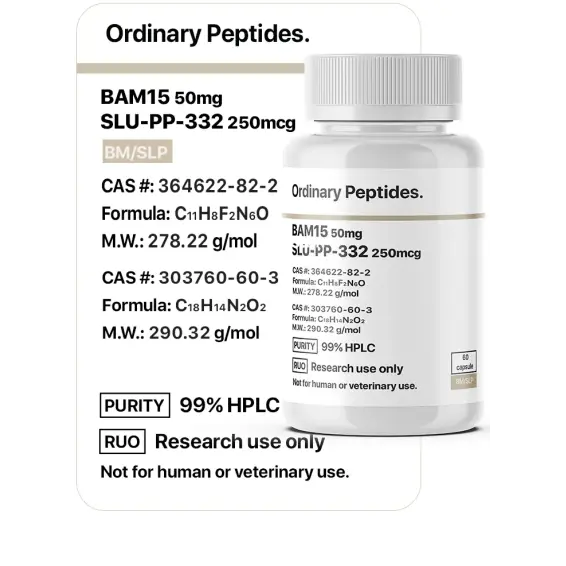
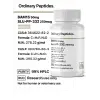
SLU-PP-332/BAM-15
For in vitro testing and laboratory use only. Not for human or animal consumption. Bodily introduction is illegal. Handle only by licensed professionals. Not a drug, food, or cosmetic. Educational use only.
SLU-PP-332 / BAM-15 Duo: Two Small Molecules at the Crossroads of Exercise Mimetic Research, Mitochondrial Uncoupling, and Metabolic Bioenergetics
The SLU-PP-332 / BAM-15 duo brings together two synthetic small molecules best known in the field of metabolic research, where they have been studied as a pan-agonist of the estrogen-related receptors (ERRα/β/γ) and a selective mitochondrial protonophore, respectively, and linked to the biology of mitochondrial energy metabolism. In the research context, the main interest in this pairing grew out of studies reporting activation of an acute aerobic exercise gene program by SLU-PP-332 and dissipation of the mitochondrial proton gradient by BAM-15, with both compounds independently increasing fat oxidation and energy expenditure in preclinical models. That sounds dramatic — and that is precisely why it attracts so much attention.
Published reports have also discussed their relationship with fat mass reduction, insulin sensitivity, and skeletal muscle oxidative capacity, while preclinical data have connected the combination to a broader two-axis metabolic framework — transcriptional reprogramming of mitochondrial biogenesis on one side, and acute bioenergetic uncoupling on the other. Still, a sober filter is essential here: a compelling complementary mechanism is not yet a ready-made metabolic therapy in a vial. If only biology were that cooperative.
What makes the SLU-PP-332 / BAM-15 duo genuinely interesting is that it sits at the crossroads of exercise mimetic hypotheses, nuclear receptor pharmacology, and the older tradition of mitochondrial uncoupling agents — with BAM-15 offering a notably narrower off-target profile than its predecessors. For readers who care not just about bold promises but about the actual scientific grounds for interest, this is exactly the kind of compound combination worth examining carefully — and without illusions.
SLU-PP-332 + BAM-15: The Scientific Basis of a Two-Mechanism Metabolic Concept
Based on peer-reviewed literature — see References. Last updated: May 2026.
Why These Two Molecules Get Discussed Together
In wellness literature SLU-PP-332 and BAM-15 regularly appear side by side. The logic runs roughly: both target metabolism through mitochondria, neither is a stimulant, neither suppresses appetite, both produce fat loss in mice through increased energy expenditure rather than reduced intake. From there, the leap to "they work through different mechanisms, so they should complement each other" looks natural.
Scientifically the picture is more nuanced. These mechanisms aren't just different. They operate at two sequential levels of the same system — mitochondrial substrate metabolism — and their intersection has concrete theoretical consequences that no study has measured in any species.
This article is an attempt to honestly describe what's known and what isn't. Not "how to combine them." But what the science knows about the point where these two mechanisms meet. For the broader landscape of compounds investigated for metabolic regulation, see the Metabolic Research category.
Two Levels of One System
Before discussing the intersection, it's worth fixing clearly what each mechanism does on its own. Both compounds have been covered individually earlier in this series — here briefly, with focus on the aspects that become important when considering them together.
SLU-PP-332: expanding transcriptional capacity
SLU-PP-332 is a pan-agonist of ERRα/β/γ, the family of nuclear receptors that coordinate the transcriptional program of oxidative metabolism. ERRα is the master regulator of mitochondrial biogenesis and the expression of genes encoding fatty acid β-oxidation enzymes, Krebs cycle, oxidative phosphorylation, and mitochondrial biogenesis machinery. Normally this hub is activated through PGC-1α after sustained aerobic training. SLU-PP-332 activates ERRα pharmacologically, without training.[1]
Phenotypic effects in mice unfold over weeks and include:
- Increased proportion of oxidative type IIa muscle fibers
- Increased mitochondrial content in skeletal muscle
- Higher maximal respiratory capacity of tissues
- Increased endurance (~70% longer time to exhaustion)
- Fat mass loss without appetite reduction[2]
The key characteristic from a combination standpoint: this mechanism raises the ceiling of cellular oxidative capacity. More mitochondria. More enzymes. Higher maximal substrate oxidation rate when needed.
BAM-15: forcing utilization of that capacity
BAM-15 is a mitochondrial protonophore. It doesn't remodel tissue. It interferes with existing mitochondrial function directly — shuttling protons across the inner membrane past ATP synthase, dissipating the proton gradient. ATP synthesis falls. The AMP/ATP ratio rises. AMPK activates. The cell compensates: it increases substrate oxidation to maintain required ATP levels.[3][4]
The key characteristic from a combination standpoint: this mechanism raises the cell's demand for using its existing oxidative capacity. It doesn't build new machinery — it pushes the machinery already present to work harder.
The intersection
Here the combination logic becomes visible:
- SLU-PP-332 → more capacity to oxidize
- BAM-15 → higher demand for oxidation
These aren't parallel mechanisms working independently. They are sequential rungs on a single axis: capacity × utilization. One raises the denominator, the other raises the numerator. The total load on the mitochondrial system isn't the sum of the two effects, it's their product.
What a "Multiplied Effect" Means Biologically
Worth being explicit here about what's known, what isn't, and where the evidence base ends.
What's known about BAM-15 alone
The protective characteristics underlying BAM-15's mouse safety profile:
- Respiratory ceiling. Respiration doesn't exceed the maximal capacity of mitochondria. In a standard mouse cellular state, headroom exists.
- No body temperature elevation. This is the most important preclinical safety finding. Metabolic effects occur without measurable heating.[3]
- Fast clearance (t½ ~1.7h in mice). Overdose is reversible.
- Mitochondrial selectivity. Plasma membranes don't get uncoupled.
All of these characteristics were measured against the backdrop of unmodified mitochondrial capacity. That is: a mouse with a normal mitochondrial count, normal ETC enzyme expression, normal PGC-1α/ERRα baseline.
How SLU-PP-332 theoretically changes that backdrop
SLU-PP-332, operating over weeks, modifies the very baseline system against which BAM-15's safety characteristics were measured. Specifically:
- ETC complexes I, II, III, IV content increases in skeletal muscle
- ATP synthase (complex V) content increases in parallel
- β-oxidation enzyme content increases
- Mitochondrial mass increases in adipocytes and muscle cells
Each of these parameters shifts the "ceiling" mentioned above. The respiratory ceiling for BAM-15 isn't an absolute biophysical constant — it's a ceiling in a specific tissue with a specific mitochondrial density. If mitochondrial density has risen, then at the same degree of uncoupling, more mitochondria each dissipating against a gradient at the same uncoupler concentration produces more absolute heat output.
This isn't speculation about some unknown mechanism — it's straightforward arithmetic from the known properties of each compound. What's unknown is the magnitude of the effect, and whether BAM-15's other protective parameters (particularly the respiratory capacity ceiling, which is the main feature protecting against runaway hyperthermia) hold in a tissue with substantially altered mitochondrial background.
Why this isn't empty worry
Cases where fine-tuned metabolic interventions become problematic precisely when the baseline shifts are well-documented in toxicology literature. DNP, the historical uncoupler that killed users in the 1930s, continues to kill today predominantly in two scenarios:
- In heat — when external thermal load adds to internal load
- In bodybuilders with hypertrophied muscle mass — that is, individuals with increased mitochondrial density relative to population baseline
The second scenario is exactly the kind of baseline shift that SLU-PP-332 pharmacologically models. A bodybuilder with hypertrophied muscle mass has, by definition, more mitochondria than an untrained person. This makes them more sensitive to uncouplers, not less. DNP toxicology literature confirms this: lethal doses in bodybuilders run lower than extrapolation from untrained population would predict.[7]
SLU-PP-332 pharmacologically mimics the training adaptation, including increased mitochondrial density. Overlaying BAM-15 on this modified baseline is theoretically the same type of scenario, just achieved chemically rather than through training.
Other Theoretical Points of Intersection
Several additional points of interaction follow from known biology:
AMPK as a convergence point
BAM-15 activates AMPK through rising AMP/ATP — this is the proven and required component of its action on adipose tissue (Axelrod 2020 showed AMPK knockout abolishes BAM-15's metabolic effects).[4] This is also the same AMPK pathway that MOTS-c activates through a different upstream mechanism.
SLU-PP-332 acts through ERRα, which functionally intersects with the AMPK-PGC-1α system. PGC-1α is a shared coactivator for both branches. Activating one branch affects the other.
What this means under combination is unknown. Several possible scenarios: amplification of shared downstream effects (synergy), compensatory desensitization, or interaction one way or the other depending on tissue. None has been measured.
Substrate availability
BAM-15 increases oxidation of both fatty acids and glucose. SLU-PP-332 increases fatty acid β-oxidation through ERRα-dependent transcription of CPT1, ACOX1, and other enzymes. Both compounds shift metabolism toward lipid substrate. In a state of full substrate availability (postprandial, individuals with substantial fat mass), this is minor. In a state of restricted substrate availability — extended fasting, ketogenic diet, very low body fat percentage — substrate could become limiting. What happens to both compounds' effects in that state is unknown.
Tissue distribution overlap
BAM-15 distributes preferentially to adipose and liver (lipophilic). SLU-PP-332 acts maximally in tissues with high ERRα expression — skeletal muscle, heart, brown adipose tissue, kidneys. Tissue domains partially overlap (brown adipose, heart) but don't fully coincide. In the heart, where BAM-15's effect is less pronounced but SLU-PP-332 showed effects via ERRγ (Xu 2024) — the combination's behavior is unclear.[5]
Cardiac considerations
Each compound individually showed cardioprotective effects in mouse pathology models. This is reassuring. But cardioprotection in disease models (heart failure, AKI, ischemia-reperfusion) is not the same as combination safety in a normal heart under metabolic load. The heart has the highest mitochondrial density in the body and is the most sensitive tissue to shifts in ATP/ADP ratio and oxidative flux. The theoretical multiplied load discussed above applies to cardiac tissue too — possibly more so than to other tissues. For broader context, see the cardiovascular research category.
Where the Evidence Base Ends
Honestly:
- No combination studies in mice. Not for fat loss, not for endurance, not for safety, not for anything.
- No cell culture data. Not even simple co-incubation experiments in adipocytes or myocytes.
- No human PK for either compound individually. Not for SLU-PP-332, not for BAM-15.
- No human safety data for either compound. No published Phase 1 for either.
- No clinical trials of the combination. Not registered anywhere.
Everything written above is mechanistic inference from properties measured in isolation. That's a legitimate scientific exercise — it's what review articles in journals like Trends in Endocrinology & Metabolism do all the time. It's also clearly distinct from clinical evidence. Every claim about how the combination might behave is a hypothesis, not a finding.
The DNP Comparison Cuts Differently Here
In the individual BAM-15 review, the case is made that BAM-15 was engineered to avoid DNP's failure modes — respiratory ceiling, mitochondrial selectivity, short half-life, no temperature elevation. The engineering case is intellectually credible.
The point worth adding in a combination context: each of those protective features was characterized against an unmodified mitochondrial baseline. A pharmacologically expanded mitochondrial system is a different test condition than any that's been published. We don't know whether the safety margin holds, narrows, or holds with shifted thresholds. The question hasn't been asked experimentally.
DNP's documented vulnerability profile — heat, exercise, increased mitochondrial mass — gives us a rough sense of the variables that matter for uncouplers generally. SLU-PP-332 specifically shifts one of those variables (mitochondrial mass) and arguably another (effective oxidative load during activity). Whether BAM-15's engineering compensates for these shifts adequately, or only partially, is the open question.
What an Honest Mechanistic Summary Looks Like
If a researcher had to write a one-paragraph description of the scientific status of this combination, it would read approximately like this:
"SLU-PP-332 is a pan-ERRα/β/γ agonist that increases mitochondrial content and oxidative gene expression in skeletal muscle, heart, and brown adipose tissue, with documented effects on endurance, fat mass, and cardiometabolic parameters in mice (Billon 2023; Xu 2024; Wang 2023). BAM-15 is a mitochondrial protonophore that increases substrate oxidation through controlled proton gradient dissipation, with documented anti-obesity and insulin-sensitizing effects in mice and a safety profile in those models reportedly lacking temperature elevation (Alexopoulos 2020; Axelrod 2020). The two mechanisms act at sequential levels of mitochondrial substrate metabolism — one raising oxidative capacity, the other increasing demand on that capacity. No combination study in any species has been published. Theoretical considerations include multiplicative thermogenic load proportional to mitochondrial mass, potential interaction at the AMPK-PGC-1α convergence point, shared lipid-substrate dependence, and uncharacterized cardiac safety under combined load. The lack of empirical data makes risk-benefit assessment impossible at this time."
That's where the science actually is. Everything beyond it is speculation — sometimes informed, sometimes not, but speculation nonetheless.
Key Takeaways
- SLU-PP-332 and BAM-15 are mechanistically distinct compounds that target two sequential aspects of mitochondrial substrate metabolism — transcriptional capacity (SLU-PP-332) and utilization demand (BAM-15) — rather than truly independent pathways.
- The intersection of these mechanisms is multiplicative in nature, not additive — the load on the mitochondrial system from combined exposure is theoretically the product of two effects, not their sum.
- ⚠️ No published study of the combination exists in any species or system. All discussion of combined effects is mechanistic inference from individual-compound data, not a description of measured combination pharmacology.
- BAM-15's mouse safety profile, including the absence of body temperature elevation at efficacious doses, was characterized against an unmodified mitochondrial baseline. Whether those protective features hold against a baseline pharmacologically modified by chronic SLU-PP-332 exposure has not been studied.
- ⚠️ DNP toxicology literature documents increased uncoupler sensitivity in individuals with higher mitochondrial mass (notably trained bodybuilders) — exactly the kind of baseline shift that SLU-PP-332 pharmacologically models. This mechanistic parallel is concerning and has not been empirically addressed.
- Theoretical points of additional interaction include the AMPK-PGC-1α convergence node, shared substrate dependence, and uncharacterized cardiac behavior under combined load.
- ⚠️ Each compound individually has, in the broader review series, been flagged with substantive unresolved safety concerns — oncological for SLU-PP-332 (ERRα and cancer), acute hyperthermic for BAM-15 (uncoupler class history). These individual concerns do not disappear in combination; they coexist.
- Neither compound has published human pharmacokinetics, human safety data, or clinical trials. The combination has even less empirical foundation.
- The honest scientific position is that risk-benefit analysis cannot be performed for this combination based on available data. The mechanisms are interesting biology. The empirical case for combined use does not exist.
Related Compounds
For the broader landscape of compounds investigated for metabolic regulation, see the Metabolic Research category. The most relevant peptide companion in this mitochondrial space is MOTS-c — the mitochondrial-derived peptide that activates the same AMPK convergence node through an entirely different upstream mechanism. For an alternative approach to weight management based on appetite/satiety rather than energy expenditure, see cagrilintide.
References
SLU-PP-332
- Billon C, Sitaula S, Banerjee S, et al. Synthetic ERRα/β/γ Agonist Induces an ERRα-Dependent Acute Aerobic Exercise Response and Enhances Exercise Capacity. ACS Chem Biol. 2023;18(4):756–771.
- Billon C, Schoepke E, Avdagic A, et al. A Synthetic ERR Agonist Alleviates Metabolic Syndrome. J Pharmacol Exp Ther. 2024;388(2):232–240.
- Xu W, Billon C, Li H, et al. Novel Pan-ERR Agonists Ameliorate Heart Failure Through Enhancing Cardiac Fatty Acid Metabolism and Mitochondrial Function. Circulation. 2024.
- Wang XX, Myakala K, Libby AB, et al. Estrogen-Related Receptor Agonism Reverses Mitochondrial Dysfunction and Inflammation in the Aging Kidney. Am J Pathol. 2023.
BAM-15
- Alexopoulos SJ, Chen SY, Brandon AE, et al. Mitochondrial uncoupler BAM15 reverses diet-induced obesity and insulin resistance in mice. Nat Commun. 2020;11(1):2397.
- Axelrod CL, King WT, Davuluri G, et al. BAM15-mediated mitochondrial uncoupling protects against obesity and improves glycemic control. EMBO Mol Med. 2020;12(7):e12088.
DNP context
- Grundlingh J, Dargan PI, El-Zanfaly M, Wood DM. 2,4-dinitrophenol (DNP): a weight loss agent with significant acute toxicity and risk of death. J Med Toxicol. 2011;7(3):205–212.
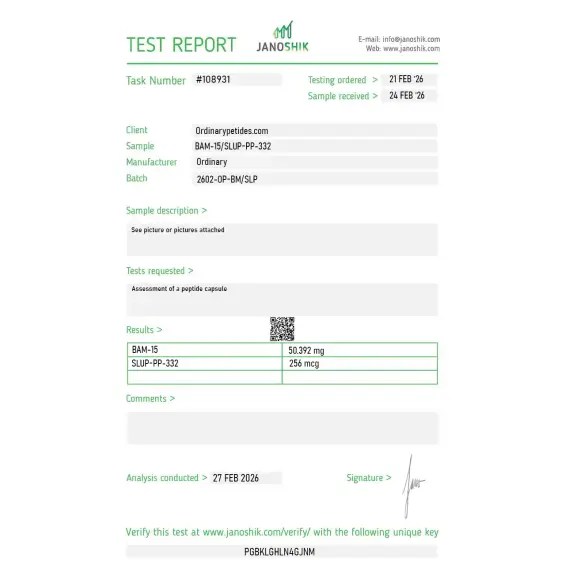
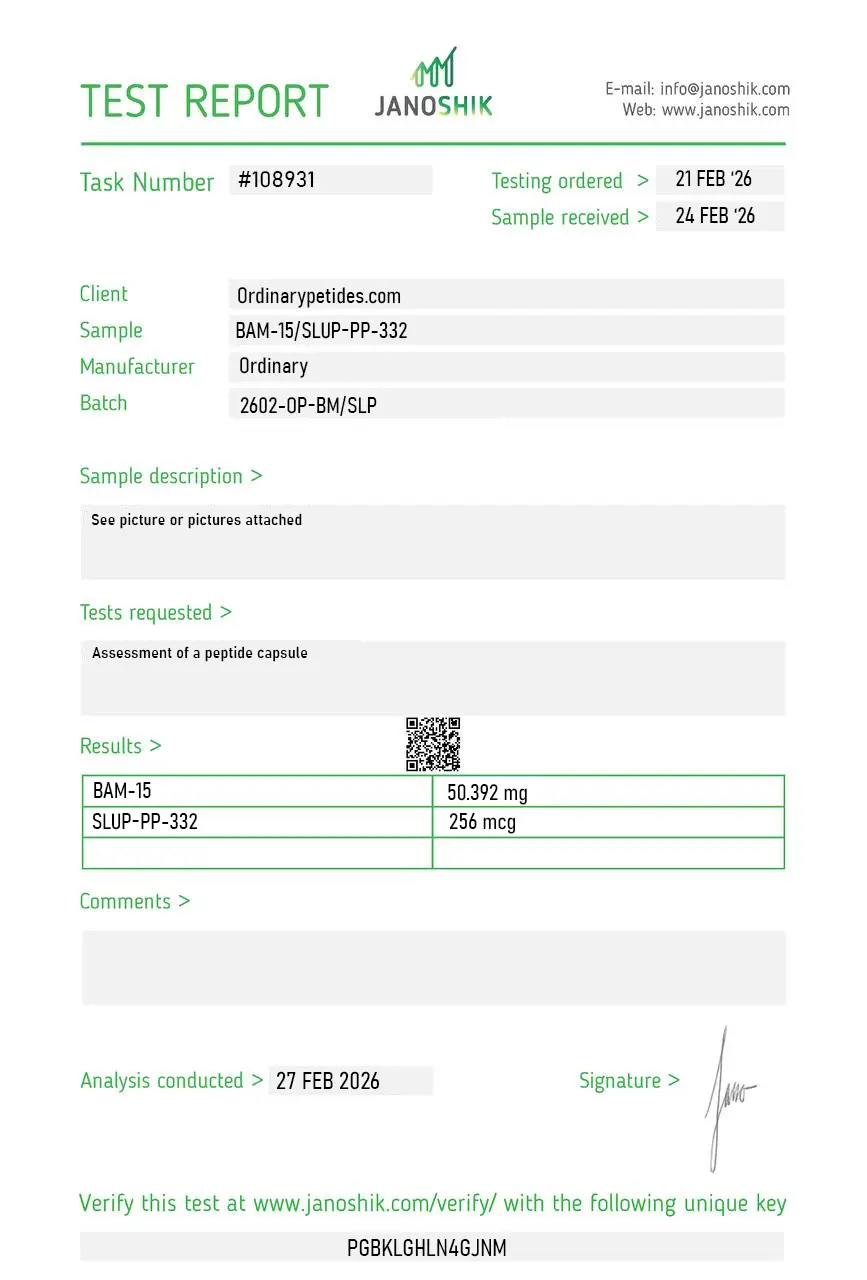
Certificate of Analysis
An independent test report is available for BAM-15 / SLU-PP-332. This report provides batch-level documentation and analytical verification information for research reference.
SLU-PP-332 and BAM-15 are two mechanistically distinct synthetic compounds that are increasingly studied together as a dual-action mitochondrial research stack. SLU-PP-332 is a pan-agonist of estrogen-related receptors (ERRα/β/γ) that activates transcriptional programs mimicking aerobic exercise adaptation, while BAM-15 is a selective mitochondrial protonophore uncoupler that directly increases energy expenditure by dissipating the mitochondrial proton gradient. They are sometimes sold under combination product names such as "SLUBAM" by research chemical suppliers. The scientific rationale for studying them together rests on their non-overlapping targets within the same mitochondrial energy metabolism axis — each attacking a distinct node of the same biological system.
SLU-PP-332 operates at the level of the nucleus: it binds ERRα (EC₅₀ ≈ 98 nM), ERRβ, and ERRγ, activating transcription factors that upregulate PGC-1α co-activation, mitochondrial biogenesis gene programs, and oxidative phosphorylation enzyme expression. Its effects are transcriptional — they build over days to weeks as gene expression changes accumulate, gradually increasing mitochondrial density and the cellular capacity for fat oxidation. BAM-15 operates at the level of the inner mitochondrial membrane: it is a protonophore that physically shuttles protons across the membrane independently of ATP synthase, immediately dissipating the electrochemical gradient and forcing the electron transport chain to run at higher flux to compensate. Its energy expenditure effects are essentially instantaneous at the biochemical level. One operates upstream through gene regulation; the other operates downstream through direct biophysical membrane disruption.
The proposed research rationale, as articulated in non-peer-reviewed scientific commentary, is that the two compounds target sequential and non-competing steps in the same metabolic axis. SLU-PP-332 is described as "priming" the mitochondrial system — increasing the number, density, and oxidative capacity of mitochondria through ERR-driven biogenesis. BAM-15 is described as "driving" those mitochondria — forcing greater substrate consumption through direct proton leak regardless of upstream transcriptional state. In theory, a cell with more and better-functioning mitochondria (SLU-PP-332 effect) that are simultaneously forced to run at higher rates (BAM-15 effect) would exhibit greater total energy expenditure than either intervention alone. Both compounds also converge on AMPK activation downstream, which may amplify shared effects on glucose uptake and fatty acid oxidation.
No. As of mid-2026, no peer-reviewed publication has examined SLU-PP-332 and BAM-15 together in any experimental model — in vitro, animal, or human. Every claim about combination effects currently derives from one of three sources: mechanistic extrapolation from the individual compound literature; commercial product descriptions from research chemical suppliers; or community discussion in biohacking podcasts and forums. The synergy hypothesis is scientifically plausible given the non-overlapping pathways, but it is entirely speculative until tested in controlled experimental conditions. Pharmacokinetic interaction data, combined toxicology profiles, optimal ratio information, and any assessment of whether the effects are additive, synergistic, or potentially antagonistic in specific cellular contexts are all completely absent from the published literature.
Yes — both compounds activate AMPK (AMP-activated protein kinase) through different upstream mechanisms. BAM-15 activates AMPK as a direct consequence of ATP depletion caused by mitochondrial uncoupling: as cellular ATP falls and AMP rises, AMPK is activated as a cellular energy sensor. SLU-PP-332 activates ERRα, which drives PGC-1α expression — PGC-1α and AMPK are closely co-regulated nodes in the same mitochondrial biogenesis axis, with PGC-1α acting as both an AMPK target and an AMPK activator through feedback. Both compounds also independently upregulate fatty acid oxidation and improve glucose metabolism markers in their respective preclinical studies. This shared downstream convergence on AMPK and metabolic gene programs is the mechanistic basis for the hypothesis that the combination may produce amplified effects — but again, this convergence has not been directly tested in combination experiments.
SLU-PP-332 preclinical data (Billon et al., 2023): approximately 12% body weight reduction in obese mouse models over 28 days, 70% improvement in running endurance, upregulation of ERRα-dependent aerobic exercise gene programs, and increased mitochondrial activity in skeletal muscle — all without appetite suppression. BAM-15 preclinical data (Alexopoulos et al., Nature Communications, 2020): reduced body fat mass in diet-induced obese mice without altering food intake, no loss of lean mass, no change in body temperature, decreased insulin resistance across multiple tissue types, and no adverse biochemical or haematological toxicity markers. Both compounds independently demonstrated fat mass reduction without food intake suppression — a mechanistic feature that researchers identify as relevant to potential combination study design, since the effects would not be expected to simply compound appetite suppression.
Several theoretical concerns are noted in the non-peer-reviewed scientific commentary. First, both compounds increase mitochondrial energy flux through different mechanisms — BAM-15 by forcing the ETC to run faster to compensate for proton leak, SLU-PP-332 by increasing the transcriptional expression of ETC components. In combination, this could theoretically produce excessive mitochondrial ROS (reactive oxygen species) generation if substrate supply cannot keep pace with electron transport chain demand, though BAM-15 has been shown to modulate rather than simply amplify ROS in its individual studies. Second, community sources specifically caution against simultaneous administration, arguing that concurrent peak exposure may generate excessive metabolic stress — suggesting staggered timing protocols in research design. Third, combined cardiovascular effects, thermal regulation interactions, and any pharmacokinetic drug-drug interactions have not been characterized.
The combination sits within a broader class of dual-mechanism metabolic research strategies. The closest comparator in terms of research maturity is the BAM-15 + semaglutide combination, which was studied in 2024 research finding that the pairing produced stronger metabolic benefits than either compound alone by countering the metabolic adaptation that limits GLP-1 drug efficacy over time — a properly studied combination with published data. The SLU-PP-332 + BAM-15 stack differs in that it targets entirely within the mitochondrial biogenesis and energy expenditure axis, without the appetite-suppression component that GLP-1 drugs contribute. A functionally analogous concept from the exercise science literature is the combination of endurance training adaptation (analogous to SLU-PP-332's ERR activation) with caloric restriction (analogous to BAM-15's forced substrate utilization) — distinct interventions that act synergistically in metabolic disease models.
The research gaps for the combination specifically — beyond the already significant gaps for each individual compound — are substantial. No combination study exists in any model. Required foundational experiments include: in vitro dose-response studies in relevant cell lines (differentiated adipocytes, skeletal muscle myotubes, hepatocytes) to establish whether the combination produces additive, synergistic, or antagonistic effects on energy expenditure, mitochondrial ROS, and cell viability; pharmacokinetic interaction studies to establish whether BAM-15's lipophilicity or SLU-PP-332's ERR activity alter each other's tissue distribution or half-life; acute and chronic combination toxicity studies in rodent models with full biochemical, haematological, and histopathological assessment; and sex-stratified analysis, given preliminary suggestions that male and female research models may exhibit differential metabolic responses to both compounds individually.
Neither SLU-PP-332 nor BAM-15 has received regulatory approval individually from the FDA or any major authority. Neither has completed human clinical trials. The combination has no regulatory status whatsoever — it has not been submitted for IND (Investigational New Drug) application, has not been evaluated in any formal safety study as a combination, and exists only as a commercially available Research Use Only (RUO) research blend sold by peptide and research chemical suppliers. Both compounds are available as RUO materials for qualified researchers conducting in vitro laboratory work. The combination product market appears to have developed significantly ahead of the science — the commercial availability and community discussion of this stack substantially outpaces the peer-reviewed evidence base, which contains zero direct combination research as of mid-2026.