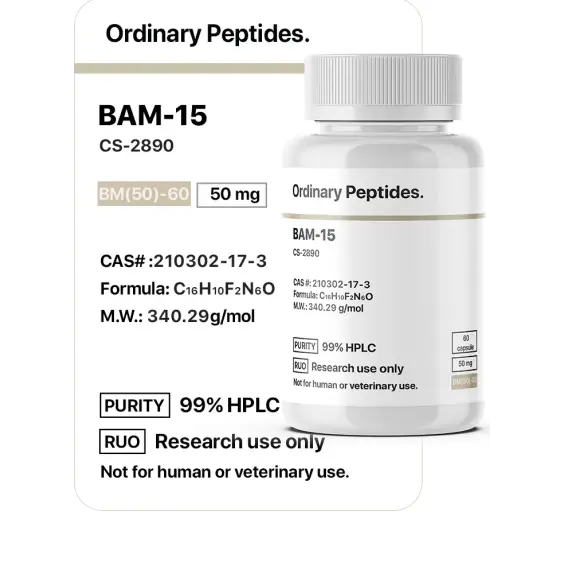

BAM-15
For in vitro testing and laboratory use only. Not for human or animal consumption. Bodily introduction is illegal. Handle only by licensed professionals. Not a drug, food, or cosmetic. Educational use only.
BAM-15: A Mitochondrial Uncoupler at the Crossroads of Bioenergetics Research, Metabolic Disease, and AMPK Signaling
BAM-15 is a synthetic small molecule best known in the field of metabolic research, where it has been studied as a selective mitochondrial protonophore / uncoupler and linked to the biology of mitochondrial bioenergetics. In the research context, the main interest in this compound grew out of studies reporting dissipation of the proton gradient, increased mitochondrial respiration, and elevated energy expenditure without changes in food intake or body temperature in preclinical models. That sounds dramatic — and that is precisely why it attracts so much attention.
Published reports have also discussed its relationship with fat mass reduction, insulin sensitivity, and AMPK activation, while preclinical data have connected it to a broader metabolic uncoupling framework, including effects in models of obesity, sarcopenia, and cardiovascular dysfunction. Still, a sober filter is essential here: a compelling bioenergetic story is not yet a ready-made metabolic therapy in a vial. If only biology were that cooperative.
What makes BAM-15 genuinely interesting is that it sits at the crossroads of exercise mimetic hypotheses, mitochondrial pharmacology, and the older tradition of protonophore-based metabolic agents — with a notably narrower off-target profile than its predecessors. For readers who care not just about bold promises but about the actual scientific grounds for interest, this is exactly the kind of compound worth examining carefully — and without illusions.
BAM-15: A Scientific Review of the Mitochondrial Uncoupler
Based on peer-reviewed literature — see References. Last updated: May 2026.
The Short Version
BAM-15 is the result of a calculated attempt to do something dangerous, safely.
Mitochondrial uncoupling is one of the most direct mechanisms imaginable for losing weight. The mitochondria in your cells normally use the energy from food oxidation to pump protons across a membrane, creating an electrochemical gradient that gets harnessed to make ATP — the cell's energy currency. An uncoupler punches a hole in that gradient. Protons leak back across without making ATP. To maintain ATP supply, the cell burns more substrate. The net result: more calories combusted, more heat produced, more fat oxidized, less stored. No appetite suppression needed. No stimulant effects. Just thermodynamic inefficiency, on purpose.
This sounds like the holy grail of obesity pharmacology, and it nearly was — a century ago. The classic mitochondrial uncoupler 2,4-dinitrophenol (DNP) was sold over the counter in the 1930s as a weight loss drug, produced spectacular results, and proceeded to kill enough people from hyperthermia, cataracts, and acute liver failure that the FDA banned it in 1938. DNP still circulates in bodybuilding underground markets and still kills people — multiple deaths every year, mostly young men, mostly from hyperthermia in the 41-43°C range that protein denaturation lives at.[6]
BAM-15 is a small molecule designed to do what DNP does, without doing what DNP did to its users. The key insight from Kyle Hoehn's group, who developed it: DNP's lethality comes from its ability to uncouple not just mitochondrial membranes but also the plasma membrane and other cellular membranes, and from its lack of a "self-limiting" mechanism at high doses. BAM-15 was engineered to be selective for mitochondria, to have a respiratory ceiling (it can only drive respiration up to maximal capacity, not beyond), and to clear the plasma membrane question entirely.
The preclinical data, published in Nature Communications (2020) and EMBO Molecular Medicine (2020), are remarkable.[1][2] In diet-induced obese mice, oral BAM-15 reversed obesity, reduced fat mass, improved insulin sensitivity across multiple tissues, decreased hepatic steatosis, reduced inflammatory markers — without changing food intake, without affecting lean body mass, without raising body temperature, and without any of the biochemical or hematological toxicity signals that killed people with DNP. This positions BAM-15 as a uniquely interesting compound in the metabolic research space — one that works through pure energy expenditure rather than appetite suppression.
That's the good news. The bad news has the same shape it has for every compound in this review series.
There are no published human clinical trials. Not Phase 1. Not pharmacokinetics. Not a single registered trial as of May 2026. The mouse data are excellent. The mouse-to-human translation, for a drug class with a documented capacity to kill humans, has not been done in any controlled setting.
| At a glance | |
|---|---|
| Full name | N5,N6-bis(2-fluorophenyl)[1,2,5]oxadiazolo[3,4-b]pyrazine-5,6-diamine |
| Chemical class | Small molecule; oxadiazolopyrazine protonophore |
| Molecular weight | 364.3 g/mol |
| Mechanism | Mitochondrial protonophore (uncoupler); selective for inner mitochondrial membrane |
| Discoverer | Originally identified by Kenwood, Lengacher, Sereda et al. (2014, Molecular Metabolism) as a high-throughput screening hit |
| Key developer | Kyle L. Hoehn lab, University of New South Wales (Australia), and collaborators including the Cleveland Clinic group (Kirwan, Axelrod) |
| Foundational obesity papers | Alexopoulos et al., Nat Commun 2020; Axelrod et al., EMBO Mol Med 2020 |
| Licensing | Continuum Biosciences (UK biotech) holds development rights |
| FDA status | ❌ Not approved. No active IND in public record. |
| EMA status | ❌ Not approved |
| Human clinical trials | ❌ None registered or published |
| Route in studies | Oral (in animal work); IP also used |
| WADA status | Not specifically named on the 2026 Prohibited List |
Background: The Uncoupler Problem
Before discussing what BAM-15 is, it's worth understanding what mitochondrial uncoupling actually does — and why getting it right matters.
The mitochondrial coupling system
Cells extract energy from food by progressively oxidizing nutrients through a series of electron-transfer reactions. In the mitochondria, the electron transport chain (ETC) uses the energy released by these reactions to pump protons (H⁺) from the mitochondrial matrix into the intermembrane space. This creates an electrochemical gradient — high proton concentration outside, low inside — that stores energy like a charged battery.
The cell then "discharges" this battery through ATP synthase, an elegant rotary enzyme embedded in the inner mitochondrial membrane. As protons flow back into the matrix through ATP synthase, the enzyme uses that flow to make ATP from ADP and inorganic phosphate. This coupling — proton gradient drives ATP production — is how 90%+ of cellular ATP is made.
The coupling is never perfect, even normally. Some protons leak back through the membrane independently of ATP synthase, dissipating the gradient as heat rather than ATP. This is "natural uncoupling," and it's mediated by proteins like UCP1 (in brown adipose tissue) and to lesser extents UCP2 and UCP3 in other tissues. Brown fat thermogenesis — the body's main mechanism for non-shivering heat production — is fundamentally UCP1-driven controlled mitochondrial uncoupling.
Pharmacological uncoupling
A mitochondrial uncoupler is a molecule that adds to this natural proton leak. It's typically a lipophilic weak acid (a "protonophore") — it picks up a proton in the intermembrane space, slips through the membrane in its protonated neutral form, releases the proton in the matrix, and then crosses back as the deprotonated anion. The molecule shuttles protons across the membrane, dissipating the gradient. ATP production drops. To compensate, cells burn more substrate. Heat increases. Energy expenditure rises.
In a controlled, narrow therapeutic window, this is a beautiful mechanism for treating obesity. In an uncontrolled or too-large dose, it's a recipe for catastrophic hyperthermia. The cell, burning more substrate to maintain ATP, produces more heat. If the uncoupling is too aggressive, the heat output exceeds the body's ability to dissipate it. Core temperature rises. Proteins denature around 41-43°C. Multi-organ failure follows.
This is exactly what kills people on DNP.
The DNP problem
2,4-dinitrophenol was used industrially (in dye manufacturing, munitions production) in the early 20th century, and its weight-loss effects were noticed in occupationally exposed workers. By the 1930s it was sold over the counter as a slimming agent. The results were dramatic: 1-2 pounds per week of fat loss with no diet changes.
Then the deaths started. By the late 1930s, hundreds of reported cases of DNP-related fatalities, plus cataracts, peripheral neuropathy, and severe rashes had accumulated. The FDA banned it for human use in 1938. It remained available as an industrial chemical and as a livestock anti-parasitic, and from there found its way into the bodybuilding community, where it continues to kill several people per year, mostly from hyperthermia, mostly young men trying to cut for competitions or photo shoots.[6]
DNP's specific safety problems include:
- Narrow therapeutic window. The dose that produces meaningful weight loss is uncomfortably close to the dose that produces dangerous hyperthermia. There's no built-in ceiling.
- Non-mitochondrial uncoupling. DNP isn't strictly mitochondrial-selective. It can uncouple plasma membranes and other organelle membranes too, contributing to off-target toxicity.
- Long half-life. ~36 hours in humans. If you overdose, you can't reverse it.
- No antidote. Supportive care only — aggressive cooling, fluids, intensive care.
Any modern mitochondrial uncoupler intended for human use has to solve these problems. BAM-15 was engineered specifically to do that.
Discovery and Development
BAM-15 emerged from a high-throughput screening campaign by Kenwood and colleagues, published in Molecular Metabolism in 2014.[7] The screen was designed to find compounds that increased mitochondrial respiration in a controlled manner — specifically, ones that drove maximal respiration without causing respiratory collapse at higher concentrations.
The screen identified an oxadiazolopyrazine scaffold that behaved as a protonophoric uncoupler with several attractive properties:
- Self-limiting respiratory effect (a ceiling at maximal respiratory capacity)
- Mitochondrial selectivity (doesn't uncouple plasma membrane)
- Reasonable lipophilicity for membrane partitioning
- Oral bioavailability
The lead compound was named BAM-15 (sources vary on what "BAM" stands for — some suggest "Bis(arylamino)" referring to the structural class, others suggest internal lab nomenclature; the chemistry team has not formally explained the name).
The compound was then characterized by the Hoehn group at UNSW Sydney and collaborators. Two pivotal in vivo papers followed in 2020 — one in Nature Communications (Alexopoulos et al.) and one in EMBO Molecular Medicine (Axelrod et al., Cleveland Clinic). Both demonstrated meaningful efficacy in mouse obesity models with what appeared to be remarkable tolerability.[1][2]
The compound was subsequently licensed to Continuum Biosciences, a UK-based biotech company developing it (under various code names) for metabolic and other indications. As of May 2026, no clinical trials are publicly registered.
Chemistry
BAM-15 is structurally unrelated to DNP. This is one of its core selling points.
DNP is a nitrophenol — a benzene ring with two nitro groups and a hydroxyl. The hydroxyl provides the dissociable proton that allows DNP to shuttle protons across membranes. The nitro groups stabilize the deprotonated form (the conjugate base), lowering the pKa enough to make DNP an effective protonophore at physiological pH.
BAM-15 is built on a completely different scaffold — an oxadiazole fused to a pyrazine, with two fluorophenylamine substituents. The protonophoric activity comes from the amine NH groups, which have pKa values tuned to function effectively at physiological pH but with different membrane partitioning properties than DNP.
The structural difference matters because it allows BAM-15 to:
- Partition preferentially into mitochondrial membranes (versus plasma membrane)
- Be cleared from the body faster (shorter half-life)
- Have a different metabolism profile (no nitroreduction, which contributes to some DNP toxicity)
| Property | BAM-15 | DNP (for comparison) |
|---|---|---|
| Molecular weight | 364.3 g/mol | 184.1 g/mol |
| Chemical class | Oxadiazolopyrazine | Dinitrophenol |
| Protonophoric pKa | ~6.5 (functional at physiological pH) | ~4.0 |
| Half-life in mice | ~1.7 hours | Much longer; ~36h in humans |
| Plasma membrane uncoupling | Minimal | Documented |
| Mitochondrial respiratory ceiling | Self-limiting at maximal capacity | No ceiling; can exceed capacity |
| Human exposure history | None (preclinical only) | Decades; documented fatalities |
The 1.7-hour half-life in mice is one of BAM-15's most important features. If something goes wrong with dosing, the compound clears quickly. With DNP, there's a multi-day window during which you cannot reverse exposure — you can only support the patient through it.
Proposed Mechanisms of Action
1. Primary: mitochondrial uncoupling
The core mechanism is as described above. BAM-15 enters mitochondrial membranes, shuttles protons across the inner membrane, dissipates the proton gradient, and forces increased substrate oxidation to maintain ATP production. The downstream metabolic effects flow from this primary action:
- Increased energy expenditure
- Increased fatty acid oxidation
- Increased glucose oxidation
- Decreased ATP/AMP ratio (which has signaling consequences below)
2. AMPK activation
When mitochondrial ATP production drops, the cellular AMP/ATP ratio rises. AMP-activated protein kinase (AMPK) is exquisitely sensitive to this ratio — it's the cell's master energy sensor, triggered whenever ATP availability falls. AMPK activation drives:
- Increased fatty acid oxidation (via inhibition of ACC, lowering malonyl-CoA, removing the brake on CPT1)
- Inhibition of lipogenesis
- Increased glucose uptake (GLUT4 translocation in muscle)
- Stimulation of mitochondrial biogenesis (via PGC-1α)
- Inhibition of mTORC1 (and therefore protein synthesis under stress)
This is the same AMPK pathway that MOTS-c activates through a completely different upstream mechanism (mitochondrial-derived peptide signaling rather than uncoupling). The Axelrod 2020 EMBO Mol Med paper specifically demonstrated that AMPK activation in white adipose tissue is required for BAM-15's metabolic effects — using AMPK-knockout models to show the dependency.[2] So BAM-15's effects are not purely thermodynamic; there's a signaling component that amplifies the direct uncoupling effect.
3. Tissue distribution: lipophilic selectivity
BAM-15's lipophilicity directs it preferentially to fat-rich tissues — adipose tissue and liver. This is convenient: these are exactly the tissues whose metabolic remodeling produces the desired effects on body composition and insulin sensitivity. Muscle tissue and CNS exposure are lower, which limits both potential muscle-wasting (DNP has been associated with muscle damage) and central nervous system effects.
4. Anti-inflammatory and antioxidant effects
Multiple papers report that BAM-15 reduces inflammatory markers and oxidative stress in metabolic tissues. The proposed mechanism involves reduced ROS production at the electron transport chain — when the proton gradient is partially dissipated, electron flow through the ETC is more efficient (less backup, fewer electrons leaking onto oxygen to form superoxide). This is somewhat counterintuitive but has experimental support.
| Proposed mechanism | Evidence type | Independence |
|---|---|---|
| Mitochondrial protonophoric uncoupling | Biochemistry, well-established | ✅ Foundational |
| AMPK activation downstream | Animal + cell culture | ✅ Multiple groups |
| Mitochondrial selectivity (not plasma membrane) | Biochemistry, comparative studies | ✅ Established |
| Self-limiting respiratory effect | In vitro respirometry | ✅ Original screen + replication |
| Lipophilic tissue distribution | Animal PK studies | ✅ Multiple groups |
| Reduced ROS production | Animal + cell culture | ✅ Multiple groups |
| Insulin sensitization across tissues | Hyperinsulinemic-euglycemic clamp studies | ✅ Cleveland Clinic + others |
Preclinical Evidence
Alexopoulos et al. 2020 (Nature Communications)
The pivotal preclinical paper. C57BL/6J mice on a Western diet (high fat, high sugar) received oral BAM-15 at doses of 0.1% by weight in the chow.
Results:
- Body fat mass decreased significantly versus vehicle
- Food intake: unchanged
- Lean body mass: unchanged
- Body temperature: unchanged (this is the critical safety endpoint — no hyperthermia signal)
- Hepatic fat: decreased
- Inflammatory lipids: decreased
- Insulin sensitivity (via hyperinsulinemic-euglycemic clamp): improved across liver, muscle, and adipose tissue
- Biochemical/hematological toxicity markers: no significant changes from vehicle
The compound both prevented weight gain in mice not yet obese and reversed established obesity in mice already on the obesogenic diet.[1]
Axelrod et al. 2020 (EMBO Molecular Medicine)
The Cleveland Clinic / Kirwan group paper, published simultaneously. Different experimental design but converging conclusions.
Key findings:
- BAM-15 enhanced mitochondrial respiratory kinetics in vitro
- Improved insulin action in cellular assays
- Sustained AMPK activation in adipose tissue
- Protected against diet-induced obesity in mice
- AMPK knockout abolished the protective effects, confirming the mechanistic role
Critically, the Axelrod paper provided independent confirmation of the obesity phenotype using a separate research group, separate methodology, and separate (though overlapping) endpoints. This is the kind of independent replication that's missing for many compounds in this review series.[2]
Other preclinical work
Beyond obesity, BAM-15 has been studied in:
- Acute kidney injury (ischemia-reperfusion model) — protective effects via reduced ROS and improved mitochondrial function
- Sepsis models — improvements in survival and organ function
- Non-alcoholic fatty liver disease (NAFLD) — decreased hepatic steatosis
- Cardiovascular models — protective effects under various stresses (see cardiovascular research for related compounds)
The 2023 Frontiers in Endocrinology review by Tian et al. catalogues this expanding literature.[3] Most of these applications are early-stage preclinical, with limited independent replication outside obesity.
Human Evidence
The short section, repeated: none.
As of May 2026, ClinicalTrials.gov returns no registered human trials of BAM-15 for any indication. No Phase 1 has been publicly announced. No human pharmacokinetic, safety, or efficacy data exists.
Continuum Biosciences holds development rights and has discussed BAM-15 in various corporate communications as a development candidate, but no clinical milestones have been publicly reached. This is unusual — for a compound with this much preclinical attention and major-journal coverage going back to 2020, the lack of clinical movement after six years suggests either substantial development hurdles (PK challenges, regulatory caution, formulation issues) or that planned trials are not yet at the registration stage.
This is a particularly dangerous evidence gap for an uncoupler specifically. The difference between an effective dose and a hyperthermic dose is what determines whether the compound is safe or fatal. That window has not been characterized in humans for BAM-15. Anyone using grey-market BAM-15 is, in essence, conducting an uncontrolled first-in-human dose-finding study on themselves.
Regulatory Status
| Jurisdiction | Status |
|---|---|
| FDA (USA) | ❌ Not approved. No active IND in public record. |
| EMA (Europe) | ❌ Not approved |
| Compounding pharmacies | Not on Category 1 list; not specifically designated Category 2 |
| WADA | Not specifically named on the 2026 Prohibited List, though as an exercise mimetic / metabolic modulator it would likely fall under class S4.5 if used by tested athletes |
| Continuum Biosciences development | Active license; no clinical milestones publicly announced |
BAM-15's regulatory situation is somewhat different from BPC-157 or KPV. It has not been placed on FDA Category 2 (the "significant safety risks" compounding list), but it's also not on Category 1 (approved for compounding). It exists in a regulatory gray zone — neither approved nor specifically banned — which means consumer access is through the same research-chemical channels as the other compounds in this series, with no quality guarantees.
Safety: The Engineered Case, and What's Not Validated
This is where BAM-15 requires the most careful discussion of any compound in this review series, because the stakes are different.
The engineered safety case
The Hoehn group's pharmacological design was specifically aimed at avoiding DNP's failure modes. The arguments in favor of BAM-15's safety:
- Self-limiting respiratory effect. Unlike DNP, BAM-15 cannot drive respiration beyond maximal mitochondrial capacity. There's a built-in ceiling. This should, in principle, prevent runaway hyperthermia at any dose.
- Mitochondrial selectivity. BAM-15 does not significantly uncouple plasma membranes. This avoids one of DNP's off-target toxicity mechanisms.
- Short half-life. ~1.7 hours in mice. If overdosing occurs, the drug clears within hours rather than days. Reversibility is built in.
- Lipophilic tissue distribution. Concentration in fat and liver, less in muscle and CNS. This may reduce risks of muscle damage and central effects.
- No body temperature change in mice. Across the published preclinical work, BAM-15 produces metabolic effects (weight loss, increased oxidation) without measurable elevations in body temperature. This is the most reassuring safety observation — and the most direct rebuttal to the DNP comparison.
- No biochemical/hematological toxicity signals in published mouse work at doses producing efficacy.
If all of these properties hold in humans, BAM-15 would represent a genuine breakthrough — a safe uncoupler. This is the engineering hope.
What's not validated
Every one of the safety properties above is established in mice, not humans. The DNP fatalities of the 1930s also followed reasonably benign-looking animal data — body weight in lab animals can mask the species differences in thermoregulation, body surface area to volume ratios, and metabolic rate that make humans handle uncouplers differently than rodents. Mice run at higher metabolic rates and dissipate heat differently than humans.
Specifically uncharacterized:
- Human pharmacokinetics. Half-life, distribution, peak concentrations — all unknown.
- Dose-response in humans. The therapeutic window has not been mapped.
- Effects of co-ingested substances. Caffeine, stimulants, ephedrine, sympathomimetics — anything that could amplify thermogenic effects could shift the safety window unpredictably.
- Effects in heat. Exercise, hot environments, fever — these add thermal load. BAM-15's behavior in these contexts is unknown.
- Effects in patients with limited heat dissipation capacity. Obese individuals (the target population!) have impaired heat dissipation. Whether this matters clinically is unknown.
- Drug interactions. Not formally studied.
- Long-term effects. No chronic exposure data beyond a few months in mice.
- Cardiac safety. Mitochondrial uncoupling affects cardiac muscle, which is mitochondria-dense. Effects on cardiac function under stress are incompletely characterized.
The DNP comparison cuts both ways
Honest framing: BAM-15 is designed to be safer than DNP. The molecular and pharmacological case is strong. But that's a hypothesis to be tested in humans, not a conclusion that's been verified. The history of pharmacology contains plenty of compounds that looked safer than their precursors in preclinical work and then surprised everyone in clinical trials — fialuridine, troglitazone, fenfluramine. Pre-clinical safety predictions are predictions, not measurements.
Cancer concern (less prominent than other compounds)
Mitochondrial uncoupling doesn't have the strong oncology pathway concerns that complicate compounds like Dihexa (HGF/c-Met) or BPC-157 (VEGF). The relationship between mitochondrial function and cancer is complex — many cancers have altered mitochondrial metabolism, and there's some literature on uncoupling as anti-cancer (via metabolic stress on tumor cells). There's no specific signal that BAM-15 promotes cancer at this point in the evidence base.
| Safety area | Status |
|---|---|
| Mouse acute toxicity | ✓ No signal at tested doses; no hyperthermia |
| Mouse subchronic toxicity (up to months) | ✓ No biochemical/hematological signals |
| Mitochondrial selectivity vs plasma membrane | ✓ Established in vitro |
| Respiratory ceiling (self-limiting) | ✓ Established in vitro |
| Human pharmacokinetics | ❌ Not characterized |
| Human therapeutic window | ❌ Not characterized |
| Drug interactions (stimulants, caffeine) | ❌ Not studied; mechanistically concerning |
| Effects in heat/exercise | ❌ Not studied |
| Cardiac effects under stress | ⚠️ Incompletely characterized |
| Long-term human safety | ❌ Not studied |
| Cancer risk | ✓ Less concerning than other compounds in this series |
| Vendor material quality | ⚠️ Variable; standard caveats |
Common Misconceptions
"It's basically a safer DNP."
The intent of the engineering is to be a safer DNP. Whether it succeeded at being a safer DNP in humans is unknown because no humans have been formally dosed in trials. "Safer than DNP" in mice does not equal "safe in humans."
"It can't cause hyperthermia because of the respiratory ceiling."
In mice, BAM-15 does not raise body temperature at efficacious doses. This is the strongest piece of safety evidence. It does not mean hyperthermia is impossible in humans at higher doses, in heat, with stimulant co-ingestion, or in individuals with impaired thermoregulation. The respiratory ceiling argument is theoretically protective but has not been clinically validated under stress conditions.
"It's already in clinical trials."
It isn't. As of May 2026, no registered clinical trials exist on ClinicalTrials.gov or equivalent registries. Continuum Biosciences holds the license but has not publicly announced trial initiation.
"Because it works through fat oxidation rather than appetite suppression, it stacks well with GLP-1 drugs."
This claim circulates online and is mechanistically plausible but completely unstudied. No clinical or even animal work has formally evaluated BAM-15 plus GLP-1 combinations with compounds like semaglutide, tirzepatide, or retatrutide. Stacking pharmacology speculatively, with one component being a mitochondrial uncoupler, is exactly the kind of decision that's safer to make based on data than based on theory.
"DNP was banned just because of regulatory overreach in the 1930s."
This is a fringe argument that surfaces in some bodybuilding contexts. The 1938 FDA ban followed documented fatalities and severe adverse events. People continue to die from DNP every year. The ban was responsive to real harm, not regulatory excess.
Frequently Asked Questions
Why hasn't Continuum Biosciences moved BAM-15 into clinical trials yet?
The honest answer is that it's not clear from public information. Possibilities include: PK or formulation challenges; regulatory caution from the FDA given the uncoupler class history (FDA might require unusually extensive preclinical toxicology before allowing first-in-human trials); strategic considerations about competing with the GLP-1 class; or capital constraints typical of small biotech companies. The fact that six years have passed since the Nature Communications paper without a clinical announcement suggests one or more of these factors is operative.
How does it compare to GLP-1 drugs in terms of weight loss potential?
Speculatively, BAM-15 could in principle produce greater weight loss than GLP-1 drugs like semaglutide and tirzepatide because it targets the energy expenditure side of the equation rather than the intake side, and the energy expenditure ceiling can be theoretically pushed higher than appetite suppression can go. In practice, this is unknown. The mouse data show meaningful but not extreme weight loss (~25-30% reduction in fat mass over weeks). Whether this translates to humans, and how it compares to incretin-based drugs, will only be determined by clinical trials.
Is there a withdrawal effect when stopping?
Unknown in humans. In mice, discontinuation appears to allow normal re-feeding and weight regulation to resume, but durability of weight loss after stopping is not strongly characterized.
What's the difference between BAM-15 and other DNP alternatives like HU-58 or niclosamide?
There's a family of compounds being explored as "safer uncouplers." BAM-15 is the most advanced in published literature. Niclosamide (an anthelmintic with uncoupler activity) has been clinically used for decades for parasitic infections and has been repurposed-studied for metabolic indications. Other candidates exist in earlier preclinical stages. None has reached human metabolic clinical trials in a definitive way.
Could BAM-15 affect mood, cognition, or other CNS functions?
The compound's lipophilic distribution favors adipose and liver over CNS, which should limit central effects. But "limited" is not "zero," and any compound that affects mitochondrial function in the brain — where mitochondria are densely concentrated — could have CNS effects at sufficient exposure. This is uncharacterized in humans.
Key Takeaways
- BAM-15 is a small-molecule mitochondrial protonophore designed specifically to provide the metabolic benefits of mitochondrial uncoupling without the safety problems that made DNP a known killer.[1][2]
- The preclinical evidence in mouse obesity models is unusually strong — independent replication across two major papers (Nat Commun and EMBO Mol Med in 2020), efficacy in reversing established obesity, improved insulin sensitivity across tissues, no body temperature elevation, no biochemical toxicity signals.
- ⚠️ There are no published human clinical trials. Six years after the major preclinical papers, no Phase 1 has been publicly registered or initiated. This unusual gap suggests substantial development hurdles or regulatory caution that hasn't been publicly disclosed.
- The engineered safety case for BAM-15 (mitochondrial selectivity, respiratory ceiling, short half-life, no plasma membrane uncoupling, lipophilic tissue distribution) is intellectually credible. It has not been clinically validated.
- ⚠️ Mitochondrial uncouplers as a class have a documented capacity to kill humans (DNP). Even though BAM-15 was specifically designed to avoid DNP's failure modes, the verification of that design in human trials has not occurred. This is the largest preclinical-to-clinical translational risk in this review series.
- ⚠️ Anyone using BAM-15 obtained from research-chemical suppliers should be aware that: heat, exercise, stimulant co-ingestion, and individual variation in thermoregulation could potentially shift the safety window in ways the mouse data don't predict. Heat illness symptoms in someone using an uncoupler should be treated as a medical emergency.
- The mechanism (mitochondrial uncoupling + AMPK activation) is more directly grounded in established biology than most compounds in this review series. The biological case is strong.
- Unlike Dihexa or BPC-157, there's no specific cancer pathway concern with BAM-15. The mechanism doesn't intersect with established oncogenic signaling in concerning ways.
- Regulatory status: not approved anywhere, not specifically banned, not on FDA Category 2 — exists in a gray zone. Consumer access is through standard research-chemical channels with no quality control.
- Honest framing: BAM-15 has the strongest preclinical case and the most coherent mechanistic story of any obesity-targeted compound in this review series. It also has, because of the uncoupler class history, the most consequential safety unknowns. The right way to use this compound is in a properly-designed clinical trial. The wrong way is to obtain it from a research-chemical supplier and self-administer without medical supervision in heat or alongside stimulants.
Related Compounds
For other compounds investigated in metabolic regulation and obesity research, see the Metabolic Research category. The most relevant peptide comparison is the mitochondrial-derived peptide MOTS-c, which activates the same AMPK pathway through a fundamentally different upstream mechanism. The amylin analog cagrilintide represents the alternative appetite-regulation approach to weight management.
References
Foundational preclinical efficacy
- Alexopoulos SJ, Chen SY, Brandon AE, et al. Mitochondrial uncoupler BAM15 reverses diet-induced obesity and insulin resistance in mice. Nat Commun. 2020;11(1):2397. doi: 10.1038/s41467-020-16298-2. PMC7224297
- Axelrod CL, King WT, Davuluri G, et al. BAM15-mediated mitochondrial uncoupling protects against obesity and improves glycemic control. EMBO Mol Med. 2020;12(7):e12088. doi: 10.15252/emmm.202012088. PMC7338798
Reviews
- Tian L, Wu D, Zhang G, et al. BAM15 as a mitochondrial uncoupler: a promising therapeutic agent for diverse diseases. Front Endocrinol. 2023;14:1252141. PMID: 37900126
Mechanism and original discovery
- Kenwood BM, Weaver JL, Bajwa A, et al. Identification of a novel mitochondrial uncoupler that does not depolarize the plasma membrane. Mol Metab. 2014;3(2):114-123.
Comparative pharmacology
- Kanemoto N, Okamoto T, Tanabe K, et al. Antidiabetic and cardiovascular beneficial effects of a liver-localized mitochondrial uncoupler. Nat Commun. 2019.
- Hoehn KL, Salmon AB, Hohnen-Behrens C, et al. Insulin resistance is a cellular antioxidant defense mechanism. Proc Natl Acad Sci USA. 2009;106(42):17787-17792.
DNP historical context
- Grundlingh J, Dargan PI, El-Zanfaly M, Wood DM. 2,4-dinitrophenol (DNP): a weight loss agent with significant acute toxicity and risk of death. J Med Toxicol. 2011;7(3):205-212.
- Colman E. Dinitrophenol and obesity: an early twentieth-century regulatory dilemma. Regul Toxicol Pharmacol. 2007;48(2):115-117.
Other indications
- Acute kidney injury, sepsis, NAFLD studies — various preclinical reports, 2014-2024 (see Tian 2023 review for catalog).
Corporate / regulatory
- Continuum Biosciences (UK) — license holder for BAM-15 development; corporate communications.
- FDA. Bulk Drug Substances Used in Compounding Under Section 503A (BAM-15 not specifically designated as of 2026 updates).
Key investigators
- Kyle L. Hoehn, PhD — University of New South Wales, Sydney. Principal developer of BAM-15 as a metabolic therapy candidate; co-author on multiple foundational papers.
- John P. Kirwan, PhD — Pennington Biomedical Research Center (formerly Cleveland Clinic Lerner Research Institute). Senior author on the EMBO Mol Med paper.
- Christopher L. Axelrod, PhD — Cleveland Clinic / Pennington. First author on the EMBO Mol Med paper.
- Stephanie J. Alexopoulos, PhD — UNSW. First author on the Nature Communications paper.
Certificate of Analysis
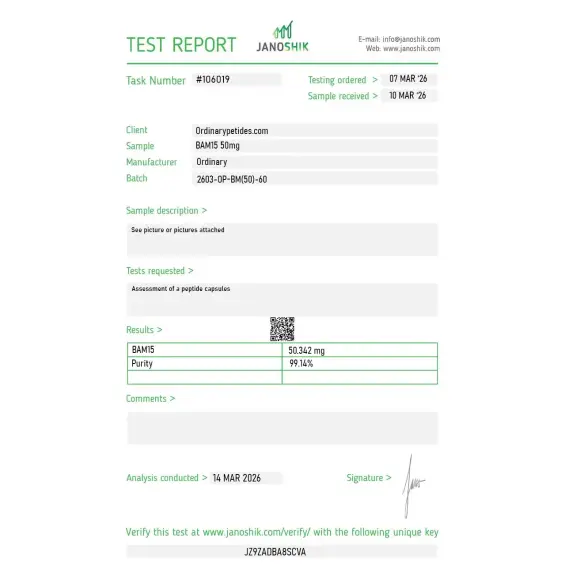
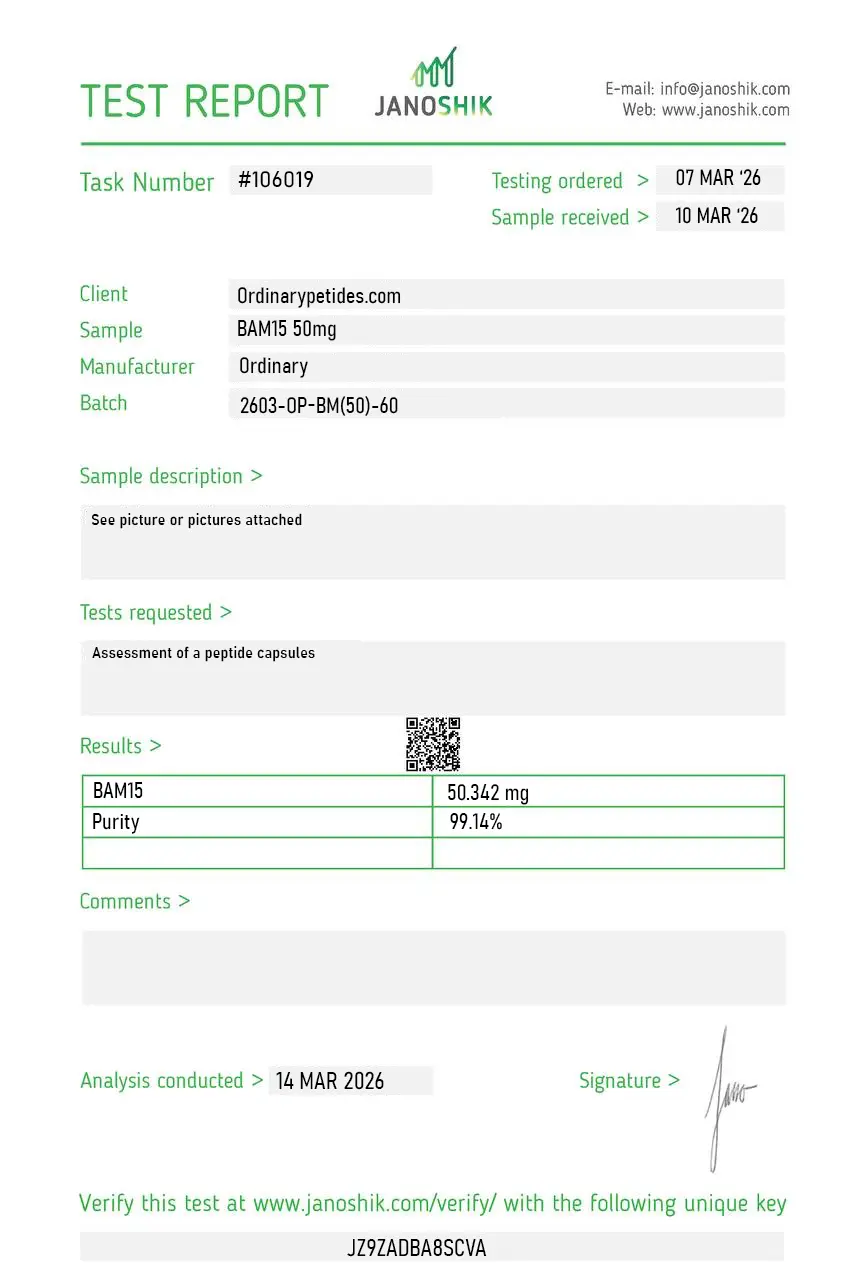
An independent test report is available for BAM15 50mg. This report provides batch-level documentation and analytical verification information for research reference.
BAM-15 (N5,N6-bis(2-fluorophenyl)[1,2,5]oxadiazolo[3,4-b]pyrazine-5,6-diamine) is a synthetic small-molecule compound classified as a selective mitochondrial protonophore uncoupler. It is structurally unrelated to 2,4-dinitrophenol (DNP) — the historically notorious uncoupler — and was identified as part of a research program to develop next-generation mitochondrial uncouplers with improved safety and selectivity profiles. BAM-15 is not a peptide despite appearing in peptide research communities; it is a synthetic heterocyclic small molecule. Its key distinguishing pharmacological feature is selective targeting of the inner mitochondrial membrane without depolarizing the plasma membrane — a critical distinction from earlier uncouplers that caused uncontrollable systemic toxicity.
Mitochondrial uncoupling refers to the dissociation of the electron transport chain (ETC) from ATP synthesis in the inner mitochondrial membrane. Under normal conditions, protons pumped by the ETC create an electrochemical gradient (proton motive force) that drives ATP synthase. Uncouplers are protonophores — molecules that shuttle protons back across the inner mitochondrial membrane independently of ATP synthase, dissipating the proton gradient as heat rather than capturing it as chemical energy. This forces cells to oxidize more fuel to maintain energy homeostasis, increasing nutrient oxidation and metabolic rate. BAM-15 is of research interest because it drives this process selectively within mitochondria, without the plasma membrane depolarization and uncontrolled hyperthermia that made earlier uncouplers such as DNP acutely dangerous.
BAM-15 functions as a lipophilic weak acid mitochondrial protonophore. It inserts into the inner mitochondrial membrane and facilitates proton transport from the intermembrane space back into the mitochondrial matrix, bypassing ATP synthase. This collapses the mitochondrial membrane potential (ΔΨm) — the electrochemical driving force for ATP production — and forces the ETC to run at higher rates to compensate. Key secondary pathway activations include: AMPK (AMP-activated protein kinase), which responds to BAM-15-induced ATP reduction by facilitating glucose uptake and fatty acid oxidation; and PGC-1α (peroxisome proliferator-activated receptor gamma coactivator 1-alpha), which enhances mitochondrial biogenesis and upregulates genes supporting mitochondrial function. A 2026 FEBS Journal study confirmed BAM-15 has higher binding capacity and stronger proton uncoupling activity than both DNP and FCCP, while also promoting mitochondrial fusion, fission, and autophagy through the tricarboxylic acid cycle.
The defining preclinical study for BAM-15 (Alexopoulos et al., 2020, Nature Communications) demonstrated that BAM-15 is orally bioavailable and dose-dependently increases nutrient oxidation in diet-induced obese mice. Key findings included: decreased body fat mass without any alteration in food intake; no reduction in lean body mass — a critical distinction from caloric restriction or most weight-loss pharmacology; no change in body temperature, confirming the absence of uncontrolled hyperthermia; decreased insulin resistance across multiple tissue types; reduction in hepatic fat content; and no adverse changes in biochemical or haematological toxicity markers. The study also established that BAM-15 is selectively enriched in lipid-rich tissues, which may explain its favorable tolerability profile relative to less selective uncouplers.
DNP (2,4-dinitrophenol) is a historical mitochondrial uncoupler used as a weight-loss agent in the 1930s that was withdrawn due to numerous fatalities from hyperthermia, cataracts, and agranulocytosis. Its primary problem is non-selectivity — it depolarizes both the plasma membrane and the mitochondrial membrane, causing uncontrollable systemic proton leak and runaway heat production. BAM-15 differs in three critical ways supported by research. First, it is mitochondrially selective — it depolarizes ΔΨm without depolarizing the plasma membrane, confirmed by direct comparison in cell studies. Second, it does not induce respiratory collapse across a broad dose range, whereas DNP has a dangerously narrow therapeutic window. Third, BAM-15 does not induce caspase-mediated apoptosis at effective research concentrations, whereas older uncouplers including DNP and FCCP do. Research estimates BAM-15 is approximately 7-fold more potent than DNP on a molar basis while maintaining this improved safety margin in preclinical models.
Beyond the 2020 Nature Communications study, a separate study published in EMBO Molecular Medicine confirmed that BAM-15 protects against diet-induced obesity and improves glycemic control in C57BL/6J mice, with improvements in whole-body glucose clearance and energy expenditure occurring independently of reductions in body weight. This metabolic independence — improving insulin sensitivity without requiring weight loss as an intermediary — was highlighted as mechanistically significant. Transcriptomic profiling in the EMBO study further revealed that AMPK is required for both the stability of mitochondrial function and the metabolic phenotype observed following BAM-15 treatment, establishing AMPK activation as a necessary rather than incidental downstream effect.
BAM-15 was originally characterized in part through studies of acute kidney injury before its anti-obesity applications were developed. Research demonstrated that intraperitoneal injection of BAM-15 protected mice from acute kidney injury caused by ischemia-reperfusion — the tissue damage pattern caused by restoration of blood flow after a period of oxygen deprivation. The proposed mechanism involves BAM-15's modulation of mitochondrial ROS (reactive oxygen species) production and its anti-inflammatory effects, including inhibition of NLRP3 inflammasome activation and modulation of STAT3 activity. Ischemia-reperfusion injury is a key pathophysiological mechanism in kidney transplantation, cardiac surgery, and stroke, making this finding relevant to multiple organ protection research contexts.
A 2025 bioRxiv preprint examined BAM-15 supplementation in aged mouse models of sarcopenia — the age-related loss of skeletal muscle mass and function. The study found that BAM-15 supplementation did not alter the age-associated loss of muscle mass itself, but significantly prevented the decline in skeletal muscle contractility and mitochondrial respiration that accompanies aging, leading to preserved functional capacity. The proposed mechanism involves BAM-15 maintaining mitochondrial efficiency and redox balance in aging muscle, with evidence of altered mitophagic processes. The finding that functional preservation occurs without mass preservation is mechanistically notable — it suggests BAM-15's benefit in aged muscle is tied to mitochondrial quality control rather than anabolic signaling.
In cancer research, a study by Zunica et al. found that BAM-15-induced uncoupling leads to sustained depolarization of ΔΨm in breast cancer cells — which have heightened metabolic adaptability and diverse energy synthesis pathways — disrupting the mitochondrial metabolism these tumors depend on for growth. In cardiovascular research, BAM-15 was found to relax phenylephrine-induced constriction in rat mesenteric arteries through an endothelium-independent mechanism, and demonstrated potent AMPK activation in vascular smooth muscle cells — more efficacious than CCCP, niclosamide, metformin, and AICAR in direct comparison. A 2026 FEBS Journal study confirmed BAM-15's anti-inflammatory, antioxidant, and hepatoprotective properties in high-fat-diet-induced obese mice through AMPK pathway activation. Research published in 2024 further examined combining BAM-15 with semaglutide, finding the combination produced stronger metabolic benefits than either compound alone by countering the metabolic adaptation that limits GLP-1 drug efficacy over time.
BAM-15 has not received approval from the FDA or any regulatory authority for any clinical indication as of 2026. All published efficacy and safety data derive from in vitro cell studies and animal models — no completed human clinical trials exist. It is available as a Research Use Only (RUO) compound. Key research gaps consistently identified in the literature include: the absence of human pharmacokinetic data (bioavailability, half-life, tissue distribution in humans); BAM-15's high lipophilicity presents formulation and delivery challenges that require alternative delivery methods to be developed for clinical translation; no systematic dose-escalation safety studies in non-rodent species; and the long-term effects of chronic mitochondrial uncoupling — including cardiovascular, hepatic, and thermogenic consequences — remain uncharacterized at any exposure level in humans. The 2023 Frontiers in Endocrinology review acknowledged the encouraging safety profile in preclinical models while noting that these limitations must be resolved before clinical development can proceed responsibly.