
Cortagen
For in vitro testing and laboratory use only. Not for human or animal consumption. Bodily introduction is illegal. Handle only by licensed professionals. Not a drug, food, or cosmetic. Educational use only.
Cortagen (AEDP): A Short Neuropeptide Bioregulator With Backstage Access to the Cell
Cortagen is a short synthetic tetrapeptide, AEDP, studied in research contexts as a bioregulator associated with nervous tissue and processes of neuronal regulation. In published preclinical data, it has attracted attention because in experimental models it was linked to modulation of gene expression, chromatin organization, and cellular processes important for nervous tissue.
In an animal model of sciatic nerve injury, Cortagen showed signals associated with faster nerve fiber growth and changes in conductivity, and in studies of chronic cerebral ischemia, it was associated with behavioral and biochemical shifts that researchers considered noteworthy.
It is also interesting that early studies attributed to it an influence on chromatin and gene activation — it almost sounds like a peptide with backstage access to the cell. For those studying short peptides, neuroregulation, and tissue-specific bioregulators, Cortagen appears to be an unusual and compelling subject for further consideration.
Cortagen (Ala-Glu-Asp-Pro / AEDP): A Scientific Review
Based on peer-reviewed literature — see References. Last updated: April 2026.
The Short Version
Cortagen is a synthetic tetrapeptide — four amino acids in sequence Ala-Glu-Asp-Pro (AEDP) — the nervous system-targeted member of the Khavinson bioregulator family, developed at the St. Petersburg Institute of Bioregulation and Gerontology. It is the synthetic Cytogen counterpart to Cortexin — a polypeptide complex extracted from bovine cerebral cortex that is a registered pharmaceutical in Russia. Within the Khavinson taxonomy, Cortagen occupies the “brain cortex / peripheral nerve” slot: where Cardiogen (AEDR) targets cardiomyocytes and Pinealon (EDR) targets the brain broadly, Cortagen (AEDP) was synthesised to replicate the active tetrapeptide fragment identified from amino acid analysis of Cortexin, with its research profile focused on the cerebral cortex, peripheral nerve regeneration, and chromatin remodelling in aged neural tissue.
Cortagen differs from Cardiogen in one important respect from an evidence standpoint: it has at least two PubMed-indexed animal studies of note — one documenting 27–40% improvement in sciatic nerve regeneration metrics, and one large-scale microarray study showing Cortagen altered expression of 110 known genes in mouse heart tissue. Additionally, a paper in the International Journal of Peptide Research and Therapeutics (Springer) documented specific chromatin changes in aged human lymphocytes. These are the most molecularly detailed studies in the Khavinson corpus for any individual synthetic peptide.
| At a glance | |
|---|---|
| Full name | Cortagen; H-Ala-Glu-Asp-Pro-OH |
| Abbreviation | AEDP |
| Type | Synthetic tetrapeptide bioregulator |
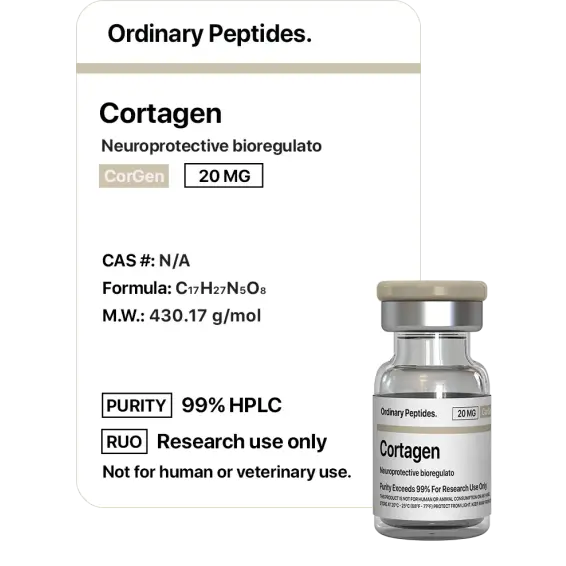
| MW | ~430.4 Da; PubChem CID: 18439621 |
| Developer | Vladimir Khavinson, St. Petersburg Institute of Bioregulation and Gerontology |
| Derived from | Cortexin (bovine cerebral cortex polypeptide complex) — directed synthesis of active fragment |
| Primary proposed target tissue | Cerebral cortex; peripheral nervous system |
| Secondary proposed targets | Cardiac tissue; immune system |
| FDA/EMA status | ❌ Not approved; not in clinical trials |
| Human clinical data | Referenced in passing; not published in systematic trial format |
Origin: From Cortexin to Cortagen
Cortexin is a polypeptide complex derived from the cerebral cortex of young cattle, developed at the Military Medical Academy in Leningrad in the 1980s — a heterogeneous mixture of short peptides with molecular weights ranging from 1,000 to 10,000 Da. Cortexin is a registered pharmaceutical in Russia (registration number P N001933/01) with approved indications including acute and chronic cerebrovascular disease, traumatic brain injury, encephalitis, epilepsy, neurodegenerative conditions, cognitive impairment, and delayed psychomotor development in children, in clinical use for over three decades.
The limitation of polypeptide complex drugs is heterogeneous composition: batch-to-batch variability, difficulty isolating active components, and pharmacokinetic ambiguity. The Khavinson programme’s approach was to identify the minimal active peptide sequence from amino acid analysis of the tissue extract and synthesise it as a pure, defined molecule. The synthetic tetrapeptide Cortagen (Ala-Glu-Asp-Pro) was obtained by directed synthesis based on amino acid analysis of the natural brain cortex peptide preparation Cortexin, which possesses neurotrophic activity.[1]
Structure
Sequence: Ala-Glu-Asp-Pro (H&sub2;N-Ala-Glu-Asp-Pro-OH; linear tetrapeptide with free N- and C-termini). Amino acid properties: Alanine (A) — small nonpolar; provides structural flexibility at position 1; Glutamic acid (E) — negatively charged at physiological pH; Aspartic acid (D) — also negatively charged; alongside Glu, gives Cortagen a net negative charge at positions 2–3; Proline (P) — cyclic imino acid; introduces a rigid kink in the peptide backbone; disrupts α-helix formation; makes the C-terminus structurally distinctive from other AEDX sequences in the Khavinson family.
The proline C-terminus is the structural feature that distinguishes Cortagen (AEDP) from Cardiogen (AEDR, with arginine at position 4) and Pinealon (EDR, a tripeptide). Proline’s rigidity creates a different three-dimensional presentation of the peptide to potential DNA or protein binding sites — part of the proposed basis for tissue specificity.
Proposed Mechanism: Chromatin Remodelling and Epigenetic Gene Regulation
Cortagen’s proposed mechanism is identical in framework to Cardiogen’s — see the Cardiogen article for a detailed discussion of the Khavinson peptide-DNA interaction hypothesis. In brief: short peptides enter cells and nuclei, interact with histones and/or DNA at promoter regions, and modify chromatin accessibility to alter gene expression patterns in a tissue-preferential manner. For Cortagen specifically, the published mechanistic data has three distinct levels of evidence, making it more granular than for most other bioregulator peptides.
Level 1: Chromatin structure changes in aged human cells
The most mechanistically detailed Cortagen study was published in the International Journal of Peptide Research and Therapeutics (Springer, 2014), examining heterochromatin remodelling in cultivated lymphocytes from individuals aged 80+. The findings: Cortagen induced selective decondensation (deheterochromatinization) of facultative heterochromatin (reversibly silenced genes); activated ribosomal gene expression through decondensation of acrocentric chromosome satellite stalks (nucleolar organiser regions, NORs); and left constitutive pericentromeric heterochromatin intact, preserving chromosomal stability.[5]
This selectivity is biologically important. With ageing, there is a progressive shift of transcriptionally active euchromatic regions into facultative heterochromatin — a global silencing of previously active genes contributing to declining cellular function and impaired protein synthesis. Indiscriminate chromatin decondensation would be dangerous (activating repetitive elements and retrotransposons); selective reactivation of facultative heterochromatin represents a meaningful reversal of age-related gene silencing. The experimental methodology (differential scanning calorimetry of chromatin, NOR activity staining, cytogenetic fluorescent analysis) is established and independently applicable — and the publication is in a Springer Nature journal, not solely in Russian-language sources.
Level 2: Large-scale transcriptome analysis
The 2004 microarray study (Anisimov, Khavinson, and Anisimov; Neuroendocrinology Letters) is a landmark in the Cortagen literature. Comparative analysis of cDNA microarray hybridisation with heart samples from control and experimental groups revealed 234 clones (1.53% of total clones) with significant changes of expression, matching 110 known genes belonging to various functional categories. Maximum up- and down-regulation was +5.42 and −2.86-fold, respectively. Intercomparison of changes induced by Cortagen, Vilon, Epitalon, and melatonin revealed both common and specific effects of Cortagen upon gene expression in heart.[2]
This study used cDNA microarray — the gold-standard genomic technology of its era — to characterise transcriptome-wide effects of Cortagen. The finding that 110 known genes were significantly affected in cardiac tissue (despite Cortagen being a brain bioregulator) suggests that the gene expression effects are not entirely organ-specific, or that the AEDP sequence affects conserved regulatory elements present in multiple tissue types. A 5.42-fold maximum upregulation is substantial and this represents actual molecular biology data — gene expression readouts, not just functional endpoint claims.
Level 3: IL-2 and immune modulation
In splenocyte experiments, Cortagen (alongside Vilon and Epitalon) activated interleukin-2 (IL-2) mRNA synthesis in the absence of specific inductors. IL-2 is the primary T-cell growth factor driving clonal expansion during immune responses. The Cortagen-induced IL-2 upregulation without specific immune activation suggests baseline enhancement of immune readiness, consistent with immunostimulatory properties described for other Khavinson bioregulators.[7]
Peripheral Nerve Regeneration: The Most Specific Preclinical Finding
This is methodologically clean preclinical data: a defined model (sciatic nerve transection and suture), defined dosing (10 μg/kg IM daily for 10 days), defined endpoints (nerve fibre growth rate by morphometry; conduction velocity by electrophysiology), and quantified effect. Conduction velocity is a direct measure of nerve function — the ability of regenerating fibres to conduct electrical signals. A 40% improvement in conduction velocity in a 10-day treatment period represents substantial acceleration of nerve recovery by any standard.
A follow-up study examined later stages of regeneration (5 months post-injury) and found that Cortagen demonstrated a pronounced therapeutic effect upon the structural and functional posttraumatic recovery of peripheral nerve tissue, with additional observations in cardiovascular and cerebrovascular parameters — suggesting early acceleration of regeneration translates into durable functional improvement.
Brain Ischaemia and Neuroprotection
Cortagen has been studied in rat models of chronic cerebral ischaemia (carotid artery occlusion with periodic hypoxic stress). Key findings: both Cortexin and Cortagen accelerated behavioural recovery (locomotor function, spatial learning) in ischaemic rats versus vehicle control; Cortagen reduced lipid peroxidation markers in brain tissue, indicating antioxidant protection; and Cortagen maintained antioxidant enzyme activity (SOD, catalase) at higher levels than ischaemic controls.
A behavioural comparison was particularly informative: Cortexin showed anxiolytic-like effects when given acutely, but anxiogenic-like arousal emerged with repeated treatment. Cortagen, by contrast, provided motor stimulation without emotional-affective fluctuations. This behavioural profile difference supports a key argument for developing defined synthetic peptides from complex natural extracts — by isolating the specific tetrapeptide sequence, researchers achieved a more targeted pharmacological effect, whereas the heterogeneous Cortexin mixture introduced confounding elements that produced the paradoxical anxiogenic effect with repeated dosing.
Cortagen vs. Related Khavinson Neurological Peptides
| Peptide | Sequence | Tissue origin | Primary proposed effects |
|---|---|---|---|
| Cortagen | AEDP (4 AA) | Cerebral cortex (from Cortexin) | Peripheral nerve regeneration; cortical gene reactivation; chromatin remodelling |
| Pinealon | EDR (3 AA) | Pineal gland (from Epithalamin) | Broad neuroprotection; anti-apoptotic; Huntington’s model |
| Semax | MEHFPGP (7 AA) | Synthetic ACTH 4-7 analogue | BDNF/NGF upregulation; nootropic; TrkB modulation |
| Selank | TKPRPGP (7 AA) | Synthetic tuftsin analogue | Anxiolytic; GABA-A modulation; IL-6 regulation |
| Cortexin | Polypeptide complex | Bovine cerebral cortex extract | Broad neuroprotective; registered Russian pharmaceutical |
Semax and Selank work through defined receptor systems — BDNF/TrkB signalling and GABA-A modulation, respectively — well characterised in Western pharmacology. Cortagen’s proposed mechanism (direct chromatin/DNA interaction) is fundamentally different and less characterised by contemporary standards. Cortagen vs. Pinealon: despite different tissue origins (cerebral cortex vs. pineal gland), their proposed mechanisms are similar (chromatin interaction, gene expression modulation). Cortagen’s strongest unique data is the peripheral nerve regeneration; Pinealon’s is Huntington’s disease cell models.
The Human Data Question
The Springer paper and the microarray paper both reference, in passing, that “Cortagen demonstrated a pronounced therapeutic effect upon the structural and functional recovery of damaged peripheral nerve tissue” in humans. This phrase appears to reference clinical use in Russia — clinical case series or small observational studies. However, no systematic, randomised, controlled, placebo-blinded trial of Cortagen in peripheral nerve injury, cerebrovascular disease, or any other human indication has been published in a form accessible via PubMed or major European databases. The human references in the literature are passing mentions accompanying primarily animal or cell data.
Regulatory Status
Cortexin (the parent polypeptide complex) is a registered pharmaceutical in Russia; Cortagen (AEDP) as a pure synthetic peptide exists in a less formally regulated space. In the United States, Cortagen is not FDA-approved and not in any registered clinical trial; it would be classified as an unapproved drug if sold for therapeutic purposes. Not EMA or MHRA approved. Not WADA-prohibited.
Safety Profile
The published animal studies report no significant adverse effects at research protocol doses (10 μg/kg IM). The peptide’s amino acid composition — four standard proteinogenic amino acids — is non-toxic; the individual residues are dietary amino acids. Behavioural profiling showed that at optimal dose (~0.03 mg/kg), Cortagen enhanced locomotor activity without anxiety-like effects — a clean stimulatory profile without the paradoxical anxiogenic effect seen with the parent Cortexin. No endocrine disruption is documented (unlike ACTH-derived peptides, Cortagen is not structurally related to hormones with known axis effects).
The primary safety concern is not toxicity but the absence of formal human safety studies. The long-term effects of repeated administration of exogenous regulatory peptides that interact with chromatin in aged cells are unknown. Whether sustained chromatin decondensation produces any unintended consequences (reactivation of retrotransposons, disruption of constitutive heterochromatin, altered cell cycle regulation) has not been formally assessed in long-term studies.
Common Misconceptions
“Cortagen is the same as Cortexin.”
Cortexin is a heterogeneous polypeptide complex from bovine cerebral cortex containing hundreds of different peptides. Cortagen (AEDP) is the pure synthetic tetrapeptide developed by identifying what Khavinson’s group determined to be the primary active fragment. Cortexin is an approved pharmaceutical in Russia; Cortagen is a research compound.
“The 27–40% nerve regeneration improvement means Cortagen will help human nerve injuries.”
Rat sciatic nerve transection is a useful but imperfect model for human peripheral nerve injury. Species differences in nerve regeneration, dosing considerations, and vast differences in nerve anatomy mean rodent data does not straightforwardly predict human outcomes. The finding is genuinely encouraging as hypothesis-generating data — it does not constitute clinical evidence.
“Cortagen proves that epigenetics can be reversed by peptides.”
The chromatin decondensation findings are real and published in peer-reviewed literature. But they represent a single research group’s findings, using specific cytogenetic methods, in cultured lymphocytes. Independent confirmation of chromatin remodelling by exogenous tetrapeptides has not been published by other groups.
Key Takeaways
- Cortagen (AEDP) is the cerebral cortex-targeted synthetic tetrapeptide in the Khavinson bioregulator series, derived by directed synthesis from Cortexin. Its proposed mechanism — chromatin decondensation and gene expression reactivation — has more mechanistic detail in the published literature than most Khavinson peptides, including a Springer-published paper demonstrating selective heterochromatin remodelling in aged human lymphocytes.[5]
- ✅ The sciatic nerve regeneration data is the most specific and quantified preclinical finding. A PubMed-indexed study showed 27% improvement in nerve fibre growth rate and 40% improvement in conduction velocity in a rat sciatic nerve transection model — methodologically cleaner than most claims for compounds in this series.[1]
- ✅ The microarray study is the most molecularly granular Khavinson publication. Cortagen altered expression of 110 known genes in mouse heart tissue across 234 genomic loci — real transcriptomic data showing broad gene regulatory effects with a 5.42-fold maximum upregulation.[2]
- ⚠️ The same single-group provenance limitation applies as to all Khavinson bioregulators. Despite publication in Springer and indexed journals, essentially all Cortagen data originates from the St. Petersburg Institute of Bioregulation and Gerontology. Independent replication by external research groups remains absent.
- ⚠️ No human clinical trial data exists in the form required by modern evidence-based medicine. References to human therapeutic use in Russian clinical settings are not equivalent to randomised controlled trial evidence. The compound is not approved anywhere outside Russia’s regulatory framework for Cortexin.
References
Primary Cortagen Publications (PubMed-indexed)
- Khavinson VKh, Malinin VV. Effect of tetrapeptide cortagen on regeneration of sciatic nerve. Bulletin of Experimental Biology and Medicine. 2001. PMID 11276314. (Primary sciatic nerve regeneration study — 27% growth rate + 40% conduction velocity improvement)
- Anisimov SV, Khavinson VKh, Anisimov VN. Elucidation of the effect of brain cortex tetrapeptide Cortagen on gene expression in mouse heart by microarray. Neuroendocrinology Letters. 2004;25(1-2):87–93. (cDNA microarray; 110 genes affected)
- Anisimov SV, Khavinson VKh, Morozov VG, Khavinson V. Effect of cortagen on gene expression in mouse brain. Bulletin of Experimental Biology and Medicine. 2008;145(2):228–231. PMID 18239817
Chromatin Mechanism
- Lezhava T, Monaselidze J, Kadotani N, Dvalishvili N, Buadze T. Anti-aging peptide bioregulators induce reactivation of chromatin. Georgian Medical News. 2006;(133):111–115.
- Lezhava T, Monaselidze J, Jokhadze T, et al. Epigenetic regulation of “aged” heterochromatin by peptide bioregulator Cortagen. International Journal of Peptide Research and Therapeutics. 2014. doi:10.1007/s10989-014-9443-7 (Springer Nature; heterochromatin decondensation in aged human lymphocytes)
Immune Effects
- Zarubina IV, Shabanov PD. Cortexin and cortagen as correcting agents in functional and metabolic disorders in the brain in chronic ischemia. (Cited in Russian; translated reference in peptide sciences literature)
- Kazakova TB, et al. In vitro effect of short peptides on expression of interleukin-2 gene in splenocytes. Bulletin of Experimental Biology and Medicine. 2002;133(6):614–616.
- Gumen AV, Kozinets IA, Shanin SN, Malinin VV, Rybakina EG. Production of lymphocyte-activating factors by mouse macrophages during aging and under the effect of short peptides. Bulletin of Experimental Biology and Medicine. 2006;142(3):360–362.
Cortexin Parent Compound
- Cortexin (polypeptide complex): registered Russian pharmaceutical. Registration P N001933/01. Used as the source compound from which the AEDP sequence was identified by directed synthesis.
Key Investigator
- Vladimir Khatskelevich Khavinson, MD, PhD, DSc — St. Petersburg Institute of Bioregulation and Gerontology; the Cortagen research programme originates from his laboratory, as does the Cortexin directed-synthesis approach that produced Cortagen.
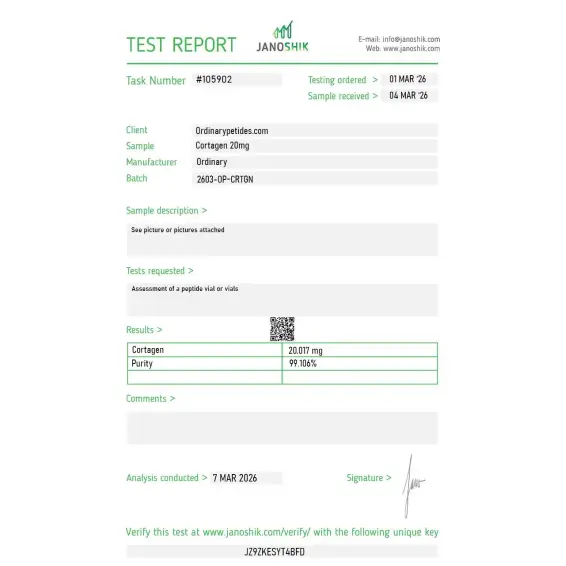
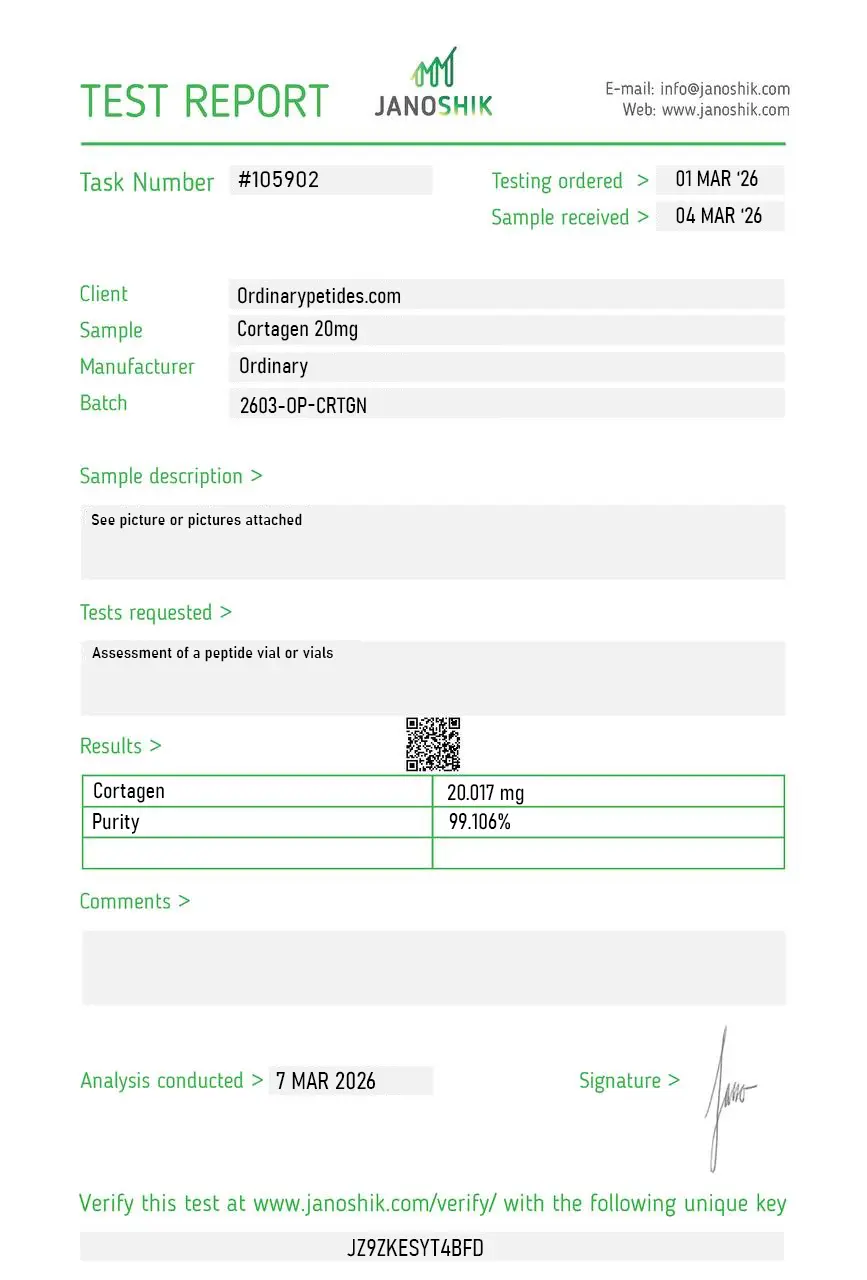
Certificate of Analysis
An independent test report is available for Cortagen 20mg. This report provides batch-level documentation and analytical verification information for research reference.
Based on 2 reviews
5.0
-
2
Reasonable price for what's structurally just a four-residue Khavinson peptide. Material was AEDP by mass spec when I checked.
Mostly Russian-language literature for this one, like the rest of the Khavinson tetrapeptide family. Means a lot of bibliographic work before designing experiments around it. Not the vendor's problem, but worth knowing.
Cortagen is a synthetic tetrapeptide bioregulator with the amino acid sequence Ala-Glu-Asp-Pro (AEDP). It was developed by Professor Vladimir Khavinson and colleagues at the St. Petersburg Institute of Bioregulation and Gerontology in Russia, derived by directed synthesis from amino acid analysis of Cortexin — a natural polypeptide extract from brain cortex tissue. It is the brain and central nervous system counterpart in the same bioregulator family as Cardiogen for the heart and Thymalin for the immune system.
Cortagen operates at the epigenetic level rather than through conventional receptor or neurotransmitter mechanisms. It penetrates cell membranes, travels to the nucleus, and binds to specific DNA and histone sites to modulate gene expression. Its key actions include decondensing age-related chromatin compaction — essentially reactivating genes that have been silenced by aging — upregulating neurotrophic factors that support neuron survival and growth, regulating glutamate and GABA neurotransmitter activity to balance neuronal signaling, and reducing lipid peroxidation while boosting antioxidant enzymes such as SOD and catalase. It also stimulates interleukin-2 expression, supporting immune regulation within the nervous system.
Research in animal models and clinical observations in Russia points to several areas of benefit. These include accelerated peripheral nerve regeneration — one study showed up to 40% increased nerve fiber regrowth after transection injury — neuroprotection against oxidative stress and ischemic damage, improved cognitive function including memory, focus, and learning, motor stimulation without negative effects on emotional or anxiety profiles, restoration of a more youthful gene expression profile in aging brain and cardiac cells, and support for recovery from traumatic brain injury and stroke. Secondary benefits have also been observed in cardiovascular tissue through microarray studies showing altered expression of cardiac repair and metabolic genes.
Unlike most cognitive enhancers that work by modulating neurotransmitter levels — such as increasing dopamine, serotonin, or acetylcholine — Cortagen acts at the genomic level to support structural repair and regeneration of neural tissue. This makes it fundamentally different in approach — addressing the root biological causes of neurological decline rather than temporarily altering brain chemistry. Research also found no tolerance build-up and no withdrawal effects.
It is given by intramuscular or subcutaneous injection, typically at doses of 0.1 to 5 mg per day. Treatment courses generally last 7 to 20 days, repeated two to three times per year based on clinical need or physician guidance. It is supplied as a lyophilized powder reconstituted with sterile water or saline before injection. In observational Russian clinical settings it has also been used orally, though injectable routes are considered more reliable for bioavailability.
Cortagen has a consistently reported minimal side effect profile across preclinical and observational studies. Animal studies found motor stimulation with no negative effects on emotional or anxiety-related behaviour. Mild side effects occasionally reported at higher doses include temporary fatigue, mild headache, or brief injection site discomfort. No allergic reactions or significant drug interactions have been documented, though comprehensive long-term human clinical trial data remains absent.
People with known hypersensitivity to any component of the formulation should avoid it. Pregnant or breastfeeding women should not use it due to the absence of safety data in these populations. Individuals with active neurological disorders or those taking medications that affect brain chemistry or immune function should only consider it under direct medical supervision. As it remains an investigational compound with no FDA approval and no Western clinical trials, use outside Russia and Eastern Europe should be approached with appropriate caution and qualified medical oversight.