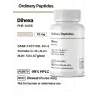
Dihexa
For in vitro testing and laboratory use only. Not for human or animal consumption. Bodily introduction is illegal. Handle only by licensed professionals. Not a drug, food, or cosmetic. Educational use only.
Dihexa: A Small Peptide at the Crossroads of Synaptogenesis Research, HGF/c-Met Signaling, and Nootropic Neuroscience
Dihexa, also known as N-hexanoic-Tyr-Ile-(6)-aminohexanoic amide, is a synthetic angiotensin IV analog best known in the field of neuroscience, where it has been studied as a potentiator of hepatocyte growth factor (HGF) signaling through the c-Met receptor and linked to the biology of synaptic plasticity. In the research context, the main interest in this peptide grew out of studies reporting increased dendritic spine density, robust synaptogenesis, and picomolar activity in hippocampal neuron cultures. That sounds dramatic — and that is precisely why it attracts so much attention.
Published reports have also discussed its relationship with BDNF signaling, neuroprotection, and cognitive performance in aged or scopolamine-treated animal models, while preclinical data have connected it to a broader neurotrophic and pro-cognitive framework. Still, a sober filter is essential here: a compelling synaptogenic story is not yet a ready-made cognitive enhancer in a vial. If only biology were that cooperative.
What makes Dihexa genuinely interesting is that it sits at the crossroads of nootropic hypotheses, growth factor pharmacology, and the broader tradition of angiotensin-derived neuroactive peptides. For readers who care not just about bold promises but about the actual scientific grounds for interest, this is exactly the kind of peptide worth examining carefully — and without illusions.
Dihexa: A Scientific Review of the Angiotensin IV Analog
Based on peer-reviewed literature, retraction notices, and clinical trial records — see References. Last updated: May 2026.
The Short Version
Dihexa is the most cognitively ambitious peptide in this review series, and it comes with the most complicated story.
Developed in Joseph Harding's laboratory at Washington State University starting in the late 2000s, Dihexa is a six-amino-acid analog of angiotensin IV — engineered to be metabolically stable, orally bioavailable, and capable of crossing the blood-brain barrier. The most repeated claim about it in the wellness press is that it's "ten million times more potent than BDNF" at promoting new synapse formation. That number is real — it appears in the 2011 Benoist et al. paper in Journal of Pharmacology and Experimental Therapeutics — and it refers to picomolar activity in cell culture spinogenesis assays.[1] It's a striking finding.
It's also, like much of Dihexa's literature, a finding that needs to be read in context.
The compound went through the standard arc of academic translation. Harding's lab published in vivo work showing oral Dihexa reversed scopolamine-induced cognitive deficits in rats. The proposed mechanism — that Dihexa potentiates HGF (hepatocyte growth factor) signaling through its receptor c-Met — was characterized in a 2014 follow-up paper. A WSU spin-off company, M3 Biotechnology, was founded by Harding's PhD student Leen Kawas to commercialize the compound. M3 renamed itself Athira Pharma, raised over $200 million in a 2020 IPO, and developed a Dihexa prodrug called fosgonimeton (ATH-1017) that entered late-stage clinical trials for Alzheimer's disease.
Then two things happened that materially changed the picture.
In 2021, Washington State University's investigation concluded that Kawas had altered images in her doctoral dissertation and in at least four research papers co-authored with Harding between 2011 and 2014. She was forced to resign as Athira CEO. Retraction Watch and For Better Science documented the findings.[14][15] In April 2025, the foundational 2014 Benoist et al. paper — the one that established the HGF/c-Met mechanism — was formally retracted. WSU's investigation found Kawas and Harding "solely responsible" for falsified and/or fabricated data.[12][16]
In 2023, Athira's Phase 2 ACT-AD trial of fosgonimeton in Alzheimer's patients failed its primary endpoint. The subsequent Phase 2/3 LIFT-AD trial, designed to be definitive, also failed.[13] In January 2025, Athira agreed to pay over $4 million to settle a False Claims Act case related to NIH grants that had cited the compromised research.
That said: not everything published on Dihexa is compromised. Independent replication does exist — most notably Sun et al. 2021, an APP/PS1 mouse Alzheimer's model paper from a separate group showing cognitive rescue.[10] The behavioral findings (Morris water maze, radial arm water maze) in the original Harding work were not directly implicated in the image manipulation findings (which centered on Western blot images). And the HGF/c-Met pathway itself is a legitimate, well-characterized neurotrophic signaling system.
So the right framing is probably this: Dihexa exists in a damaged evidence space. Some of the science is sound. Some of the science is retracted. The clinical translation has failed. The mechanism story has been undermined. Anyone using or evaluating this compound needs to know all of that — not just the "10 million times BDNF" headline.
| At a glance | |
|---|---|
| Full name | N-hexanoic-Tyr-Ile-(6)-aminohexanoic amide |
| Sequence | Hexanoyl-Tyr-Ile-Ahx-NH₂ |
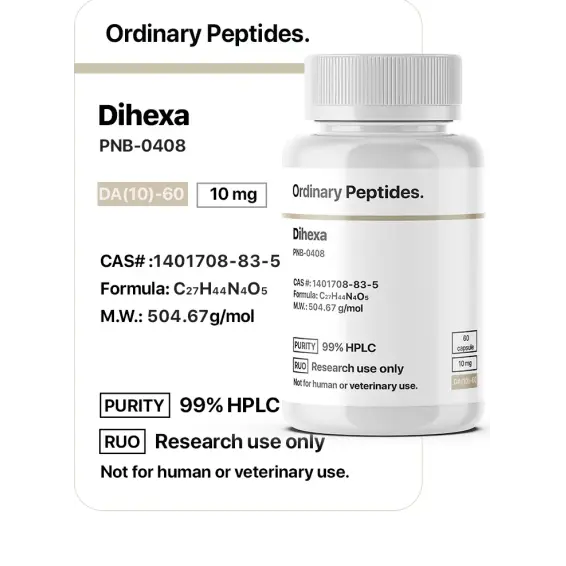
| Development codes | PNB-0408 (Dihexa); ATH-1017 / fosgonimeton (Athira prodrug) |
| Chemical class | Modified hexapeptide / angiotensin IV analog |
| Molecular formula | C₂₆H₄₂N₄O₅ |
| Molecular weight | 504.67 g/mol |
| CAS | 1401708-83-5 |
| Originator | Joseph W. Harding lab, Washington State University |
| Parent compound | Angiotensin IV (Val-Tyr-Ile-His-Pro-Phe) |
| Proposed mechanism | Potentiation of HGF/c-Met signaling (now-retracted foundational paper) |
| Foundational paper status | ⚠️ Benoist et al. 2014 (JPET) — RETRACTED April 2025; 2011 Benoist paper had expression of concern |
| FDA status | ❌ Not approved. ⚠️ Category 2 bulk drug substance |
| EMA status | ❌ Not approved |
| Human clinical trials | ✓ Phase 1/2/3 conducted by Athira on fosgonimeton; ❌ both Phase 2 ACT-AD and Phase 2/3 LIFT-AD failed primary endpoints |
| WADA status | Not specifically named on Prohibited List as of 2026 |
The Origin: From Angiotensin IV to Cognitive Enhancement
The starting point for Dihexa is an unlikely place: the renin-angiotensin system, normally discussed in the context of blood pressure regulation.
Angiotensin IV (Ang IV, sequence Val-Tyr-Ile-His-Pro-Phe) is a hexapeptide produced by enzymatic processing of angiotensin II in the brain. By the 1990s, researchers had observed that Ang IV had cognitive effects in animal models that were distinct from its peripheral cardiovascular role — particularly effects on learning and memory mediated through what was called the "AT4 receptor."
In the 2000s, the AT4 receptor was identified as insulin-regulated aminopeptidase (IRAP) — a finding that complicated the story but didn't kill the cognitive interest. Harding's group at WSU systematically modified the Ang IV sequence to produce more stable, more potent, brain-penetrant analogs. The core procognitive activity was traced to the first three N-terminal amino acids (Tyr-Ile-His in the original; modified in later analogs). Through structure-activity work, the lab arrived at a compound with:
- Hexanoic acid modifications at both termini (improving lipophilicity and metabolic stability)
- The N-terminal tyrosine-isoleucine dipeptide preserved
- A C-terminal aminohexanoic acid spacer terminating in an amide
That compound was Dihexa. The "hex" in the name refers to the dual hexanoic acid modifications, not the six amino acids (it's actually a modified dipeptide with two C6 chains attached, depending on how you count it; "hexapeptide analog" is the common shorthand).
The mechanism story shifted along the way. Originally the work focused on IRAP inhibition. Then, around 2012-2014, the Harding group proposed that the real target was HGF/c-Met — that Dihexa and its parent compounds bind HGF and facilitate its signaling. The 2014 Benoist paper was the key publication establishing this — and is the paper that was later retracted.
Chemistry
Dihexa is a small modified peptide. Structurally it sits between "peptide drug" and "small molecule" — small enough to cross membranes and the blood-brain barrier, but built on a peptide backbone with amino acid components.
The two hexanoic acid groups (N-terminal hexanoyl, C-terminal aminohexanoic amide) are the key modifications that distinguish Dihexa from its peptide precursors. They serve two functions:
- Metabolic protection — they block the N- and C-terminal positions where peptidases would normally cleave the molecule, dramatically extending half-life.
- Lipophilicity — they push the molecule's logP into a range where it can cross the blood-brain barrier passively, unlike most peptides.
This is the same general design principle used in many peptide-to-small-molecule conversion projects: take a bioactive peptide sequence, protect the termini, and add lipophilic groups to enable CNS penetration.
| Property | Detail |
|---|---|
| Molecular weight | 504.67 g/mol |
| Solubility | Slightly water-soluble; better in DMSO and organic solvents |
| Blood-brain barrier penetration | Yes (confirmed in animal studies) |
| Oral bioavailability | Reported in animal studies; absolute bioavailability in humans not formally published |
| Plasma half-life | Estimated 8-12 hours (animal data) |
| Routes studied | Oral, intracerebroventricular, intraperitoneal, subcutaneous |
The prodrug fosgonimeton (ATH-1017) is a phosphate prodrug of Dihexa, designed for improved injectable pharmacokinetics. In the body, fosgonimeton is hydrolyzed to release Dihexa. This is the compound Athira took into human clinical trials — which means there's actually some human safety data via this route.
The Mechanism Story (and Its Complications)
The original story
The Harding group's account of Dihexa's mechanism, as it stood circa 2014-2020, was approximately this:
Dihexa binds HGF (hepatocyte growth factor) directly with high affinity. HGF, in its native state, exists as inactive monomers. Dihexa promotes HGF dimerization and stabilizes its productive binding to c-Met, the HGF receptor tyrosine kinase. Activated c-Met triggers a signaling cascade through PI3K/AKT, MAPK, and other pathways that drive neurogenesis, synaptogenesis, dendritic spine formation, and neuronal survival.
The mechanism was attractive because HGF/c-Met is independently well-established as a critical neurotrophic system. Genetic deletion of c-Met in brain regions causes developmental and cognitive deficits. HGF infusion has independent neuroprotective effects in stroke and TBI models. So the target was credible even if the Dihexa data turned out to be problematic.
The retraction
In April 2025, the 2014 Benoist et al. paper in Journal of Pharmacology and Experimental Therapeutics — the paper that established the HGF/c-Met mechanism for Dihexa — was formally retracted.[12][16] The retraction followed WSU's special committee investigation, which concluded that Kawas and Harding were "solely responsible" for falsified and/or fabricated data. The image manipulations identified included copying and pasting Western blot data between experiments, digital alteration of band intensity, and reuse of identical images to represent different experimental conditions.
The 2011 Benoist paper (the source of the "10 million times BDNF" claim) received an expression of concern but remains published.[14] Four total papers from the Harding/Wright/Kawas group received expressions of concern in 2021.[14][15]
Athira's defense, in 2022, was that the company had independently replicated the key Dihexa experiments at M3 Biotechnology and that the patent for ATH-1017 did not cite the papers containing altered images.[18] This is a meaningful distinction — the prodrug development was, in principle, independent of the compromised academic publications. But "we replicated it internally" is not the same as "the published literature is reliable," and the published literature is what the broader field has built on.
What's left of the mechanism
So where does the mechanism story sit in May 2026?
- HGF/c-Met as a legitimate neurotrophic system: Well-established, independent of Dihexa work.
- Dihexa as an HGF agonist/potentiator: Originally established by the now-retracted 2014 paper; remaining evidence comes primarily from the same lab, with limited independent replication of the mechanism specifically.
- Dihexa's behavioral cognitive effects: Replicated by an independent group (Sun et al. 2021 in APP/PS1 Alzheimer's model mice).[10] Not directly compromised by the image manipulation findings.
- Dihexa's synaptogenic effect in vitro: Reported in the 2011 Benoist paper (expression of concern, not retracted). The picomolar potency claim rests on this paper.
- HGF binding studies: Primarily Harding lab work. Reliability is degraded by the broader integrity concerns.
The honest summary: there is some independent evidence Dihexa does something in animal cognitive models. The mechanism for how it does that is materially less certain than it appeared in 2020.
| Proposed mechanism component | Evidence status |
|---|---|
| HGF/c-Met as a neurotrophic pathway | ✅ Well-established (independent of Dihexa) |
| Dihexa binds and activates HGF | ⚠️ Foundational paper retracted (Benoist 2014); not adequately re-established independently |
| Dihexa promotes synaptogenesis in vitro | ⚠️ Benoist 2011 expression of concern; not retracted |
| Dihexa improves cognition in animal models | ✅ Replicated independently (Sun 2021) |
| Dihexa crosses BBB orally | ✅ Generally accepted; modest independent confirmation |
| "10 million times more potent than BDNF" | ⚠️ Claim sourced from Benoist 2011 (expression of concern) |
Preclinical Evidence (After the Filter)
Reading the preclinical literature on Dihexa requires the asterisks to be visible. Setting that aside, here's what has been reported:
Cognitive rescue in scopolamine models
Scopolamine — a muscarinic acetylcholine receptor antagonist — produces reliable cognitive deficits in rodents that approximate certain features of cholinergic dysfunction in Alzheimer's. Multiple Harding-group papers reported that oral Dihexa (typically 2 mg/kg) reversed scopolamine-induced deficits in Morris water maze performance. The behavioral findings here weren't directly implicated in the image manipulation investigation, which focused on Western blot images.
Cognitive rescue in aged rats
Older rats show natural cognitive decline on spatial memory tasks. Dihexa reportedly improved performance on the radial arm water maze, correlating with increased dendritic spine density and synaptophysin expression in hippocampal tissue. Same provenance caveat.
Alzheimer's mouse model (independent replication)
Sun et al. 2021, published in Brain Sciences by a Chinese research group, reported that Dihexa rescued cognitive impairment and improved memory in APP/PS1 transgenic mice (a standard Alzheimer's model), with downstream effects involving PI3K/AKT signaling.[10] This is one of the most important independent papers on the compound — it's outside the Harding/Kawas orbit and supports at least the behavioral story.
Synaptogenesis in vitro
The original 2011 in vitro work in hippocampal neuronal cultures showed picomolar Dihexa increased dendritic spine density. The "10 million times more potent than BDNF" comparison comes from this assay. This paper has an expression of concern but has not been retracted.
Other models
Stroke recovery, traumatic brain injury, Parkinson's models — Dihexa has been studied in all of these by the Harding group with reported neuroprotective effects. Independent replication is limited.
Human Evidence: Fosgonimeton (ATH-1017)
This is where Dihexa's story diverges from most peptides in this series — there's actually substantial human clinical data, via the prodrug.
Phase 1 (2018-2019)
Athira's Phase 1 trial of fosgonimeton in healthy volunteers reportedly demonstrated safety, tolerability, and target engagement — the latter assessed using quantitative EEG and event-related potential (ERP) P300 biomarkers as surrogates for CNS effect. Adverse events were generally mild. The compound was advanced into efficacy trials.
Phase 2 ACT-AD (completed 2023)
This was a Phase 2 randomized, double-blind, placebo-controlled trial in patients with mild-to-moderate Alzheimer's disease. The primary endpoint failed. Cognitive measures did not differentiate the fosgonimeton arms from placebo to a statistically significant degree.
Phase 2/3 LIFT-AD (completed 2024)
The pivotal trial designed to support potential registration. The primary endpoint also failed. Fosgonimeton did not show a statistically or clinically significant cognitive benefit over placebo in Alzheimer's patients.[13]
Athira has continued to publish post-hoc analyses suggesting potential efficacy in specific patient subgroups (particularly those not on co-administered acetylcholinesterase inhibitors), but these are exploratory analyses of failed trials, not positive evidence by regulatory standards.
Implications
The trial failures cut multiple ways:
- Safety: Hundreds of patients received fosgonimeton (and therefore Dihexa) in monitored clinical settings. Serious adverse events were not reported at rates that would have halted the trials. This is genuine human safety data, even if the efficacy failed.
- Efficacy: The cognitive benefits seen in animal models did not translate to measurable benefits in Alzheimer's patients. This is the standard cross-species failure mode that has killed dozens of Alzheimer's candidates over the past 25 years.
- Mechanism: A negative trial doesn't prove the mechanism is wrong, but it weakens the translational case for the compound's pharmacology.
Regulatory Status
| Jurisdiction | Status |
|---|---|
| FDA (USA) | ❌ Not approved. ⚠️ Dihexa was placed on Category 2 bulk drug substance list (Sept 2023). Recent update: removed from Category 2 (April 22, 2026) per FDA notice. |
| Compounding pharmacies (US) | Status in flux following recent FDA action |
| EMA (Europe) | ❌ Not approved |
| WADA | Not specifically listed on the 2026 Prohibited List |
| Fosgonimeton clinical status | Phase 2/3 trials failed; no active path to approval announced as of May 2026 |
For consumer access, the practical reality is that Dihexa is sold predominantly through "research chemical" suppliers operating outside GMP standards. Material quality cannot be assumed.
Safety
Animal safety
Across the Harding group's preclinical work, Dihexa was reportedly well-tolerated in rodents at the doses used for efficacy studies (typically 1-2 mg/kg orally). No major organ toxicity, no obvious behavioral toxicity, no consistent adverse effect signal in published work.
Human safety (via fosgonimeton trials)
This is actually one of the better-characterized safety datasets in this review series, given that hundreds of patients received the prodrug in Phase 1-3 trials over years. Reported adverse events were generally mild and manageable. Some injection-site reactions (fosgonimeton is administered subcutaneously). No major cardiovascular, hepatic, renal, or psychiatric safety signals reported as serious enough to halt development.
That said, the trials were in elderly Alzheimer's patients receiving the prodrug, not in healthy adults using research-chemical-sourced Dihexa for cognitive enhancement. The safety profile may differ substantially across those contexts.
The cancer concern — this one is real
Here is where Dihexa has the most important unresolved safety issue, and it deserves explicit attention.
HGF/c-Met is one of the most studied oncogenic signaling pathways in human cancer biology. c-Met activation drives tumor proliferation, invasion, and metastasis across a long list of cancers — non-small cell lung cancer, gastric cancer, hepatocellular carcinoma, renal cell carcinoma, glioblastoma, breast cancer, colorectal cancer. Multiple pharmaceutical c-Met inhibitors have been developed as anticancer drugs (capmatinib, tepotinib, crizotinib among others), and HGF/c-Met antibodies are an active oncology development area.
If Dihexa's primary mechanism is indeed potentiation of HGF/c-Met signaling — even granting all the asterisks above — it is pharmacologically activating the same pathway that pharmaceutical industry oncology teams have spent billions trying to block.[5]
This is not theoretical concern. It's the most direct mechanistic conflict between proposed therapeutic action and well-established cancer biology of any compound in this review series. The animal cognitive studies were short-term. The fosgonimeton clinical trials were in elderly patients with limited remaining lifespan exposure. Neither addresses the question of what chronic HGF/c-Met activation does to cancer risk in a younger, healthier user. For broader context on this area, see the oncology research category.
Other unknowns
- Long-term effects on neuroplasticity: Promoting synaptogenesis is good in injury and disease contexts. Whether continuously promoting it in a healthy brain is good is genuinely unknown. The brain has reasons for its existing synaptic pruning and connectivity patterns.
- Blood pressure effects: Dihexa derives from an angiotensin family peptide. Cardiovascular effects in long-term use have not been adequately characterized in healthy users.
- Drug interactions: Not formally characterized for Dihexa as a standalone compound.
- Pregnancy and reproductive effects: Not studied; contraindicated by default.
- Vendor material quality: Variable; standard research-chemical caveats apply.
| Safety area | Status |
|---|---|
| Acute animal toxicity | ✓ No signal at tested doses |
| Human safety (via fosgonimeton trials) | ✓ Hundreds of patient-years; no halting AE signals |
| Cancer risk via HGF/c-Met | ⚠️ Mechanistically concerning; not characterized in healthy users |
| Long-term neuroplasticity effects | ❌ Not studied |
| Cardiovascular safety | ⚠️ Theoretical concern (angiotensin family); not adequately studied |
| Drug interactions | ❌ Not characterized |
| Pregnancy/lactation | ❌ Contraindicated by default |
| Vendor material quality | ⚠️ Variable |
Common Misconceptions
"It's 10 million times more potent than BDNF in the brain."
The 10⁷ figure refers to picomolar vs nanomolar activity in a cell culture spinogenesis assay (Benoist 2011, expression of concern). It's a measure of in vitro concentration efficiency in one specific assay, not a measure of clinical effect or overall brain enhancement. The framing as a multiplier for "brain power" is marketing language with no clinical basis.
"It's been proven to work in Alzheimer's clinical trials."
The opposite is true. Fosgonimeton (the Dihexa prodrug) failed its primary endpoints in both the ACT-AD Phase 2 trial and the LIFT-AD Phase 2/3 trial. Post-hoc subgroup analyses don't change a failed primary endpoint.
"The image manipulation thing was minor and unrelated to Dihexa itself."
The 2014 Benoist paper, which established Dihexa's HGF/c-Met mechanism, was formally retracted in April 2025 specifically due to fabricated/falsified data. The 2011 Benoist paper, which contains the famous potency claim, has an expression of concern. These are the foundational mechanism and potency papers for the compound. "Unrelated" doesn't characterize the situation accurately.
"The HGF/c-Met mechanism makes it safer than other nootropics."
The opposite case can be argued. HGF/c-Met is one of the most established oncogenic pathways in cancer biology, and activating it is precisely the opposite of what oncology pharmacology spends billions trying to achieve. This isn't a safety feature. Other neuroscience research peptides like Semax work through entirely different mechanisms without this specific oncogenic concern.
"Athira's failure was just bad trial design, the drug works."
This is a common defense argument from compound advocates. It's a possible explanation for Alzheimer's-specific failure (the disease is brutally hard to treat, and dozens of compounds have failed). It's not, by itself, evidence that the compound has cognitive benefits in healthy users — that's a separate claim that requires its own evidence.
Frequently Asked Questions
Should I read the original Harding-group papers, or are they all suspect?
A balanced approach: read them with awareness that the Harding/Kawas papers from 2011-2014 had significant integrity findings, one was retracted, and the others had expressions of concern. Independent replications (like Sun et al. 2021 in APP/PS1 mice) carry more evidentiary weight in this context. The HGF/c-Met pathway biology that exists independent of Dihexa work is fully legitimate.
Did Joseph Harding face consequences?
Per the WSU investigation findings, both Kawas and Harding were named as responsible for the data integrity issues. Harding remained at WSU. Kawas was forced to resign as Athira CEO in October 2021.
Is fosgonimeton still being developed?
Athira has indicated continued interest in subgroup-based analyses but as of May 2026, no clear regulatory path to approval has been announced following the Phase 2/3 LIFT-AD failure. The compound's commercial future is uncertain.
If the prodrug failed in patients, why are people using research-grade Dihexa for cognitive enhancement?
Several possibilities, none of them strong: (1) belief that the trial failures were due to patient selection or design rather than the compound; (2) the placebo effect of self-administered injectables in motivated users; (3) the existence of an established marketing ecosystem that pre-dated the trial failures; (4) hope that effects in healthy brains differ from effects in degenerated Alzheimer's brains. None of these are evidence-based reasons.
What other compounds are studied for cognitive function?
The broader Neuroscience Research category includes peptides studied for cognitive enhancement and neuroprotection through different mechanisms — with cleaner integrity records than the Dihexa literature.
Key Takeaways
- Dihexa was developed in Joseph Harding's lab at Washington State University as an oral, brain-penetrant cognitive enhancement candidate, with a proposed mechanism of HGF/c-Met pathway potentiation.
- ⚠️ The foundational 2014 mechanism paper (Benoist et al., JPET) was formally retracted in April 2025 following a WSU investigation that found Kawas and Harding responsible for falsified/fabricated data. Three additional papers from the same group received expressions of concern.[12][14][16]
- The famous "10 million times more potent than BDNF" claim originates from the 2011 Benoist paper, which has an expression of concern but is not retracted. It refers to picomolar activity in a cell culture spinogenesis assay, not overall clinical potency.
- ⚠️ Fosgonimeton (ATH-1017), the Dihexa prodrug developed by Athira Pharma, failed both its Phase 2 ACT-AD trial and its Phase 2/3 LIFT-AD trial in Alzheimer's disease. This is the most definitive negative clinical signal of any compound in this review series.[13]
- Independent replication of behavioral effects exists (Sun et al. 2021 in APP/PS1 mice), so the compound is not pharmacologically inert. But the mechanism story and the clinical translation story are both substantially compromised.[10]
- ⚠️ The HGF/c-Met mechanism, if real, raises the most serious cancer concern in this review series. c-Met is a major oncogenic pathway that pharmaceutical oncology programs spend billions to block. Activating it chronically in healthy users has uncharacterized cancer risk that is mechanistically meaningful, not generic.
- Some genuine human safety data exists via the fosgonimeton trials — hundreds of patient-years of monitored exposure without serious safety halts. This is more than most peptides in this series.
- Athira agreed in January 2025 to pay over $4 million to settle a False Claims Act case related to NIH grants citing the compromised research. Athira's class-action settlement cost another approximately $10 million.
- Regulatory status (FDA Category 2 placement, subsequent removal) is in flux. Consumer access is via research-chemical channels with no quality guarantees.
- Honest summary: of all the peptides in this review series, Dihexa has the weakest combination of (a) preclinical evidence reliability, (b) clinical translation success, and (c) mechanism safety profile. The mechanism is interesting biology. The clinical translation has failed. The foundational papers have been retracted. The cancer mechanism is real. Anyone using this compound is operating on substantially less evidence than the marketing implies — and substantially more risk than the marketing acknowledges.
Related Compounds
For other peptides investigated for cognitive function and neuroprotection — with cleaner research integrity records than the Dihexa literature — see the Neuroscience Research category. Notable companions in this space include the Russian heptapeptide Semax (cognitive function and neuroprotection) and the anxiolytic tuftsin analog Selank.
References
Foundational pharmacology (with status notes)
- Benoist CC, Wright JW, Zhu M, Appleyard SM, Wayman GA, Harding JW. Facilitation of hippocampal synaptogenesis and spatial memory by C-terminal truncated Nle1-angiotensin IV analogs. J Pharmacol Exp Ther. 2011;339(1):35-44. PMID: 21719467. ⚠️ Expression of concern.
- McCoy AT, Benoist CC, Wright JW, et al. Evaluation of metabolically stabilized angiotensin IV analogs as procognitive/antidementia agents. J Pharmacol Exp Ther. 2013;344(1):141-154. PMID: 23055539. ⚠️ Expression of concern.
- Benoist CC, Kawas LH, Zhu M, et al. The procognitive and synaptogenic effects of angiotensin IV-derived peptides are dependent on activation of the hepatocyte growth factor/c-met system. J Pharmacol Exp Ther. 2014;351(2):390-402. PMID: 25187433. ❌ RETRACTED April 2025.
- Yamamoto BJ, Elias PD, Masino JA, et al. The angiotensin IV analog Nle-AngIV facilitates spatial learning and induces hippocampal LTP. J Pharmacol Exp Ther. 2010;333(1):161-173. PMID: 20086056.
Oncology context for HGF/c-Met
- Wright JW, Harding JW. The brain hepatocyte growth factor/c-Met receptor system: a new target for the treatment of Alzheimer's disease. J Alzheimers Dis. 2010;22(4):1097-1113.
- HGF/c-Met signaling in the tumor microenvironment. Adv Cancer Res. 2021;149:1-45. PMID: 33579418.
- Trusolino L, Bertotti A, Comoglio PM. MET signalling: principles and functions in development, organ regeneration and cancer. Nat Rev Mol Cell Biol. 2010;11(12):834-848.
Independent replication
- Sun J, et al. AngIV-Analog Dihexa Rescues Cognitive Impairment and Recovers Memory in the APP/PS1 Mouse via the PI3K/AKT Signaling Pathway. Brain Sci. 2021;11(11):1487. (Independent group, outside Harding/Kawas orbit.)
Clinical trial outcomes
- Athira Pharma corporate disclosures and SEC filings regarding ACT-AD Phase 2 trial results (2023) and LIFT-AD Phase 2/3 trial results (2024).
- Fosgonimeton (ATH-1017) Phase 2/3 LIFT-AD trial primary endpoint failure — Athira Pharma announcement, 2024.
Retraction and scientific integrity
- Retraction notice: Benoist CC, Kawas LH, Zhu M, et al. J Pharmacol Exp Ther. April 2025.
- Retraction Watch. Four papers by Athira CEO earn expressions of concern. September 24, 2021.
- For Better Science. How to cure all diseases. June 15, 2021.
- Washington State University Special Committee Investigation Report findings (2021), as disclosed in Athira SEC filings.
Corporate / regulatory
- Athira Pharma SEC filings, 2021-2025, including disclosures regarding image manipulation findings and patent independence.
- Athira Pharma False Claims Act settlement, January 2025 (~$4 million, NIH grants).
- FDA. Bulk Drug Substances Used in Compounding Under Section 503A — Category 2 list (September 2023; subsequent updates including April 2026 modifications).
Key investigators
- Joseph W. Harding, PhD — Professor, Washington State University. Co-developer of Dihexa; named in the WSU investigation findings.
- John W. Wright, PhD — Professor emeritus, WSU. Long-time Harding collaborator.
- Leen Kawas, PhD — Former WSU PhD student; co-founder and former CEO of M3 Biotechnology / Athira Pharma. Forced to resign October 2021 following findings of image manipulation in her dissertation and published papers.
- Sun et al., 2021 — Independent Chinese research group providing the most important replication of behavioral cognitive effects.
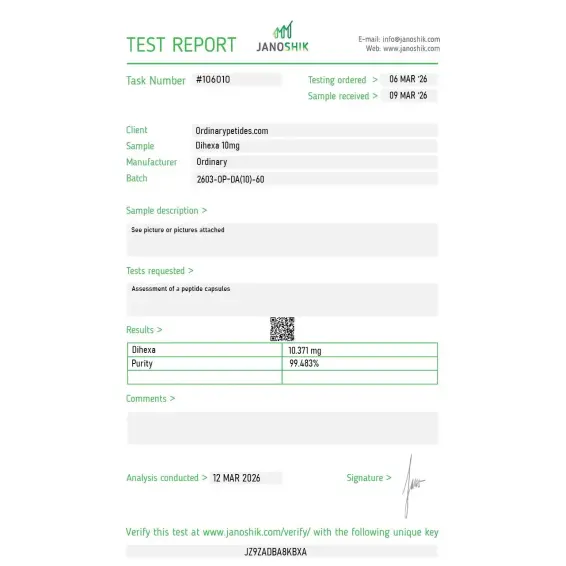
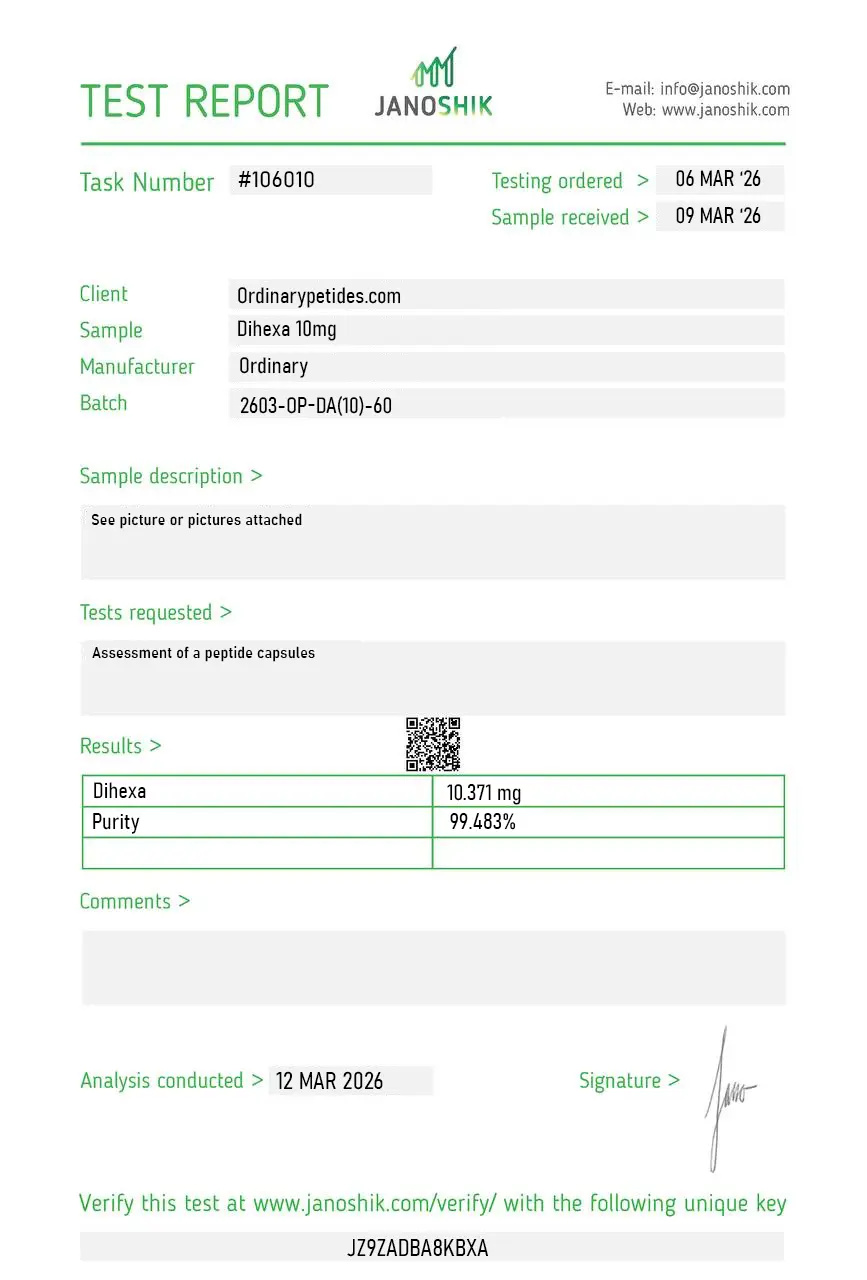
Certificate of Analysis
An independent test report is available for Dihexa 10mg. This report provides batch-level documentation and analytical verification information for research reference.
Dihexa (also designated PNB-0408 or N-hexanoic-Tyr-Ile-(6) aminohexanoic amide) is a synthetic oligopeptide developed in the late 2000s and early 2010s by Dr. Joseph Harding and colleagues at Washington State University. It is a chemically modified derivative of angiotensin IV — a naturally occurring peptide fragment of the renin-angiotensin system with known roles in CNS function — engineered for significantly greater potency, metabolic stability, and blood-brain barrier penetration than its parent compound. Its molecular formula is C₂₇H₄₄N₄O₅ and molecular weight is 504.67 g/mol. It is classified as a neurotrophic peptide — one that acts on pathways governing neuronal growth, survival, and connectivity — and is notable among peptides for being both orally bioavailable and capable of crossing the blood-brain barrier.
Dihexa's proposed mechanism centers on potentiation of the hepatocyte growth factor (HGF) / c-Met receptor signaling pathway in the central nervous system. HGF is a large protein that, in the brain, promotes neuron survival, stimulates dendritic growth, and drives synaptic plasticity. Dihexa acts not as a direct agonist of c-Met but as a potentiator of HGF at its receptor — enhancing HGF-dependent c-Met activation. Upon c-Met activation, downstream signaling proceeds through the PI3K/Akt and MAPK/ERK cascades, both associated with neuronal survival, dendritic arborization (branching), spinogenesis, and synaptogenesis — the formation of new synaptic connections between neurons. This structural mechanism distinguishes Dihexa fundamentally from compounds that modulate neurotransmitter availability — it targets the physical architecture of synaptic networks rather than their chemical signaling.
The HGF/c-Met pathway plays established roles in embryonic neural development and continues to function in the adult brain in the context of neuroplasticity, learning, and memory consolidation. Synaptic loss — the progressive reduction in the number and density of synaptic connections — is considered one of the primary neurological correlates of cognitive decline in Alzheimer's disease and aging. Compounds that can drive synaptogenesis through HGF/c-Met activation are hypothesized to counteract this structural deficit directly, rather than merely compensating for it pharmacologically. The pathway also promotes dendritic arborization and spinogenesis — structural changes that increase the surface area available for synaptic contact and strengthen existing connections.
Foundational preclinical research from the Harding laboratory, conducted between approximately 2012 and 2017, examined Dihexa across three validated rodent models: scopolamine-induced amnesia (cholinergic blockade), aged rats with spontaneous cognitive decline, and transgenic Alzheimer's disease models expressing human amyloid precursor protein. Across all three paradigms, Dihexa administration was associated with restoration of spatial memory performance on the Morris water maze, radial arm maze, and novel object recognition tasks — in some cases to levels statistically indistinguishable from young, healthy control animals. A 2021 study by Sun et al. in APP/PS1 transgenic mice, from an independent Chinese research group, provided additional supportive evidence for Dihexa's cognitive effects in an Alzheimer's disease model, representing the most significant independent replication to date.
A widely cited finding from early Dihexa research is that it demonstrated synaptogenesis-inducing potency orders of magnitude greater than brain-derived neurotrophic factor (BDNF) in specific in vitro assay conditions. This comparison is a molar potency figure for synaptogenesis induction in particular experimental contexts — it is not a claim about overall cognitive effect magnitude or clinical efficacy. BDNF and Dihexa operate through different receptor pathways: BDNF signals through TrkB receptors, while Dihexa potentiates HGF at c-Met. The mechanistic comparison highlights that c-Met-driven synaptogenesis can be activated at very low concentrations of Dihexa relative to direct neurotrophin application, which is of research interest for understanding the relative efficiency of different synaptogenic pathways.
Washington State University spun out the commercial development of Dihexa into a company initially called M3 Biotechnology, later renamed Athira Pharma. Athira developed a prodrug of Dihexa — initially called NDX-1017, later renamed ATH-1017, and then fosgonimeton — for clinical development in Alzheimer's disease. The compound progressed to a Phase 2/3 clinical trial (the LIFT-AD trial) in Alzheimer's patients. The trial failed to meet primary or secondary endpoints, representing a significant setback for the clinical translation of the HGF/c-Met approach. Separately, in 2021, Athira's CEO resigned following the discovery of manipulated western blot images in foundational Dihexa research papers from her doctoral work. In January 2025, Athira agreed to pay over $4 million to settle False Claims Act allegations related to NIH grants referencing compromised research. The 2014 Benoist et al. paper was fully retracted in April 2025 following Washington State University's investigation confirming fabricated data.
The research fraud concerns are significant and cannot be minimized. The retracted 2014 Benoist et al. paper contributed mechanistic western blot data to the HGF/c-Met story, and its retraction damages the mechanistic evidence base. However, independent researchers and reviewers consistently note that the HGF/c-Met pathway's role in neuroscience is corroborated by work from multiple laboratories unconnected to the Harding group, and the behavioral data (water maze performance improvements) was not directly implicated in the fabrication findings. The 2021 Sun et al. study from an independent group provides partial independent support. The scientific consensus appears to be that the core mechanistic hypothesis — HGF/c-Met potentiation driving synaptogenesis — retains biological plausibility, but that the specific quantitative claims about Dihexa's potency and the supporting mechanistic data must be regarded with caution pending clean independent replication.
Because Dihexa activates the HGF/c-Met signaling pathway, and c-Met is a known proto-oncogene involved in tumor progression in several cancer types, researchers have flagged a theoretical oncological concern. In oncology, c-Met overexpression or constitutive activation is associated with tumor growth, invasion, and metastasis in certain cancers. Pharmacological activation of this pathway in a cancer context could theoretically be pro-tumorigenic. It is important to note that no animal or human data has directly demonstrated Dihexa causing cancer, and the pathway's activity in normal neuronal tissue differs from its dysregulation in tumor cells. However, this theoretical concern is consistently noted in the research literature as a safety consideration that requires systematic investigation — particularly for any long-term or high-exposure protocols — before clinical development could responsibly proceed.
Dihexa occupies a unique mechanistic position in the landscape of cognitively active research peptides. Semax — an ACTH analogue — modulates dopaminergic pathways and upregulates BDNF, offering acute cognitive enhancement and neuroprotection through TrkB signaling. Selank is an anxiolytic and putative nootropic with GABAergic modulating properties. Cerebrolysin is a multi-component neurotrophic peptide mixture with the broadest clinical trial dataset of any neuropeptide in this class, supporting multiple neurotrophic factor pathways simultaneously. None of these operate through HGF/c-Met. Dihexa's c-Met potentiation is described in the research literature as mechanistically unique among peptides currently available for research use — targeting structural neuroplasticity directly rather than neurotransmitter modulation or indirect neurotrophin upregulation.
Dihexa itself has no completed human clinical trials. All efficacy and safety data derive from animal models and in vitro work. The only human clinical program built on this mechanism — fosgonimeton/ATH-1017 via Athira Pharma — failed its Phase 2/3 trial in Alzheimer's patients, though this was a prodrug with a distinct pharmacological profile from Dihexa and the trial failure does not directly disprove Dihexa's preclinical findings. Dihexa was removed from the FDA Category 2 list in April 2026, a regulatory status change noted in recent literature. It remains available as a Research Use Only (RUO) compound from research chemical suppliers. The gap between Dihexa's preclinical promise and its human evidence base is widely described in the research community as among the widest seen in cognitive enhancement peptide research — compelling mechanistic rationale alongside zero completed human studies, compromised foundational data, and a failed clinical trial of the related pharmaceutical compound.