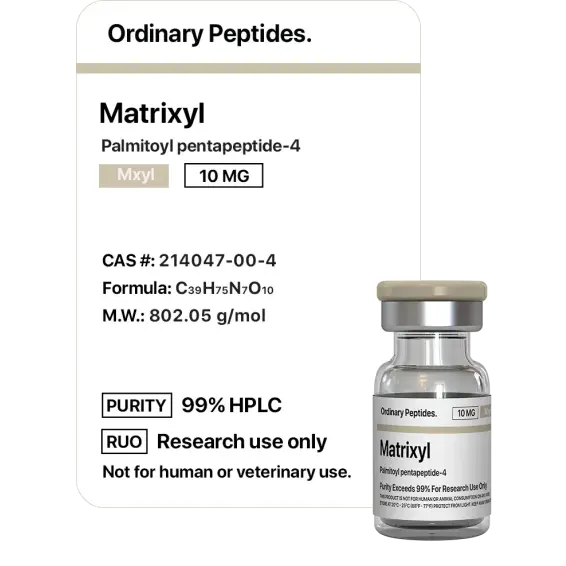
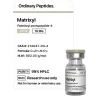

Matrixyl
For in vitro testing and laboratory use only. Not for human or animal consumption. Bodily introduction is illegal. Handle only by licensed professionals. Not a drug, food, or cosmetic. Educational use only.
Matrixyl: A Peptide Signal Your Skin Actually Understands
Matrixyl is not "magic in a jar," but a cosmetic signal peptide studied in research contexts as a gentle way to remind the skin to synthesize components of the extracellular matrix. In published observations, the original Matrixyl was associated with stimulation of collagen I, III, and IV, as well as fibronectin, while Matrixyl 3000 was also linked to an anti-inflammatory signal through IL-6 suppression.
In other words, the formula is not only about "density," but also about inflammaging. In early clinical studies and double-blind cosmetic trials, these peptides showed statistically significant wrinkle reduction and improvements in skin firmness and elasticity.
It is also reassuring that Matrixyl is one of the few cosmetic peptides backed not only by attractive marketing, but also by real published topical data. For anyone looking for an ingredient with a clear rationale, a solid cosmetic evidence base, and none of the feel of "just another trendy word on the label," Matrixyl looks very compelling.
Matrixyl (Palmitoyl Pentapeptide-4 / Pal-KTTKS): A Scientific Review
Based on peer-reviewed literature and cosmetic science publications — see References. Last updated: April 2026.
The Short Version
Matrixyl is the trade name for palmitoyl pentapeptide-4, developed by the French cosmetics ingredient company Sederma in the early 2000s. It is one of the most commercially successful and scientifically substantiated cosmetic peptides ever produced — appearing in hundreds of skincare products globally.
The compound is a lipopeptide: a five-amino acid sequence (Lys-Thr-Thr-Lys-Ser, abbreviated KTTKS) derived from the procollagen type I C-terminal propeptide, conjugated to palmitic acid to improve skin penetration. The mechanism is elegant and grounded in genuine connective tissue biology: KTTKS is a matrikine — a naturally occurring fragment released during collagen degradation that signals fibroblasts to produce more collagen. By introducing synthetic KTTKS topically, Matrixyl mimics the signalling event that normally accompanies collagen breakdown, stimulating repair without the actual breakdown needing to occur. The evidence base includes multiple published human clinical trials showing wrinkle reduction comparable to retinol but without retinol’s irritation. Key limitations: most trials are small (N=21–93), short (4–12 weeks), and conducted by or in partnership with the manufacturer.
| At a glance | |
|---|---|
| Trade name | Matrixyl® |
| Chemical name | Palmitoyl pentapeptide-4; palmitoyl pentapeptide-3 (older INCI designation) |
| Peptide sequence | Lys-Thr-Thr-Lys-Ser (KTTKS) |
| Full structure | Palmitoyl-Lys-Thr-Thr-Lys-Ser-OH (pal-KTTKS) |
| MW | 802.05 Da (palmitoyl conjugate); KTTKS alone: 563.64 Da |
| Developer | Sederma (France; Croda International subsidiary since 2008) |
| Type | Signal peptide / matrikine mimic; lipopeptide |
| Primary action | Stimulates collagen types I, III, and IV; fibronectin; hyaluronic acid |
| Route | Topical only |
| Human clinical trials | ✅ Multiple published RCTs (small; manufacturer-funded) |
Origin: The Procollagen Fragment and Matrikine Biology
When the extracellular matrix (ECM) is degraded — by matrix metalloproteinases (MMPs) during normal turnover, by UV-induced photodamage, or by mechanical stress — enzymatic cleavage of ECM proteins releases short peptide fragments called matrikines. These fragments are active signalling molecules that bind to specific receptors on nearby fibroblasts and trigger repair responses, stimulating new synthesis of the ECM components that were just broken down. This is an elegant homeostatic feedback loop: ECM degradation releases fragments that signal replacement synthesis. The collagen fragment KTTKS is one of the best-characterised matrikines.
KTTKS (Lys-Thr-Thr-Lys-Ser) is a 5-amino acid fragment of procollagen type I, specifically corresponding to residues 212–216 of the pro-alpha-1 chain C-propeptide. When procollagen type I is processed or collagen is degraded, this sequence is released. In the physiological context, circulating KTTKS serves as a signal to fibroblasts indicating that collagen remodelling is occurring and new synthesis may be needed. This is why the concept of “sending the body a signal to produce more collagen” is not merely marketing language for Matrixyl — it reflects a genuine biological mechanism.
The delivery problem: why palmitic acid conjugation?
The bare KTTKS peptide is ionic and hydrophilic — it cannot cross the stratum corneum in meaningful quantities when applied topically. Sederma’s key innovation was conjugating palmitic acid (a 16-carbon saturated fatty acid) to the N-terminus of KTTKS. The palmitoyl conjugation increases lipophilicity (improving passive diffusion through stratum corneum lipid bilayers); improves metabolic stability (resisting aminopeptidase degradation for up to 8 hours); enables self-assembly into amphiphilic fibrous nanostructures that may create a slow-release depot; and maintains biological activity — the KTTKS sequence retains receptor-binding capability with palmitic acid at the N-terminus. Pal-KTTKS is stable after incubation with proteases for up to 8 hours.[3]
Mechanism of Action
After penetrating the stratum corneum, pal-KTTKS reaches the dermis and interacts with receptors on dermal fibroblast surfaces. The exact receptor(s) have not been fully characterised, but downstream signalling involves: activation of TGF-β pathway components → upregulation of procollagen I gene transcription (COL1A1, COL1A2); stimulation of procollagen type III synthesis (COL3A1); upregulation of collagen type IV (COL4A1) at the dermal-epidermal junction; fibronectin synthesis stimulation; and hyaluronic acid synthase-1 (HAS1) upregulation. Palmitoyl Pentapeptide-4 acts as a signalling agent that binds to receptors on the fibroblast cell surface and through a series of cellular pathways boosts collagen types I and III production, intervenes with collagen degradation resulting in higher concentrations of fibrillar proteins, and regulates hyaluronic acid synthesis in fibroblasts.[6]
Beyond stimulating collagen synthesis, pal-KTTKS demonstrates an anti-fibrotic property: it reduces alpha-smooth muscle actin (α-SMA) expression and inhibits the trans-differentiation of fibroblasts into myofibroblasts. Inhibiting myofibroblast differentiation (which drives fibrosis and scar formation) while stimulating normal collagen synthesis produces better quality skin remodelling rather than excessive scar-like tissue.[4]
Clinical Evidence
Matrixyl has an unusually strong evidence base by cosmetic ingredient standards — though all major clinical trials were conducted by or in partnership with Sederma or research groups affiliated with the cosmetics industry.
Landmark 12-week split-face RCT (Robinson et al., 2005)
Published in the International Journal of Cosmetic Science (2005). The 3 ppm (0.0003%) concentration producing statistically significant improvement is a marker of potency. The split-face design (each subject’s face is its own control) is one of the more rigorous designs available for cosmetic claims.
Additional published studies
Periocular (crow’s feet) study: Applying pal-KTTKS at 0.005% (50 ppm) to the periocular area twice daily for 28 days resulted in quantitative decreases in fold depth, fold thickness, and skin rigidity of 18%, 37%, and 21%, respectively, by optical profilometry.
Four-month double-blind study (49 women): Significant improvements in skin roughness, wrinkle volume, and wrinkle depth compared to vehicle, with increased elastin fibre density and thickness, and improved collagen IV regulation at the dermal-epidermal junction.
Crow’s feet RCT in Asian subjects (2023): Double-blind randomised trial in 21 Indonesian female subjects aged 26–55 years for eight weeks, assessed using Corneometer, Tewameter, Cutometer, digital photography, and Crow’s Feet Grading Scale. Showed improvements in the crow’s feet compared to placebo.[2] Limitation: N=21 is underpowered for between-group comparisons.
Key in vitro findings
Pal-KTTKS was tested in human dermal fibroblasts at 10 ppm for 24 hours and showed a 1.8-fold increase in COL1A1 gene expression and 12.6-fold increase in hyaluronic acid synthase-1 (HAS1) mRNA. At 20 ppm for 3 days, significant increases in actual collagen protein content were found. The discrepancy between mRNA upregulation at 10 ppm and protein synthesis at 20 ppm illustrates an important point: mRNA upregulation does not automatically translate to increased protein synthesis; concentration, exposure time, and cell context all matter.[8]
Comparison with retinol
Robinson et al. conducted a comparison of pal-KTTKS with retinol — the gold standard of evidence-based topical anti-ageing. Matrixyl produced comparable wrinkle reduction with far less irritation than retinol. Retinol’s efficacy is not disputed, but its side effects (dryness, peeling, photosensitivity, redness) make it poorly tolerated by significant portions of the population. Matrixyl’s profile — effective but gentle — fills a genuine clinical niche for retinol-intolerant patients.
The Three Matrixyl Generations
Matrixyl (original) — Palmitoyl Pentapeptide-4
The formulation described throughout this article. Contains pal-KTTKS as the sole active peptide. The most studied and the reference standard for Matrixyl efficacy claims.
Matrixyl 3000 — Palmitoyl Tripeptide-1 + Palmitoyl Tetrapeptide-7
Palmitoyl tripeptide-1 (Biopeptide CL; palmitoyl GHK): A fatty acid conjugate of the tripeptide Gly-His-Lys — the same GHK that forms GHK-Cu (copper tripeptide, covered earlier in this series). Without copper, palmitoyl GHK primarily stimulates collagen synthesis via TGF-β pathway signalling rather than copper-mediated enzyme activation. Palmitoyl tetrapeptide-7 (Rigin): The tetrapeptide Gly-Gln-Pro-Arg (GQPR), a fragment of immunoglobulin G. Its primary mechanism is anti-inflammatory: it reduces interleukin-6 (IL-6) secretion both basally and after UV-B irradiation. IL-6 is a key cytokine driver of inflammatory skin ageing. Matrixyl 3000 therefore combines collagen stimulation (tripeptide-1) with inflammatory cytokine reduction (tetrapeptide-7) — addressing both the damage-promotion and repair-inhibition components of photoageing.
Matrixyl Synthe’6 — Palmitoyl Tripeptide-38
A single palmitoyl tripeptide claimed to simultaneously stimulate six major skin matrix components: collagen I, III, and IV; fibronectin; hyaluronic acid; and laminin-5. Matrixyl Synthe’6 has its own clinical studies but less independent peer-reviewed validation than the original formulation.
Matrixyl vs. Other Cosmetic Actives
| Compound | Mechanism | Evidence tier |
|---|---|---|
| Matrixyl (pal-KTTKS) | Matrikine signalling → collagen I/III/IV synthesis | Multiple published human RCTs (small, manufacturer-funded) |
| GHK-Cu | Copper delivery + Nrf2/antioxidant + collagen stimulation | Human topical studies; extensive in vitro |
| Argireline (Acetyl Hexapeptide-3) | SNARE complex interference → reduced muscle contraction | Human split-face studies; different mechanism |
| Retinol | RAR/RXR nuclear receptor → broad gene expression changes | Extensive multi-decade evidence; gold standard |
| Palmitoyl Tripeptide-3/5 | TGF-β mimetic → collagen synthesis | Human studies showing superiority to pal-KTTKS in some contexts |
Matrixyl occupies a specific niche: the best-evidenced pure collagen-stimulating signal peptide for topical use, validated in human skin by placebo-controlled trials.
Formulation Considerations
Matrixyl is used at concentrations from 1 ppm (0.0001%) to 50 ppm (0.005%). This is a critical distinction from most actives: effective concentrations are in the parts per million range, consistent with a receptor-mediated signalling mechanism that does not require high substrate concentrations. A product listing “palmitoyl pentapeptide-4” near the end of the INCI ingredient list may still contain an effective concentration — because even 5 ppm is effective, and at that concentration the ingredient would appear at the very end of a standard INCI list by weight. Pal-KTTKS is stable across pH 4–8, compatible with the range of formulations in which it is used. It is compatible with most common cosmetic actives including niacinamide, hyaluronic acid, vitamin C, and antioxidants.
Safety Profile
Pal-KTTKS at a concentration of 3% has been proven to be safe, non-irritating, and non-sensitising, tolerated by all skin types including oily and acne-prone skin. At the concentrations used in actual formulations (3–50 ppm — far below 3%), the safety margin is enormous. The Cosmetic Ingredient Review Expert Panel concluded the compound is safe as a cosmetic ingredient at concentrations up to 3%. No systemic concerns: at topical use concentrations, even if a small fraction crosses the skin barrier, plasma concentrations would be biologically negligible. Pal-KTTKS is composed of standard dietary amino acids (Lys, Thr, Ser) conjugated to palmitic acid — all endogenous/dietary compounds. No documented endocrine activity; no allergy or sensitisation signals in multiple studies.
Common Misconceptions
“Matrixyl is a collagen supplement.”
It is a collagen-stimulating signal peptide, not collagen itself. It works by signalling fibroblasts to produce their own collagen — the opposite approach from collagen creams (which apply exogenous collagen that is too large to penetrate skin and too quickly degraded to be effective topically).
“Higher concentration always means better results.”
Because Matrixyl acts through receptor-mediated signalling, there is likely a saturation effect beyond which additional peptide provides no benefit. The dose-response data suggests 3–50 ppm is the active range for topical application.
“Matrixyl 3000 is three times more effective than original Matrixyl.”
The “3000” in Matrixyl 3000 refers to the formulation’s internal product designation, not a potency multiplier. Matrixyl 3000 works through complementary mechanisms rather than through greater potency at a single pathway.
“Matrixyl is just marketing — no real evidence.”
The evidence base for Matrixyl is stronger than for the vast majority of cosmetic actives. Multiple published, placebo-controlled, randomised trials in human subjects exist. The legitimate criticism is that these trials are small, short, and manufacturer-funded — not that evidence is absent.
Key Takeaways
- ✅ Matrixyl (pal-KTTKS) is the most clinically validated collagen-stimulating signal peptide for topical use, with multiple published placebo-controlled human trials demonstrating wrinkle reduction and collagen synthesis improvement. The mechanism — matrikine signalling, mimicking natural procollagen degradation fragments — is grounded in genuine connective tissue biology.[1]
- The palmitic acid conjugation is the key enabling technology. Without it, the KTTKS sequence cannot penetrate the stratum corneum. The lipopeptide structure also improves metabolic stability and may facilitate self-assembly into sustained-release nanostructures.[3]
- Evidence quality is moderate-strong for a cosmetic ingredient, limited by small trial sizes and manufacturer sponsorship. Statistically significant wrinkle reduction in a split-face RCT of 93 subjects is real and meaningful; it would be stronger with independent replication in larger populations.
- ✅ Matrixyl is genuinely safer and better tolerated than retinol, at the cost of some potency. For retinol-intolerant patients, it is the most evidence-supported alternative, with comparable wrinkle efficacy and dramatically less irritation.
- The three generations of Matrixyl address different aspects of skin ageing. Original Matrixyl: pure collagen stimulation. Matrixyl 3000: collagen stimulation + anti-inflammatory (targeting UV-driven ageing). Matrixyl Synthe’6: broader matrix stimulation across six components. Selection depends on primary skin concern rather than a simple “newer is better” logic.
References
Primary Clinical Studies
- Robinson LR, Fitzgerald NC, Doughty DG, Dawes NC, Berge CA, Bissett DL. Topical palmitoyl pentapeptide provides improvement in photoaged human facial skin. International Journal of Cosmetic Science. 2005;27(3):155–160. PMID 18492182
- Aruan RR, Hutabarat H, Widodo AA, et al. Double-blind, randomised trial on the effectiveness of acetylhexapeptide-3 cream and palmitoyl pentapeptide-4 cream for crow’s feet. The Journal of Clinical and Aesthetic Dermatology. 2023;16(2):37–43. PMC10005804
Mechanism and In Vitro
- Jones RR, Castelletto V, Connon CJ, Hamley IW. Collagen stimulating effect of peptide amphiphile C16-KTTKS on human fibroblasts. Molecular Pharmaceutics. 2013;10(3):1063–1069. PMID 23320752
- Park H, An E, Cho Lee AR. Effect of palmitoyl-pentapeptide (Pal-KTTKS) on wound contractile process in relation to connective tissue growth factor and α-smooth muscle actin expression. Tissue Engineering and Regenerative Medicine. 2017;14(1):73–80.
Systematic Reviews
- Errante F, Ledwoń P, Latajka R, Rovero P, Papini A. Cosmetic peptides in dermatology. Cosmetics. 2020;7(4):91.
- Peptides: Emerging candidates for the prevention and treatment of skin senescence: A review. PMC11762834. 2025.
- Topical peptide treatments with effective anti-aging results. Cosmetics. 2017;4(2):16.
In Vitro Gene Expression
- Bioactive peptides in cosmetic formulations: Review of current in vitro and ex vivo evidence. ScienceDirect. 2025. (COL1A1 1.8-fold and HAS1 12.6-fold mRNA data in fibroblasts at 10 ppm)
Certificate of Analysis
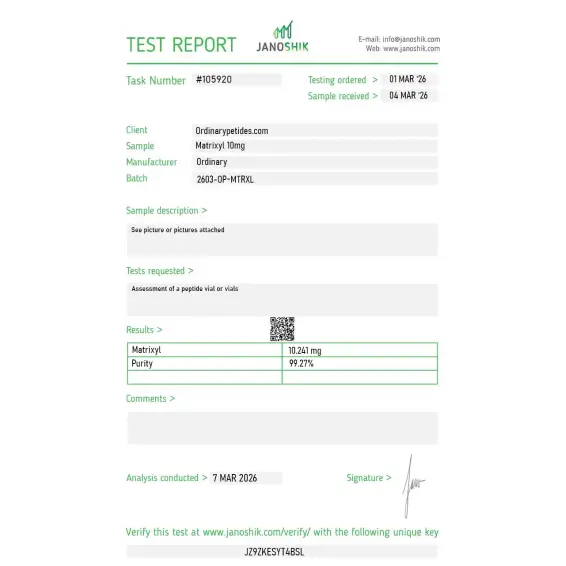
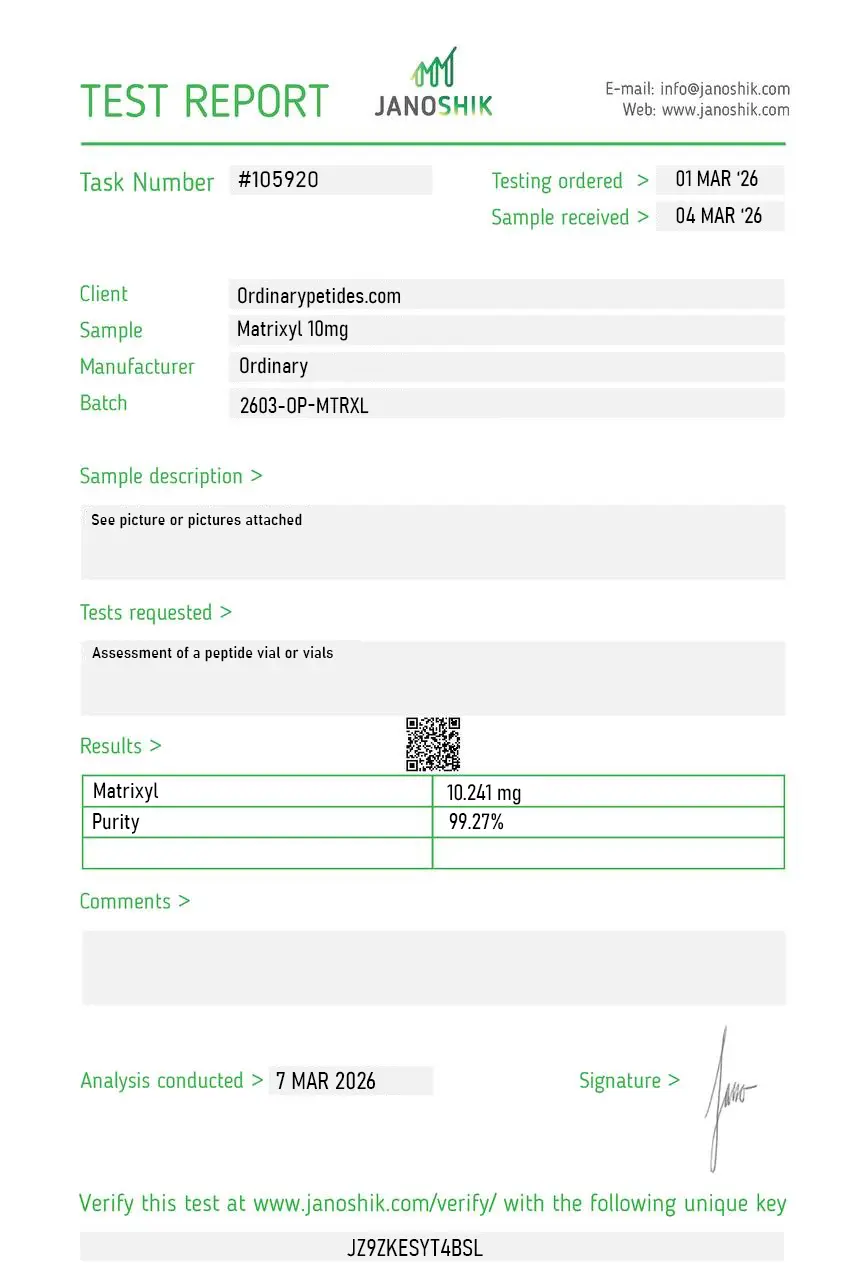
An independent test report is available for Matrixyl 10mg. This report provides batch-level documentation and analytical verification information for research reference.
Matrixyl is the brand name for a patented family of cosmetic peptides developed by the French biotechnology company Sederma in the early 2000s. Unlike most peptides in this series which are injectable bioregulators or therapeutic compounds, Matrixyl is a topically applied skincare ingredient. It belongs to a class called matrikines — signal peptides that mimic fragments of damaged collagen to trigger the skin's own repair response. The Matrixyl family includes three main generations — the original Matrixyl (palmitoyl pentapeptide-4), Matrixyl 3000, and Matrixyl Synthe'6 — each building on the last with broader anti-aging targets.
Matrixyl peptides are attached to a fatty acid called palmitic acid, which increases their lipophilicity and helps them penetrate the stratum corneum into the dermis. Once there, they bind to fibroblast cell surface receptors and activate signaling pathways similar to TGF-β — the growth factor responsible for collagen synthesis. In essence they trick the skin into believing collagen has been damaged, prompting a repair response that increases production of collagen, elastin, and other extracellular matrix proteins. Matrixyl 3000 adds anti-inflammatory action through its second peptide component. Matrixyl Synthe'6 targets six structural components simultaneously — collagen I, III, and IV, fibronectin, hyaluronic acid, and laminin-5.
The primary benefits are reduction in the appearance of fine lines and wrinkles, improved skin firmness and elasticity, enhanced hydration through support of the skin's barrier function, smoother overall skin texture and tone, and reduced pore appearance through regulation of sebum production. Many dermatologists recommend it as a gentler alternative to retinoids for patients who cannot tolerate the irritation, peeling, or photosensitivity associated with retinol. Results typically begin to appear within 8 to 12 weeks of consistent daily use.
Matrixyl works through collagen stimulation from below rather than skin cell turnover acceleration like retinol. This makes it significantly more tolerable for sensitive skin types — no irritation, redness, peeling, or photosensitivity. It can be used both morning and night without restriction. Against Argireline, another cosmetic peptide, Matrixyl targets structural collagen production while Argireline works by relaxing facial muscles to reduce expression lines — they operate through different pathways and can be used together for more comprehensive anti-aging coverage.
The main honest limitation is skin penetration. Matrixyl must pass through over 500 protease enzymes in the skin that eagerly break down peptides before they reach fibroblasts. Some studies show clear collagen-boosting effects in fibroblast cell cultures, but penetration in intact human skin is variable and depends heavily on formulation quality, concentration, and delivery system. Human clinical trials have shown statistically significant but modest improvements in some studies, with mixed results in others. Product quality — particularly peptide concentration and formulation stability — varies considerably across brands.
Matrixyl has an excellent safety profile and is one of the most well-tolerated anti-aging ingredients available. Side effects are rare and when they do occur are mild — occasional temporary redness or irritation, particularly in very sensitive skin types. A patch test before first use is recommended. It is suitable for all skin types including sensitive and mature skin, and can be used during pregnancy unlike retinoids, though consultation with a physician is always advisable.
There are very few absolute contraindications. People with known hypersensitivity to any of the peptide components should avoid it. Beyond individual sensitivities, Matrixyl is considered safe for almost all adults. It is not an injectable or systemic compound — all activity is topical and localized to the skin surface and dermis.