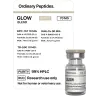
GLOW
For in vitro testing and laboratory use only. Not for human or animal consumption. Bodily introduction is illegal. Handle only by licensed professionals. Not a drug, food, or cosmetic. Educational use only.
Glow Blend: Three Peptides, One Research-Driven Formula
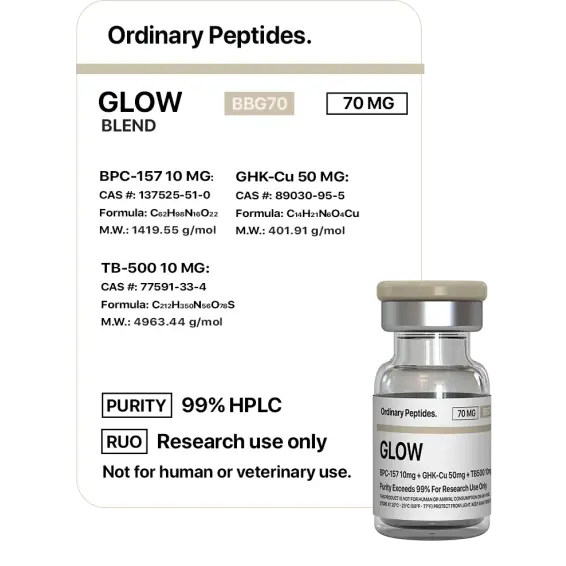
Glow Blend brings together three research peptides — BPC-157, TB-500, and GHK-Cu — in one formulation built around a simple idea: target different parts of the repair cascade at the same time. In the research context, BPC-157 has been studied for nitric oxide signaling, angiogenesis, and growth-factor-related pathways, TB-500 for actin-driven cell migration and cytoskeletal remodeling, and GHK-Cu for extracellular matrix support, collagen-related activity, and copper-dependent redox biology.
What makes the blend interesting is that these pathways look complementary rather than repetitive, which is why the combination attracts attention in regenerative research. At the same time, the honest read is important: the blend itself has never been studied in a controlled human clinical trial, and the evidence comes mainly from separate animal, in vitro, and topical cosmetic studies on the individual components.
So this is not a "proven shortcut" — it is a research-first formulation built around biologically coherent ingredients with very different evidence depth. For anyone exploring the science, Glow Blend is compelling because the concept is elegant, the components are well-known in peptide circles, and the unanswered questions are just as important as the hype.
GLOW (BPC-157 + TB-500 + GHK-Cu Peptide Stack): A Scientific Review
Based on peer-reviewed literature — see References. Last updated: April 2026.
The Short Version: What GLOW Actually Is
“GLOW” is not a peptide. It is not a defined compound with a single sequence, molecular weight, or mechanism. It is a brand name applied by wellness clinics to a peptide stack — a marketed combination of three separate peptides, each described elsewhere in this series. The name was popularised by TRT/wellness clinics and compounding pharmacies, primarily as an aesthetic-facing marketing product targeting skin rejuvenation, post-procedure recovery, and general “vitality,” proliferating across med spas, telehealth platforms, and social media.
| Component | Also known as | Primary marketed purpose | FDA compounding status |
|---|---|---|---|
| BPC-157 | Body Protection Compound-157 | Tissue repair, gut healing, anti-inflammatory | ⚠️ Category 2 — prohibited |
| TB-500 | Thymosin Beta-4 fragment; Ac-LKKTETQ | Wound healing, connective tissue repair, mobility | ⚠️ Category 2 — prohibited; WADA S2 |
| GHK-Cu | Copper Tripeptide-1; Copper Peptide | Skin rejuvenation, collagen stimulation, anti-aging | Generally permissible; not FDA-approved for injection |
The article contextualises GLOW within the scientific evidence for each component, explains why the regulatory status is more complicated than clinic marketing suggests, and provides an honest assessment of the synergy claims. BPC-157 and TB-500 are covered in full detail in separate articles in this series; GHK-Cu receives its primary treatment here.
Why These Three Peptides Were Combined
The marketing rationale for combining BPC-157, TB-500, and GHK-Cu is coherent at the mechanistic level, even if the clinical evidence for the combination is absent. The three components target partially overlapping wound-healing and regeneration pathways — angiogenesis (BPC-157), cell migration (TB-500/Tβ4 fragment), and matrix component synthesis (GHK-Cu). In theory, these are complementary: new blood vessels (BPC-157) serve the newly migrated cells (TB-500) laying down the structural proteins (GHK-Cu). This mechanistic story is biologically plausible.
⚠️ The critical honest statement: no published study has examined the combination. Every claim about GLOW as a stack is extrapolated from individual component preclinical evidence, mostly from rodent models. The synergistic effect is asserted by clinics; it has not been demonstrated in any model system.
GHK-Cu in Detail
What is GHK-Cu?
GHK (Gly-His-Lys) is a naturally occurring tripeptide first isolated from human plasma albumin by Loren Pickart in 1973. It forms a stable complex with copper(II) ions — the GHK-Cu complex — and is found endogenously in human plasma (~200 ng/mL in young adults), urine, and saliva. Plasma GHK levels decline with age: approximately 200 ng/mL at age 20, declining to ~80 ng/mL by age 60 — providing the biological rationale for supplementation in an ageing context.[3]
Molecular details: Sequence Gly-His-Lys; MW 340.38 Da (free tripeptide); CAS 49557-75-7 (GHK), 89030-95-5 (GHK-Cu). Loren Pickart (University of California) is credited with the discovery and much of the foundational characterisation work spanning five decades.
Mechanism
Copper delivery: GHK is a high-affinity copper chelator; the GHK-Cu complex delivers Cu(II) to cells and tissues, where copper serves as a cofactor for lysyl oxidase (essential for collagen cross-linking), superoxide dismutase (antioxidant), and several enzymes involved in pigmentation and energy metabolism. Collagen and ECM synthesis: GHK-Cu stimulates fibroblasts to produce collagen (types I, III), fibronectin, and glycosaminoglycans including dermatan sulphate — the primary mechanism for anti-wrinkle and skin-firming properties. Antioxidant and anti-inflammatory: Activates Nrf2/ARE pathway upregulating antioxidant enzymes; reduces TGF-β1-driven fibrosis; suppresses TNF-α, IL-6, and IL-1β. Wound healing: Promotes keratinocyte migration (re-epithelialisation), angiogenesis, and nerve outgrowth in wound models.[1]
Gene expression modulation: Pickart and Margolina’s 2018 International Journal of Molecular Sciences analysis found that GHK-Cu reversed the expression pattern of genes associated with metastatic colon cancer to a more normal profile — a striking computational genomics finding that requires validation but suggests GHK-Cu’s effects extend to epigenetic regulation.[2]
Evidence base for GHK-Cu
The GHK-Cu literature is notably better quality than BPC-157 or TB-500 in two respects: the compound is endogenous to humans (inherent biological plausibility), and controlled human trials for topical application exist. Small RCTs and controlled clinical trials have examined GHK-Cu cream formulations for: skin photoaging (improvements in skin laxity, fine lines, and wrinkle depth in multiple small controlled trials); post-laser resurfacing wound healing; and alopecia (some evidence for hair follicle stimulation via DHT-independent pathways).
⚠️ The injectable GHK-Cu evidence gap: The GLOW protocol uses injectable GHK-Cu. The human evidence for GHK-Cu is almost entirely topical (cream formulations). Whether subcutaneous injection produces systemic biological effects comparable to topical skin application, or whether injection concentrations and pharmacokinetics are appropriate, has not been studied in any published human trial.
GHK-Cu and natural ageing
The age-related decline in plasma GHK provides the most scientifically coherent argument for GHK-Cu use: if supplementation (topical or injectable) restores levels towards those of younger individuals, the anti-aging rationale is physiologically grounded rather than purely pharmacological. This distinguishes GHK-Cu from BPC-157 (not an endogenous human peptide in any meaningful concentration) and TB-500 (a fragment of an endogenous protein but not itself a naturally circulating entity).
The GLOW Stack: Assessing the Synergy Claims
Clinics marketing GLOW typically describe BPC-157 as initiating tissue repair and angiogenesis, TB-500 as promoting cell migration and connective tissue remodelling, and GHK-Cu as driving collagen synthesis with the skin-specific anti-ageing effect. This framing is mechanistically plausible in the way that any combination of things working through different pathways is: the pathways are conceptually complementary and combining them might produce additive effects.
What the evidence cannot support: synergy (effects greater than additive) is a specific pharmacological claim requiring demonstration — it has not been demonstrated for this combination in any published work. The skin rejuvenation framing is built entirely on GHK-Cu evidence (topical), BPC-157’s angiogenesis effects in wound models (rodent), and TB-500’s tissue repair effects in animal models — none demonstrated in intact skin via SC injection for aesthetic purposes. Clinical outcome claims (reduced wrinkles, improved skin texture, “glow”) from the combination lack any controlled human study.
Regulatory Summary for GLOW Components
| Component | FDA compounding status | WADA | US DoD |
|---|---|---|---|
| BPC-157 | ⚠️ Category 2 — prohibited for compounding (2023) | Not specifically listed | Prohibited |
| TB-500 | ⚠️ Category 2 — prohibited for compounding | ❌ Prohibited S2, non-specified substance (4-year standard ban) | Prohibited |
| GHK-Cu | Generally permissible; not FDA-approved for injection | Not listed | Not listed |
The standard GLOW formulation (BPC-157 + TB-500 + GHK-Cu) as offered by US telehealth and wellness clinics includes two compounds that US compounding pharmacies are not legally supposed to be providing. This does not mean these products are unavailable in practice — enforcement is inconsistent and the grey-market peptide industry operates broadly — but it does mean that clinics claiming to source from “FDA-approved compounding pharmacies” are making claims that require scrutiny against the actual FDA Category 2 list.[4]
Is There Any Human Evidence for GLOW?
Directly, no. There are no published clinical trials of the GLOW combination. For individual components: BPC-157 — no human clinical trials published; TB-500 — no human clinical trials published; GHK-Cu — small controlled human trials for topical application (skin anti-ageing, wound healing), no injectable human trials. The entirety of the clinical evidence base for GLOW as a combination is anecdotal — patient and practitioner testimonials, social media results, clinic outcomes tracking without controls. This does not mean nothing happens; it means we cannot distinguish pharmacological effect from placebo, regression to the mean, concurrent lifestyle interventions, or natural healing processes.
Safety Profile
BPC-157: No long-term human safety data; theoretical angiogenesis concern (could accelerate vascular tumour growth in susceptible individuals); FDA Category 2 reflects absence of adequate safety data for compounding. TB-500: Same theoretical cancer biology concerns; WADA-prohibited status; potential for immune reactions as a thymic peptide fragment. GHK-Cu: Generally well tolerated in topical form across decades of cosmetic use; copper toxicity at injectable concentrations is negligible (the copper content per GHK-Cu dose is very small); injection site reactions as with any subcutaneous peptide.
⚠️ Product quality concern: As a compounded combination product, GLOW is subject to all the quality concerns of compounded injectables: sterility, dosing accuracy, ingredient identity, and excipient compatibility for a three-component mixture. Combining three peptides in a single vial raises additional stability questions that have not been formally characterised.
Common Misconceptions
“GLOW is a specific patented compound.”
It is a marketing brand name applied to a variable-composition compounded peptide blend. Different clinics use different concentrations, some add additional ingredients (NAD+, glutathione, vitamin C), and there is no standardised GLOW formulation.
“All three ingredients are legal and safe to inject.”
⚠️ TB-500 is FDA-prohibited from compounding and WADA-prohibited from competitive sport. BPC-157 is FDA-prohibited from compounding. Only GHK-Cu is generally permissible. The stack as standardly formulated contains two compounds whose compounding is legally restricted in the US.
“The synergy of the three peptides creates effects greater than any single peptide.”
This may be true, but it has not been demonstrated. “Synergy” in this context is a marketing assertion. The complementary mechanisms are plausible; the actual combined effect in humans is unknown.
Key Takeaways
- GLOW is a commercial brand name, not a compound. It refers to a marketed combination of BPC-157, TB-500, and GHK-Cu — three peptides with separate evidence bases and regulatory statuses that vary significantly.
- ⚠️ The regulatory situation is significantly more restrictive than clinic marketing suggests. Two of the three standard GLOW components (BPC-157 and TB-500) are FDA-prohibited for compounding. TB-500 is additionally WADA-prohibited and DoD-prohibited — a career-ending risk for any athlete subject to drug testing.[5]
- GHK-Cu has the strongest individual evidence base — an endogenous human peptide with a clear mechanism, age-related decline, and controlled human trials for topical skin applications. Its injectable use is extrapolation from topical evidence.[1][2]
- ⚠️ No human clinical trial has studied GLOW as a combination. All clinical claims for the stack are extrapolated from individual preclinical studies — mostly rodent models — and from uncontrolled clinical observation.
- The mechanistic rationale is coherent but unvalidated. Complementary pathways (angiogenesis + cell migration + matrix synthesis) do not guarantee synergy; they guarantee that the combination is not pharmacologically contradictory.
References
GHK-Cu
- Pickart L, Vasquez-Soltero JM, Margolina A. GHK peptide as a natural modulator of multiple cellular pathways in skin regeneration. Biomed Research International. 2015.
- Pickart L, Margolina A. Regenerative and protective actions of the GHK-Cu peptide in the light of new gene data. International Journal of Molecular Sciences. 2018;19(7):1987.
- Pickart L. The human tri-peptide GHK and tissue remodelling. Journal of Biomaterials Science. 2008;19(8):969–988.
Regulatory
- FDA Category 2 Bulk Drug Substances list — TB-500 and BPC-157 designations. FDA PCAC meeting records 2021–2023.
- WADA Prohibited List 2024 — S2 category including TB-500 (thymosin β4 fragment).
BPC-157 and TB-500
- See BPC-157 article in this series for full references. Key: Sikiric P et al., multiple preclinical rodent studies 1993–present.
- See TB-500 article in this series for full references. Key: Malinda et al. 1999 (JID); Philp et al. 2003; Bock-Marquette et al. 2004 (Nature); Rahaman et al. 2024 (Journal of Chromatography B).
Certificate of Analysis
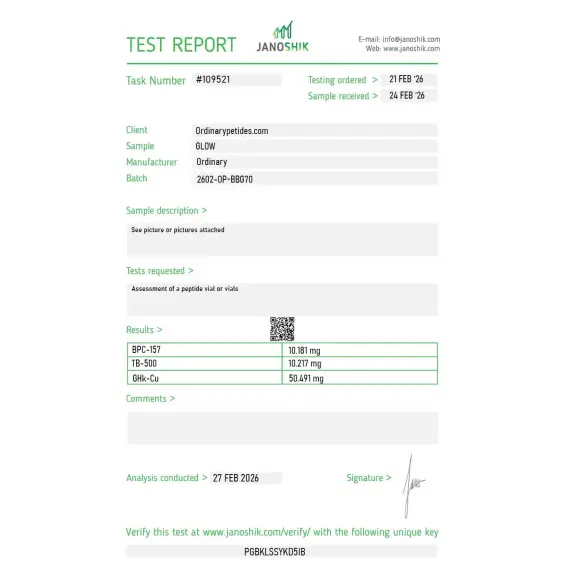
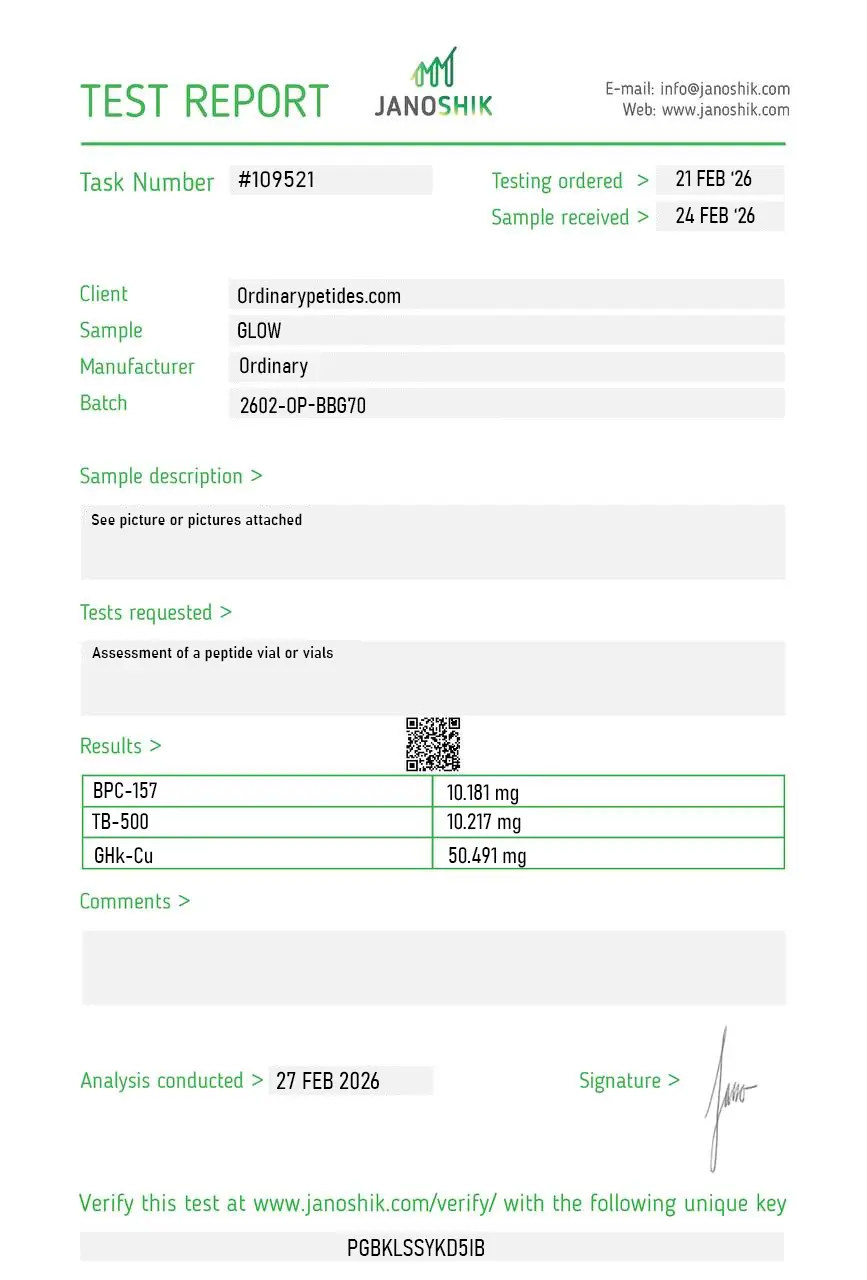
An independent test report is available for GLOW 70mg. This report provides batch-level documentation and analytical verification information for research reference.
Based on 3 reviews
4.7
-
2
-
1
Following the metal-stability question — sent samples to a collaborator with ICP-MS capability to verify copper remained on GHK rather than migrating to other formulation components. Confirmed stable across the storage timeline. Knocking nothing because the underlying material was fine, but vendor still hasn't addressed metal-coordination stability documentation, which would prevent labs without ICP-MS access from having to verify themselves.
The three-component design lets us run a single experimental arm against three matched standalone arms (BPC-157 alone, TB-500 alone, GHK-Cu alone) — comparing the blend's activity against each component to isolate interaction effects. The matched-source advantage is the practical reason to order the blend versus reconstructing it ourselves, since vendor variability across three peptides would compound. The blend itself slotted in cleanly against the standalone controls.
The three-component formulation is interesting from a blend-QC standpoint specifically — characterizing the ratio integrity across three peptides in a single vial is meaningfully harder than for the two-peptide blends, since you're verifying three purities AND two ratios AND no cross-component interactions. The supplier broke out each peptide's purity separately on the certificate, which is the minimum baseline for a tri-blend. Material assayed as expected in our component-resolved chromatography.
GLOW is not a single peptide but a compounded peptide stack — a combination of three well-researched peptides formulated together into one injectable protocol. The standard GLOW stack consists of GHK-Cu (Copper Tripeptide-1), BPC-157, and TB-500. It is designed to support skin rejuvenation, tissue repair, and cellular regeneration from the inside out, addressing aging, inflammation, and healing simultaneously.
GHK-Cu is a naturally occurring copper peptide that stimulates collagen and elastin synthesis, promotes skin remodeling, improves firmness and elasticity, supports wound healing, and has antioxidant and anti-inflammatory properties. BPC-157 is derived from a protein found in gastric juice and is known for accelerating tissue repair, promoting angiogenesis (growth of new blood vessels), reducing inflammation, and supporting gut and tendon healing. TB-500 is a synthetic fragment of Thymosin Beta-4 that promotes cell migration and proliferation, reduces fibrosis, improves connective tissue flexibility, and enhances muscle and tendon recovery.
Each peptide targets a different but complementary pathway. GHK-Cu drives structural skin repair through collagen and elastin production. BPC-157 promotes the new blood vessel formation needed to deliver oxygen and nutrients to healing tissue. TB-500 organizes the cellular movement required during the repair process. Together they create a broad-spectrum regenerative effect that addresses skin aging, tissue damage, and inflammation more comprehensively than any single peptide alone.
Reported benefits include improved skin texture, tone, and firmness, reduced fine lines and wrinkles, accelerated healing of scars and wounds, faster recovery from musculoskeletal injuries including tendons and ligaments, reduced systemic and localized inflammation, and improved skin clarity and radiance. Some users also report secondary improvements in hair quality due to GHK-Cu's effects on hair follicles. Results typically begin appearing within three to six weeks with full effects developing over two to three months.
GLOW is given as a subcutaneous injection, typically several times per week during an initial loading phase followed by a maintenance schedule. Injection sites can be rotated around the abdomen, thighs, or areas near the tissue being targeted. It is available through licensed compounding pharmacies under physician prescription. It can also be paired with aesthetic procedures such as microneedling or laser therapy to enhance results during the skin's natural repair window.
GLOW is generally well tolerated. The most commonly reported side effects are mild injection site reactions including temporary swelling, redness, or itching. Some users report transient headache or nausea. These typically resolve quickly. More serious reactions such as severe redness, fever, or spreading rash are rare but warrant immediate medical attention and discontinuation.
People with active cancer or a history of hormone-sensitive tumors should avoid it, as peptides that promote tissue growth and angiogenesis may theoretically stimulate tumor activity. Pregnant or breastfeeding women should not use it. Those with known allergies to any of the components, active infections in planned injection areas, or autoimmune conditions should consult a physician before use. As none of the individual peptides in GLOW are FDA-approved for cosmetic or general therapeutic use, it should only be used under the supervision of a qualified and licensed medical professional.